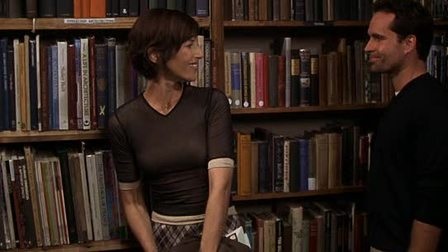
Your Friends & Neighbors
First screened and reviewed in August 1998
Director: Neil LaBute. Cast: Ben Stiller, Jason Patric, Catherine Keener, Amy Brenneman, Aaron Eckhart, Nastassja Kinski. Screenplay: Neil LaBute. Twitter Capsule:
Actors range from superb (Keener) to over-studied (the men). LaBute needs some visual ideas and new tones.
VOR:②
May as well be a special feature on In the Company of Men DVDs. Even "risky" set-pieces like Patric's monologue already feel predictable, even safe, from LaBute.
Neil LaBute, the sharp-tongued provocateur behind In the Company of Men, this time gets to excoriate the sexual mores and misbehaviors of everyone, ever, not just the male half of the world. It's nice when a director grows, or at least thinks he is growing. Sadly, Your Friends & Neighbors seems too bilious and narrow in its projects to convince anyone that LaBute is as promising a filmmaker as he'd like to be,or that he has any reason to be so wrapped around the axle about everything.
In the Cheap Shot Awards of 1998, a big statuette will have to go to the director-screenwriter who named his six urban jungle-folk Mary, Barry, Terri, Cheri, Cary, and Jerry. The gesture, which only becomes apparent in the end credits of the picture, given how anonymously these dried-out souls interact with one another during the film, makes them all seem absurd. Such bold-stroke but essentially hollow gestures also undermine LaBute's point that this sextet might represent anything about the rest of the human condition: he's obviously created six "types" in a his private lab and run them through his own tightly controlled experiment—even if he believes he's aimed a telescope at a wider array of people. If my name's not a homonym, may I assume that I'm off the great big hook of LaBute's cynicism? Let's hope so. At the very least, the echo-style naming underscores the fact that all of these characters are essentially minor riffs on one another.
Jerry and Terri (Ben Stiller and Catherine Keener) are lovers running on inertia who find that things work better when they just don't talk to one another. Terri would like to extend this mandate to their carnal encounters, closing off completely and rolling over with a slew of verbal lacerations as soon as Jerry starts grunting and exclaiming. He, by contrast, cannot figure out what the big problem is. "I am
accused of speaking," he tells his male pals, in total consternation as to how to address a problem that, by definition, denies him a way to address anything. Terri just wants everyone to shut up.
Mary, played with a dewy, reserved watchfulness by former NYPD Blue-er Amy Brenneman, only wishes she had something to say. She seems to be at a permanent loss, however, in understanding the dynamics of her own marriage, much less the couples around her. Mary's silence seems at least partially attributable to a recognition on her part that she is neither angry enough nor bloodthirsty enough to compete with the people this screenplay sticks her amongst. Meanwhile, Mary's husband Barry can't believe his own good luck at having scored such a beautiful, uncomplaining wife. He's so delighted with the way things have worked out that he can't stop pleasuring himself even when she's gone to sleep on the other side of the bed; with surprising good cheer, he admits to a co-worker that he has never had a sexual experience as gratifying as those he supplies on his own. Aaron Eckhart, who ignited In the Company of Men with his cobra-like magnetism, makes an admirable about-face playing this loser, but it's not a commanding enough performance to really confirm him as a promising talent.
The other two characters in this vicious ensemble are the most problematic. Nastassja Kinski's Cheri is an insipid secretary at an art gallery, or at least that's what she seems to be. Her entree into the picture is her recurring pattern of hijacking visitors to the gallery—many of Neighbors' protagonists included—with the same set of faux-spontaneous questions, as though she's merely a curious bystander. This barely contextualized, repetition-based aspect of Kinski's
role never allows for much fullness of characterization, so this striking beauty is stuck with yet another role that hides whatever acting gifts she may or may not possess. Finally, in the film's most discussed role, Jason Patric emerges from the vortex of Speed 2 (at least he has some reason to be furious) to play a misognynist so hateful that the populace of LaBute's previous film seem almost demure. The screenplay overreaches in portraying Cary, whom we are asked to believe is such a villain that his most fondly-remembered sexual release arrived when he helped gang-rape a feeble male classmate in a high-school gym class. Cary's wickedness seems a bit too extreme to accept, and Patric's self-conscious "change of pace" approach to playing him as a kind of sadistic automaton doesn't help.
LaBute's movie keeps moving at an efficient little clip, and several of the
dialogue exchanges are engaging enough even when they don't lead anywhere. Ben Stiller's trademark comic dither is an interesting ingredient in all the mix, perhaps because he makes Jerry seem aware of both the morbidity and the absurdity of the goings-on of the plot. Meanwhile, Catherine Keener, the shining light of Walking and Talking and Tom DiCillo's films, is utterly
riveting. Her scabrous Terri, fork-tongued though she often sounds, is at least relentlessly honest and often even witty, and Keener's intelligent style—passing all kinds of thoughts across her prominent, off-kilter features—makes all the difference in showing LaBute's anger by making it seem to come from
somewhere. Terri's rage is, for her, the least of several evils with an untenable situation. Nobody understands her when she asks for what she wants; staying silent only propmts others to talk over her, soliciting all sorts of irritating questions. Being garrulously pissed off all the time, then, is her only solution for being as contented as possible without intrusion or aggravation. You wouldn't want to have a cup of coffee with her, but you're happy to see her take a few classic stabs
at Patric, and it's an indelible portrait bound to go down as one of the year's best.
Your Friends & Neighbors itself, however, is not even a standout in the context of August, a famously dry month that doesn't feel any fuller for the addition of this vaguely proficient but hard and soulless exercise. You couldn't call this picture a sophomore slump, really, especially if you were as unconvinced as I was by In the Company of Men that LaBute was a budding genius. Your Friends & Neighbors extends those habits of default spitefulness and schematic dramaturgy that are already LaBute's big pitfalls. Meanwhile, his signal strength of precise and truculent dialogue too rarely serves any characters with the level of dimension that could make the words matter. They sting, but that's all they do. I'll still be curious to see what LaBute comes up with next, but if it's just another document
of mantis-like men and women, most of whom enjoy devouring whomever they just mated with, I don't think I'm the only viewer who will stop showing up for more. Grade:C