Wild at Heart
Director: David Lynch. Cast: Nicolas Cage, Laura Dern, Diane Ladd, Willem Dafoe, Harry Dean Stanton, J.E. Freeman, Crispin Glover, Sherilyn Fenn, Isabella Rossellini, Grace Zabriskie, Calvin Lockhart, Marvin Kaplan, John Lurie, Pruitt Taylor Vince, Freddie Jones. Screenplay: David Lynch (based on the novel by Barry Gifford).
When you call your film Wild at Heart, you're hardly hedging your bets about tonal excess, broad characterization, or extreme circumstance. So it's hard to apply these descriptions to David Lynch's 1990 Palme d'Or winner, apt though they may be, as though they were epithets. Sailor Ripley and Lula Fortune, the lead characters played by Nicolas Cage and Laura Dern, bear the chromosomal residue not only of American pop archetypes (Elvis Presley, Marilyn Monroe, Marlon Brando) but also of previous Lynch creations. Sailor is emphatically more oddball, more animal, less sheltered than the Kyle MacLachlan character in Blue Velvet, and Laura Dern is playing an obviously more capacious spirit than the one she contributed to the same, earlier film. In fact, Dern's Lula, with her sexual degradations, her eccentric but relentless carnality, and her strangely divided reactions to her own suffering, feels more reminiscent of Isabella Rossellini's Blue Velvet character than of Dern's own—and if it's already sounding as though Wild at Heart, even in its differences, lives largely in the shadow of Lynch's warped Americana of 1986, that's hardly an accident. Watched in 2002, Wild at Heart palpably lacks the unnerving control, the pleasure-painful combination of tense, primary-color images and charged narrative in either Blue Velvet or Mulholland Drive, the films that will perhaps furnish most of the associations of the adjective "Lynchian" as it popularizes itself in cinema conversations.
Again, though, Wild at Heart doesn't seem at all calculated to reproduce the chamber-drama textures of those other films, so perhaps the temptation to privilege the comparisons all the same is a reflection of this fact: what Wild at Heart is actually doing, when the film is considered in isolation, could hardly be blurrier to me. It is easy to observe the iconic embroideries of Cage's character, for example—the shellacked hair, the T-shirts, the open-top convertible, the husky baritone—or to listen to Sailor's weirdly reflexive awareness of his type-ness ("This snakeskin jacket symbolizes my individuality and belief in personal freedom") and construct some preliminary hypothesis. Let's say Lynch is investigating what happens to stock figures of American pop narratives when they are thrust into the quintessentially American (or, at least, American cinematic) landscape of the Southwestern highway. The schizophrenic mismatch between Dern's baby-doll allure and the barren mesas on her horizon intimates that America's favorite visions of itself don't always cohere in juxtaposition, and maybe they never do.
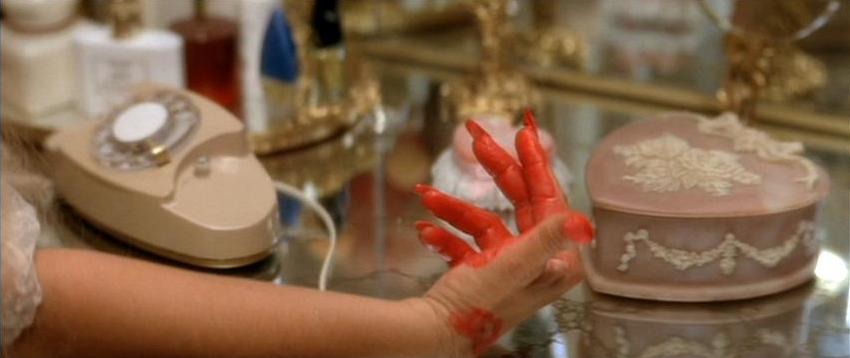
But ideas like these are still grasping at straws, because Lynch has tossed so many other elements into his concoction: the gentle weirdos like Rossellini's motel-dwelling fortune-teller, Perdita Durango; the dangerous, psychopathic weirdos like Willem Dafoe's lecherous and grotesquely toothsome Bobby Peru; the endearing, minor-league weirdos like Johnnie Farragut, the scraggly and perplexed private-eye played by Harry Dean Stanton in one of his priceless renderings of taciturn, agog picaresques. These are all memorable characters, and they bear certain associations within the populations of cinematic and social history, but we are clearly a far cry from the hypericonic aspects of the Cage and Dern figures. This is not, then, a film "about" iconicity, or reorderings of inherited elements. These impulses toward academic classification or meta-contemplation may not even be on the right track. Violating the spectator's distance from the film is Diane Ladd's Marietta Fortune, who gives Angela Lansbury in The Manchurian Candidate some febrile competition as the screen's wickedest Mama, and who sufficiently exceeds the realm of mere caricature so as to inject the proceedings with furious, jealous emotion. This woman's outbursts, not just taking out a hit on her daughter's fiancé but smearing the surface of her skin with scarlet lipstick shortly afterward, are as irrational to her as they appear to us. They are only intelligible, at least to me, on the plane of pure emotion, where they certainly register hotly.
In general, that's where I'm left with Wild at Heart, especially after only one viewing: I receive it as a strange, heterogeneous, fiercely colored art-object that is more alert to provoking a response than to codifying whatever that response might be. I will happily call myself out on this cop-out, which I'm sure isn't a good enough description of what Wild at Heart has to offer: after all, when some audiences have spoken similarly of Mulholland Drive, I have largely taken the statement as a verbal way of throwing one's analytic hands in the air. Nevertheless, I don't doubt that Lynch and his signature collaborators – cinematographer Frederick Elmes and composer Angelo Badalamenti – are unperturbed if their films provoke bafflement in their spectators. Few would dispute that, meaning aside, their sounds and images are often indelible as sensory impressions. There are elements in Wild at Heart—Ladd's hairstyles and cosmetic adventures, the sound of a blown-off head hitting the pavement, the rushing air in slowed moments of melodramatic import—that are bracing in ways that only film can be bracing. An entire sequence in which Sailor and Lula encounter a car-accident victim who has lost her bearings—Sherilyn Fenn, in a pre-Twin Peaks cameo—is a haunting, expertly shot and edited interlude to rival anything in Cronenberg's Crash, which in my mind is distinguished company.
I can't pretend that I "enjoyed" watching Wild at Heart in the same way as I did The Elephant Man, Blue Velvet, or Mulholland Drive. The narrative and the images of this film have a static quality and, paradoxically, an outward-spiralling geography that provoked at least as much boredom and confusion as they did fascination. Ladd's rage is so over-the-top that she almost throws the film out of whack; certainly, the other supporting players seem pale by comparison, and since the fraught triangle of Sailor, Lula, and Marietta is no longer at the picture's core by the second hour, I found my attention drifting. The reason I am saying all this is that I find it uncomfortable to recommend Wild at Heart, and I recognize that recommendation is the reason many of my readers utilize the website. I am drawn to watch the movie again, so as to formulate a clearer description and a sharper guess about the structure, but I am also loath to have the Wild at Heart experience repeatedly in close succession. What I suppose all of this amounts to is that even though I'm not sure what to do with movies like this, I wish there were more of them: Wild at Heart is a total challenge, an outright provocation, in a medium that is producing less of those experiences than it should. I was, and am, grateful for Wild at Heart even when I was, and am, manifestly uncertain what, exactly, I felt so grateful for. If you go on this journey, send me a postcard—tell me what you found. Grade: C+
- Academy Award Nominations:
- Best Supporting Actress: Diane Ladd
- Golden Globe Nominations:
- Best Supporting Actress: Diane Ladd
- Other Awards:
- Cannes Film Festival—Palme d'Or (Best Picture)