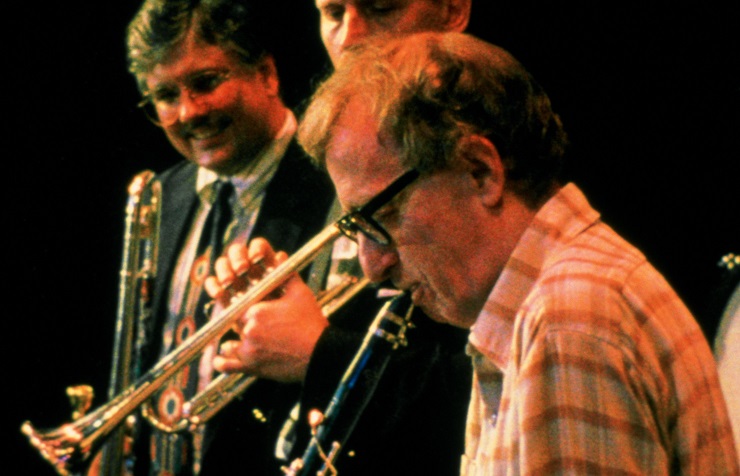
Director: Barbara Kopple. Documentary. Follows Woody Allen and his jazz band's Spring 1996 tour of West European cities. With Woody Allen, Soon-Yi Previn, Letty Aronson, Eddy Davis.
In March 1996, Mira Sorvino was onstage in Los Angeles accepting her Best Supporting
Actress Oscar for Mighty Aphrodite. That film's writer-director,
nominated the same evening for his screenplay, was named earlier that month as the Directors Guild of
America's Lifetime Achievement Award recipient. And where during all these festivities
was the illustrious filmmaker himself?
Testing out a new mouthpiece for his clarinet. In Milan.
Woody Allen is not someone generally considered predictable, but this scene in Barbara
Kopple's rollicking documentary Wild Man Blues reveals a supreme irony. While
missing the Academy Awards to go woodwind-shopping might seem eccentric to us, that
decision seems utterly predictable to Allen himself. He'll always pick his music over his
stardom—it's just that no one in America cares that he even plays.
Wild Man Blues follows Woody Allen and his seven-member jazz band along their
1996 springtime tour of Europe. If that synopsis sounds like material for a three-minute
Entertainment Tonight profile, then kudos go out immediately to Kopple, who
knows that Allen's career as a jazzman is not a fluff-level footnote to his more obvious
engagement in the cinema. Her feature-length documentary has already been faulted by
some viewers at Sundance for downplaying Woody-as-Filmmaker, a criticism that misses
Wild Man Blues' whole point: Woody Allen considers himself a developing
musician who's lucky to have a steady day-job making movies.
"I think it's seen just as a hobby of mine," Allen tells his sister Letty early in the movie,
when the band and entourage are flying across the Atlantic to begin the tour. Any
nervousness about the presence of Kopple's camera is small potatoes next to his genuine
stagefright at the prospect in front of him: weeks of one-night-only stops in Paris, Madrid,
Turin, and other Old World cities, playing to audiences who know little about primitivist
New Orleans jazz (which the band renders with real zest) but who know a great deal
about the man on the marquee.
Unfortunately, simple star-gazing might be the wrong reason to come. "I'm not a sufficient enough
musician to hold their attention," Allen frets, but his travelling companions, apparently
used to his anxieties, gently console him. These initial scenes of conversation not only
introduce us to the various members of the caravan, including then-fiancée Soon-Yi
Previn, they also establish the level of access we get to Woody throughout Wild Man
Blues. He talks comfortably, even conversationally before the camera, and he is as
happy to discuss perceptions of him as he is presenting his own thoughts.
How strictly honest Allen is in presenting himself, or to what degree he is "performing," is
a question the film simultaneously raises and dismisses. On the one hand, his barbed
humor—which the movie captures more ecstatically than any of Allen's own recent
work—can easily be read as deflective, resistant to any penetrating insight into how he
really operates, what he really thinks.
At the same time, might Allen's "honest self" actually exist in the permanence with
which he "performs"? A man who tours Europe in a band, who has made one movie a year
for two decades, and whose most private relationships are themselves so inherently
sensational is hardly giving a false image of himself by coming across as a constant entertainer, an
inveterate showman. The Woody
Allen of Wild Man Blues may or may not be "the real Woody Allen," whatever
that means, but his jokes, confessions, and worries all ring true when held against one
another.
Nor, however, do Kopple or cinematographer Tom Hurwitz use their camera merely to
point and shoot, arbitrarily recording whatever material Woody provides. A staggering, insidious myth of
documentary filmmaking is that craft is
somehow absent, that the lack of actors and scripts translates to films that make
themselves. Moreover, because of the twice-Oscared Kopple's towering reputation,
Wild Man Blues bears the brand of a "vacation film"; as with Scorsese's Cape
Fear or Coppola and Altman's recent Grisham adaptations, the idea of Kopple filming
a celebrity bio sounds on paper like a hard-working master taking a crowd-pleasing
breather.
All of these allegations are unfair criticisms of all the above-listed projects, and they certainly fail
to
acknowledge what Kopple has accomplished in Wild Man Blues. Nothing here will
make anyone forget Harlan County USA, the landmark documentary she made
about union strikes among Kentucky coalminers, but craftsmanship and wit are as present
here as in her more socially-minded, dramatic work. Consider the sequence in which Kopple and Hurwitz
leave the camera directly on Woody during a flailing, ten-minute performance when his lips have failed and
his clarinet reed won't vibrate properly. Though the same scene played just as gruelingly and effectively
in 1995's dramatic film Georgia, the sequence brilliantly captures the
audience's
experience of watching a doomed performance, as well as Allen's own furious
determination to literally breathe the life back into his music.
Further evidence of Kopple's sagacity appears in the dialogues she has chosen to include in
her film. Any movie ultimately rides on what is or is not cut, and Kopple and editor
Lawrence Silk have chosen impressively candid, crystalline moments through which Allen
and his companions represent themselves. His assertion that "I just don't want to be where
I am at any given moment" speaks as informatively about his personal-life problems as it
does about his approach to touring.
Which brings us to the Soon-Yi question. Without a doubt, one of Wild Man
Blues's big selling points is its unprecedented access into the Woody/Soon-Yi
relationship, which proves to be both nervily discomfiting and prosaically normal. Soon-Yi
herself, whose first line in the film is "Yeah," comes across as a profoundly hesitant and
unformed personality, with little faith in her own convictions or conversation.
Nevertheless, she earnestly tries to support and encourage Woody, and to prevent his
anxieties from compromising his friendships, as when she stresses the importance of
praising his bandmates.
Have I mentioned, though, how uproarious this whole thing is? Allen arrives in London,
the band's final stop, with the prediction that this time "they'll hate me in my own
language." Between concerts, as American tourists in ritzy locales flash his photo with
starstruck squeals, he wonders why people who will fly overseas to take his picture "won't
pay ten cents to see one of my movies." The kicker sequence is the last, when Woody and Soon-Yi return to
New York and have
lunch with his parents. His father is 96 and has never seen one of his films. His mother
looks just like Woody and asserts that, throughout his growing-up, "You did a lot of good
things but you never pursued them"—this while three of his Oscars sit atop the bureau
over her shoulder, and a filmmaking crew sits in her dining room following his
movements. You can't impress everyone all the time, I guess.
Wild Man Blues is a lively, belly-laugh comedy that neither cheapens its subjects
for laughs nor reveres him too much to make fun of him. Of the non-documentary films
released so far this year, only Love and Death on Long Island maintains such
jubilant giggles alongside real psychological acuity and with equal dramatic flair.
Woody Allen himself is filming a script called Celebrity to be released
this fall. He will be well-challenged to study and vitalize the phenomenon of fame as sharply and
engagingly as Kopple does here. Grade: B+
- Awards:
- National Board of Review—Best Documentary