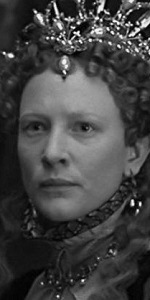
Best Actress: Champs Cate Blanchett
3 Nominations (98, 07, 13)
1 Win (13)
3 Supporting Nominations (04, 06, 07)
1 Win (04)
click boldfaced years for profiles of those races
I wrote this article in 2008 and have not updated it to encompass more recent work, including her Oscar-winning performance in Blue Jasmine.
Cate Blanchett has the most vexing relationship to the Oscars. By early 2008, as I'm writing this, in advance of the ceremonial verdict on her double-dip nominations for the execrable Elizabeth: The Golden Age and the exquisite I'm Not There, Blanchett has assumed the status of a perennial nominee, a classy standby option for filling out a vague or thinnish race even when regard for the performance has hardly been stratospheric (certainly the case with the Elizabeth sequel but also for her demoted lead in last year's Notes on a Scandal). What is especially frustrating about this, besides the unadventurous discounting of superior work like Emily Blunt's in The Devil Wears Prada or Angelina Jolie's in A Mighty Heart, is that Blanchett has somehow wandered into this "default nominee" status after a long and more creative period of her career when she couldn't seem to get nominated for anything. She was widely characterized as a wronged woman after losing for the first Elizabeth, but then, despite almost constant work in well-reviewed performances in a huge gamut of films, she waited six whole years for a We Owe You nomination—and in the supporting category, at that. No small feat, but hardly the astral beam of Academy endorsement that people increasingly ascribe to her.
Blanchett was the male Ralph Fiennes in the late '90s and early '00s: respected by critics and revered by fellow actors, admired for strong performances in films that somehow couldn't escape the late-December glut and which consequently lost any chance to catch on with AMPAS. For Fiennes, this rut of worthy non-starters began with Oscar and Lucinda, where Blanchett enjoyed her first real lead, and contined with The End of the Affair, Onegin, Spider, and The White Countess. Blanchett is droll and cagey but not quite potent enough in Lucinda to have made a real bid, especially against a heavily foregone roster of five, but it's a shame that her sublime supporting turn in The Talented Mr. Ripley (still, perhaps, the jewel of
her career) couldn't get swept along with that film's raft of technical nominations. She was similarly, lamentably passed over for her decent but creepy psychic in The Gift and for her soured, hard-shelled frontierswoman in The Missing, a vocal and physical exercise in creative anachronism in the Daniel Day-Lewis vein. The range and depth of the part and the quality of Ron Howard's direction limit the potency of her work in The Missing, but Blanchett's technique is still fascinating. Both movies were terrible drudges to sit through, but the actress redeemed them. Other moviegoers would make similar arguments for her Resistance fighter in Charlotte Gray, her tarty dancer in The Man Who Cried, her terrorist reborn in Heaven, her quickly absconded wife in The Shipping News, and her riff on Dietrich, studious but inert, in The Good German: most of them late December releases, all of them rather tedious if you ask me, and none of them anywhere close to Oscar's radar despite hale forecasts. Returning to her latter-day career as a regular inamorata of Oscar, her 2007 nods embody her worst nominated performance and her best (more praise of Blanchett's Dylan dissection
here), but I'm wondering how long it will take for her to score a nomination for a performance as subtle and plausibly
soulful as her Ripley gal or her Gift seer or, in my favorite of Blanchett's least stylized performances, her distressed political wife in
An Ideal Husband.
Indeed I wonder, now that she's so "prestige" and so justly lauded for her technical capabilities, how many of these kinds of parts casting directors will even think of her for, even if they seem to think of her for everything these days. (Cate Blanchett in Indiana Jones?) Watching Paradise Road in the theater in early 1997, I liked Blanchett but was much more stirred by Jennifer Ehle, whom I would have bet money as the Girl Most Likely to follow Blanchett's subsequent trajectory into middlebrow superstardom and Streepian versatility. I wonder whether Blanchett's best option for restoring the fascination she engendered six or seven years ago—unless I'm the only one who's starting to doze a bit—would be to walk the route Ehle has walked so successfully, to the tune of two Tony awards. Blanchett on stage? Blanchett in one movie every two years? Blanchett as subdued and direct as Ehle tends to be, for better, as in Sunshine, or for worse, as in Possession? Christabel LaMotte, Ehle's
under-explored character in that misbegotten film, needed more of Blanchett's penchant for the uncanny, which is especially visible when she's working in period
contexts. Hollywood, meanwhile, needs more of Ehle, perhaps even in Indiana
Jones; as it happens, she already played "Empress Zita of Austria" in a long-ago episode of The Young Indiana Jones Chronicles. So: I believe I have hit on a savvy compromise. Who out there is listening? FAQs
|