White Banners
First screened and reviewed in November 2005 / Most recently screened in May 2008
Director: Edmund Goulding. Cast: Claude Rains, Fay Bainter, Jackie Cooper, Kay Johnson, Bonita Granville, Henry O'Neill, James Stephenson, J. Farrell MacDonald, Edward McWade, William Pawley, Edward Pawley, John Ridgley, Mary Field. Screenplay: Lenore J. Coffee, Cameron Rogers, and Abem Finkel (based on the Cosmopolitan magazine article by Lloyd C. Douglas). Twitter Capsule:
Warm, minor Warner Bros. melodrama that wears its modest competency as a badge of honor. Rains, Bainter both super.
VOR:②
Wee, enjoyable glimpse of the movies trying to do the cozy work of the Saturday Evening Post. This is what good actors look like with a director making them extremely comfortable.
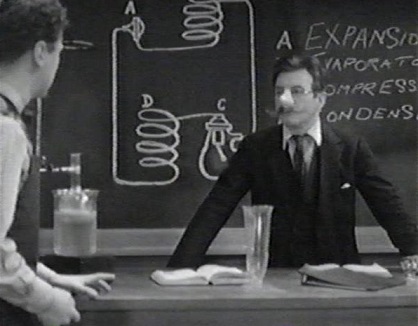
A sacrificial-mother melodrama, a primer in small-town values, and a literally illustrated crash course in the sciences of refrigeration and coffee percolation: White Banners is such an improbable meld of dissimilar elements, united only in their quaint anachronism as subjects for the screen, that it's hard not to like the picture just for pursuing such a cheerfully odd path. "Adapted from the Cosmopolitan Magazine Article" is not a screenplay credit you see every day, nor would you expect something quite this modest, in all senses of the word, to emerge from such a history. The strenuous and conspicuously placed disclaimer that White Banners bears no relation to any persons living or dead, etc. etc., seems built to forestall comparison to whatever real-life inventor decided that iceboxes shouldn't need drip pans, and whatever household of stout-hearted servants, nervous wives, precocious children, and housebroken miscreants may have orbited around him.
I wonder, though, if the safeguard is necessary. Under the typically assured and generous direction of Edmund Goulding, the whole cast performs in such a way that you'd love to see your family, your work, your hometown represented this way.
Claude Rains, cast in the wholly unfamiliar role of the jocular family-man, is as relaxed and winning as Bette Davis in Dark Victory, Goulding's triumph of the following year. He's such a good director for calming down actors who typically seem much more wound up, albeit to very good advantage. Fay Bainter (Jezebel, Show Boat), another supporting-cast fixture enjoying a rare turn in the spotlight, was Oscar-nominated for her role as the mysterious but eminently trustable housekeeper Hannah, who shows up at the Ward family's doorstep one morning and pertly makes good on the promise of their name. Of course, the family's new charge quickly reveals herself as the wind beneath their wings. Hannah is the explicit source of the movie's unabashedly frank philosophies of giving, adapting, extending second chances, and taking the high road, but Bainter's smart underplaying of Hannah's goodness protects both the character and the film from our resentment. She also makes room for Rains and Jackie Cooper, as a smart but spoiled teenager, to emerge as the real and admirably rounded centers of the movie, profiting from her wise advice without seeming like mere test cases for her homespun theses. Even the technical crew offer calmer, easier work than usual, including a bouncy and unobtrusive score by Max Steiner and some lucid but unremarkable photography from Charles Rosher (better known for his wizardry on Murnau's Sunrise, for example). The proud but humble contributions of everyone involved reflect that White Banners is minor Warner Bros., but the film exemplifies its own themes of honest diligence and warm-hearted communalism, making it much more memorable than some grander, fussier productions of the same period. Remember when simple, inexpensive, knockoff pictures were a pleasure in themselves? When family movies were quiet, people-centered, and unafraid of genuine emotion, rather than antic and shrilly self-marketing? If you've forgotten that this was even possible, try this on for size. There's a good chance even your kids might like it. Grade:B–