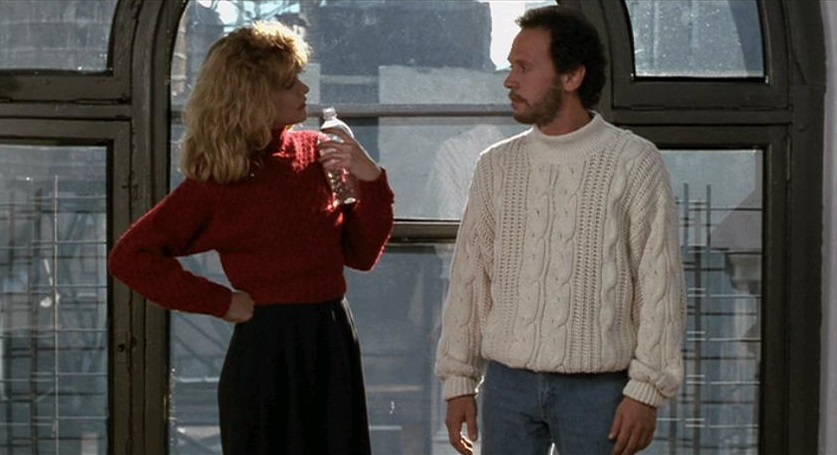
When Harry Met Sally...
Director: Rob Reiner. Cast: Billy Crystal, Meg Ryan, Bruno Kirby, Carrie Fisher, Steven Ford, Harley Jane Kozak. Screenplay: Nora Ephron.

When Harry Met Sally…, arriving in the final year of the 1980s, was the greatest American romantic comedy of that decade. Nor did it have any serious challengers to that claim in the 1990s, a filmmaking decade that arguably contributed less to the canon of American love comedies than to any other major genre—notwithstanding the ensuing work executed in this tradition by WHMS alums Rob Reiner, Nora Ephron, Meg Ryan, and Billy Crystal. Of all the great American movies of the last 20 years, When Harry Met Sally… is almost certainly the humblest in tone, cast, and construction, and yet it has also proved among the hardest to replicate along any reasonable standard of quality. Though its title has become synonymous with a style of commercial moviemaking that has generated few artistic dividends—a quirky, lite-neurotic verbal comedy ornamented with bright location footage and tied with a sonic bow of pop standards—the pre-eminent craft of this film only becomes clearer as its most obvious imitators successively pale by comparison. Sleepless in Seattle, While You Were Sleeping, Jerry Maguire, You've Got Mail, My Big Fat Greek Wedding: these movies vary in quality, but they all betray some impress of When Harry Met Sally…’s example, and whatever their respective charms, they all suffer for the comparison.

If When Harry Met Sally… deserves any comparisons at all, a much more appropriate context is comprised of the triumphant romantic comedies of the 1930s and 1940s, when the studios treated this genus of popular cinema as rich and ever-renewable, rather than a quicky and inexpensive way to generate a decent opening weekend. Ephron’s script, Reiner’s direction, Barry Sonnenfeld’s cinematography, and Robert Leighton’s editing—weak in continuity, yes, but expert at timing and performance control—demonstrate a rapturous love of movie-love, a consummate unabashedness that they are making a movie about hearts and wit and badinage and destiny. It is as a film about love in the movies, even more than as a film about love in life, that When Harry Met Sally… succeeds most gloriously.

The movie’s expert sense of structure is evinced from the very beginning, in the quick transitions between an opening sequence in 1977 when Harry actually does meet Sally, one in 1982 when he re-meets her in an airport, and again in 1987 (or 1988—the timelining gets a little fuzzy), when they meet yet again—and this time, make the smart choice of staying in touch. The details of costume, hairstyling, and production design that demarcate these chronological shifts are delightful in and of themselves, but more rewardingly, Billy Crystal as Harry and Meg Ryan as Sally are immediately allowed the opportunity to show us subtly different versions of their characters over the course of a ten-year period. Yes, Sally Albright is consistently optimistic, and Harry is a wisecracking brooder-type, the guy who always starts a novel on the last page lest he should die before knowing what happens. But, within those broad and sturdy personas, real change takes place: Sally, for example, is a brisker and pithier version of herself in 1982 than she was in 1977; the girl who is initially too embarrassed to admit out loud that Harry is making a pass at her (“Amanda is my friend,” she whispers, in aghast euphemism) has become a woman with no reluctance to tell Harry on an airplane, “You may or may not believe this, Harry, but I never considered not sleeping with you a sacrifice.” Harry remains a dour joker, but his inner wiseacre seems, by the third meeting, like an overt attempt to avoid introspection and dilute unhappiness—our sense of him as a bruised character with a genuine interiority increases.

From all this build-up, the film mines some of its best jokes—Sally’s “It just so happens that I have had plenty of good sex!” is perfectly timed and delivered, as is Harry’s gradual provocation of that outburst—but the film also prefigures a romantic sensibility that is seasoned and unquestionably adult. When Harry Met Sally… does not, unlike Sleepless in Seattle, treat romance as the cosmic meeting of ordained soul-mates. Instead, the repeated re-introductions of Harry and Sally to each other, as well as the palpable personality adjustments that both characters experience, intimate that love is made possible by a complex simultaneity of the right person, with the right history, at the exact right time. A+


Academy Award Nominations:
Best Original Screenplay: Nora Ephron

Golden Globe Nominations:
Best Picture (Musical/Comedy)
Best Director: Rob Reiner
Best Actress (Musical/Comedy): Meg Ryan
Best Actor (Musical/Comedy): Billy Crystal
Best Screenplay: Nora Ephron

Other Awards:
Los Angeles Film Critics Association: Best Actress (Bonham Carter)
Boston Society of Film Critics: Best Actress (Bonham Carter)
National Board of Review: Best Actress (Bonham Carter)
British Academy Awards (BAFTAs): Best Original Screenplay

Permalink Home 1989 ABC Blog E-Mail