What Lies Beneath
First screened and reviewed in December 2000
Director: Robert Zemeckis. Cast: Michelle Pfeiffer, Harrison Ford, Diana Scarwid, Amber Valletta, Joe Morton, James Remar, Miranda Otto, Sloane Shelton. Screenplay: Clark Gregg (based on a story by Sarah Kernochan and Clark Gregg). Twitter Capsule:
Some delicious scenes in this modern Gothic scarum, so it's disappointing that the overall dish tastes so stale.
VOR:②
Enthusiasm from some peers is the only thing floating it this high. Its whole schtick seems to involve doing very old things in passably new ways, pleasurable in the moment.
People sometimes ask me how I justify my reviews of the films I see. Essentially, I evaluate each movie as closely as possible on its own terms—how well did it accomplish its apparent goals?—and then I assess the sincerity, difficulty, novelty, and value of those goals. In keeping with this tradition, I want to clarify that What Lies Beneath is not really a movie, but an expensive machine designed to startle you every few minutes. To this end, the movie is fairly successful. However, whether Hollywood needed to shell out dozens of millions of dollars to make another such contraption, and whether you want to hand over eight big ones to see it, are different questions. How much credit one can give What Lies Beneath for being frightening, even if we concede that it is? If it were a difficult or novel thing to startle someone by making a loud noise, or showing them blood, or forcing them to watch women in danger, the film might be more admirable or more lastingly enjoyable. As it is, the movie passes its own test as a scare-fest, but at least five other movies each month are tackling tougher goals, sometimes surpassing them. Why aren't you watching those? Why aren't I?
What Lies Beneath so embraces time-honored Gothic motifs that its opening-credits montage features both swirling mists and dark, rippling water. Ooooh, you say, instantly either bored or intrigued. I was bored, though giddily, because I knew I'd asked for this stuff, and at that moment I wanted it. I was delighted the movie didn't remain this tediously conventional. In fact, the story's exposition is unveiled with a refreshing slowness. We see Michelle Pfeiffer, playing a middle-aged, upper-middle-class mother named Claire, packing her daughter off to college. We also see Harrison Ford, playing a piece of furniture that impersonates Pfeiffer's husband, accompany her to their daughter's campus and drive her back to their house. None of this is boring, because Pfeiffer and Ford are gorgeous (duh), because composer Alan Silvestri hired every string player west of Missouri, and because the film provides even more junk thrills besides the music. The house is set on the water, fog rolls in routinely, and the rooms are full of mirrors and doors that won't stay shut, so we know the property is Spooky. At the same time, the film refuses to wholly explain itself. Though we see a photograph of a wrecked car and notice how everyone treats Claire with a strange, tense benevolence, at least a half-hour goes by before we learn that she was recently in a terrible crash that may have been a suicide attempt.
Director Robert Zemeckis has called What Lies Beneath his "Hitchcock" picture, and if we accept that increasingly preposterous notion, the picture most called to mind by the film's first hour is not Rear Window, despite superficial plot similarities, but The Birds. What initially scares us about What Lies Beneath is not the banal, telegraphed evil of the house but the creepy remoteness and serene placidity of the heroine, who seems to exist in a pocket of calm that can't be accidental, or natural, or permanent. Pfeiffer, who is good at being an exquisite object even though she's capable of more, was a canny choice to play the lead, or else she was canny to choose it; one has to reach all the way back to 1995's Dangerous Minds for her last hit. She gamely goes through the motions of pricking her ears up at strange sounds, tiptoeing around the house of the strange new neighbors, and spying on them with binoculars when she believes the husband in that couple has murdered his wife. (I wasn't kidding about the thefts from Rear Window.) Still, what is best about Pfeiffer's performance, and about the script's treatment of her role, is that she's every bit as mysterious as the things that are happening to her. The actress is brave enough to make Claire a bit stupid and more than a bit self-defeating, so that we almost think she welcomes or deserves whatever shivery fate befalls her.
Meanwhile, Zemeckis and his crew of hacks—some talented, some not, but all acting like hacks—remain ambivalent about whether less is more, or more is more. Their early restraint with scene-setting and characterization finds its equal and opposite force in their plodding, hackneyed ploys at circumstantial scares: eyeballs that suddenly fill the frame, crashing percussion, Ouija boards, footsteps leading into the house! The film's eeriest, most sudden shock is followed by Michelle Pfeiffer walking into a chemistry lab where someone happens to be discussing a new drug that paralyzes mammals—"Yes, even humans!"—for five minutes or more. Gee, think that'll come up again? Tonal indecision is hardly new to Zemeckis, who has built an improbably durable career out of feathered fish. The youth comedy/adult fantasy Back to the Future and the animation/live-action experiment Who Framed Roger Rabbit? were daring and accomplished genre mashups, whereas the dopey/brilliant Contact suggested a director making his mind up about the material. Forrest Gump, the definitive 1990s liberal historical fable that hated both liberals and history, showcased a director uncertain about whether to have a mind about the material. I think he decided not to. What Lies Beneath sticks out from this crowd because its unevenness has nothing to do with genre: it is decisively and unmistakably a ghost story, even more straightforwardly than Contact is a space adventure. The division has instead to do with approach. Does Zemeckis want to make a stupid horror film or a smart one? A predictable hunk of cheese or an insinuating web of unease?
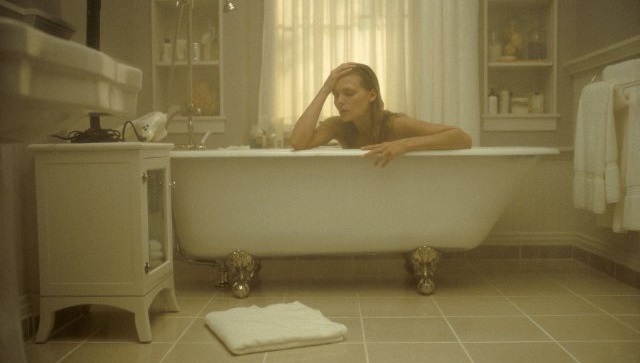
Friends who saw the movie before I did all agreed that the movie squats on both sides of all of these fences (a startling conceptual feat, no?). However, they differed widely over when the movie shifted from startling to stupefying, and their reactions were even more severely polarized as to the plot's climactic convolutions—which might, might, arrive as a surprise, so my lips are sealed. Let me just say that What Lies Beneath works best when it opts for creepy minimalism. Imagine a room of people demanding, "What is the scariest, weirdest scene we can design involving only a running faucet and a person who cannot move?" and then living up to their own assignment reasonably well. Even these peak set-pieces, though, succeed largely because they are so obviously set-pieces; it is clear that Zemeckis has not made a movie, but a series of fiddlings and traps. Within that structure, momentum and fright exist in reverse proportion. The movie tends to stop cold when it has something cool to show off; when it accelerates, we tend to rush headlong into inanity. The first half of What Lies Beneath is mostly platitudes and cheap tricks, but they combine into something strangely fixating. The second half comprises a series of striking, off-kilter scenes, but they are utterly self-contained, increasingly repetitive, and finally absurd. If you thought Jodie Foster's dead father in Contact pulled off the oddest resurrection in recent history, rest assured that Zemeckis has more rabbits to pull out of that particular hat. If you think Harrison Ford would contact his time (with top billing) to play a generic, second-fiddle husband while his co-star gets all the action, you should keep leaving teeth under your pillow. If you think bad people who die from blows to the head are Really Dead The First Time, you're in way over your head—or, put another way, you're the ideal audience for this folderol.
I admit, my hands flew to my face more than a few times during What Lies Beneath. I also fought the urge to yell things at the characters, and usually this was a good thing. At the same time, I realized as each new plot twist unfolded that most of what preceded it had just been rendered irrelevant, implausible, or both. Obviously, you know better than I do what your priorities are in deciding whether to see a film like this. Just know ahead of time, with total certainty, that you know exactly what "a film like this" is, and the moviemakers know as well. They're willing to tinker with the elements for short, engaging stretches, but the overall design is remarkably conservative, and increasingly cheesy and cowed. What Lies Beneath might surprise you from scene to scene, but the sum total won't surprise you at all. Grade:C+