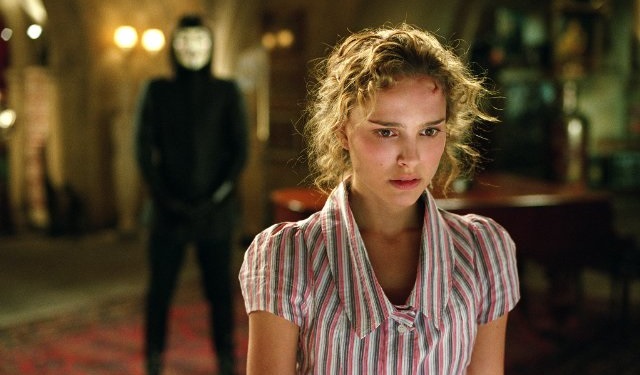
V for Vendetta
First screened and reviewed in March 2006
Director: James McTeigue. Cast: Natalie Portman, Hugo Weaving, Stephen Rea, John Hurt, Stephen Fry, Rupert Graves, Tim Pigott-Smith, Natasha Wightman, Sinéad Cusack, Roger Allam, Ben Miles, Eddie Marsan, John Standing, Billie Cook. Screenplay: Lana and Lilly Wachowski (based on the graphic novel by Alan Moore and David Lloyd). Twitter Capsule:
Gutsy, anyway: bold setpieces, ambitious notion of justice. But tired motifs, ramshackle assembly. Portman unready.
VOR:③
Can't rightfully dimiss this, since I wish more action spectacles and graphic-novel adaptations took this many thematic risks. Scattershot execution but worth considering.
"People shouldn't be afraid of their governments," blare the ads for V for Vendetta. Instead, "Governments should be afraid of their people." If I may ask, must anyone be afraid of anyone? Apparently the question has become rhetorical for screenwriters Lana and Lilly Wachowski, who have frittered all of the juicy irony and narrative instincts that governed Bound, their debut feature as directors, instead embracing the murderous paranoia and flat-footed abstractions of their misbegotten but munificent Matrix trilogy.
True, the Wachowskis have not directed V for Vendetta. Nor has anyone else, though onscreen credit accrues to first-timer James McTeigue. A figurehead leader if ever there was one, McTeigue seems to have been manacled from imposing any texture or
order onto the film's scenes. Whether or not the Wachowskis actively threw their weight around the project, V for Vendetta is almost laughably profligate in recycling Matrix motifs. The totalitarian state of the near future. A forced conversion of a new rebel-savior, whose enlightenment commences with the shaving of a head. Reckonings in subway stations and marble-paneled office buildings. A messianic underground of armed resistors, including a fine-boned woman and a masked man. (If anyone's face is a mask, it's Keanu's.) A late-breaking orgy of violence, where the laws of physics are helpfully annotated; this time, instead of bullets that ripple the air, we have knives that trace their own trajectories. Perhaps after allowing the Matrix sequels to depart so drastically from the first film's successful recipe, then watching a globe of frothing disciples reject the series as quickly as they previously took it up, the Wachowskis are either too eager to revert to familiar tropes and spectacles or too scared to try anything remotely new. Whatever the reason, V for Vendetta plays like a fanboy's excursion into Matrix style, lacking the Wachowskis' gleaming finesse but aping their appetite
for nihilistic narrative. That V for Vendetta feels more ramshackle in construction and even more transparent in its rabble-rousing ambitions is certainly to the film's artistic discredit. Mercifully, though, I expect these very failings will curb the movie's appeal, making it less accomplished than The Matrix but, for that very reason, less dangerous as a vehicle for the thinly tarted-up vigilantism underlying both projects.
A certain measure of credit is due to any film that mounts a full-scale detonation of the (unpopulated) houses of Parliament and asks the audience not just to sympathize,
but to believe that our collective disenfranchisement has been symbolically interpellated and vented. The smoky pandemonium after a bombing in a television studio makes even greater visual impact here. Still, equal discredit is due to any film that can't stage surrounding contexts for sequences like these with any verve or coherence, and to any film where Natalie Portman probes sub-Amidala levels of catatonic non-charisma, and to any film with photography this stilted and a story this discombobulated. The problem isn't that V for Vendetta is vacuous; the film strenuously attaches itself to contemporary political anomies and angers, so you can't call it empty or irrelevant. It's helpless, though, at giving shape to these feelings in any but the most threadbare ways, give or take its plagiarisms of earlier films that at least had formal craftsmanship on their side. And this, in a grandiloquent ode to Thinking For Yourself! Grade:C–