Prizzi's Honor
Director: John Huston. Cast: Jack Nicholson, Kathleen Turner, William Hickey, John Randolph, Lee
Richardson, Anjelica Huston, Robert Loggia. Screenplay: Richard Condon and Janet Roach (based on the novel
by Richard Condon).
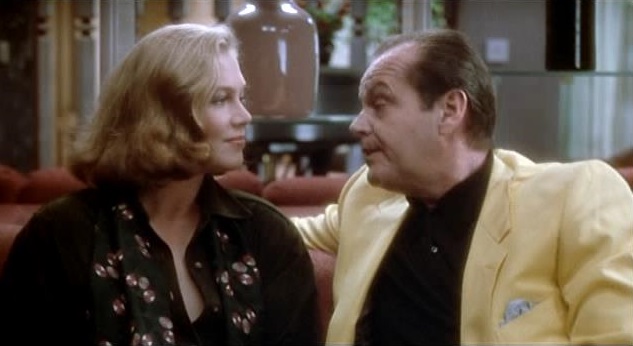
There is a moment in John Huston's Prizzi's Honor in which Kathleen Turner's Irene Walker, a
contract killer, and Jack Nicholson's Charley Partana, a hitman for his Mafia family, are planning a
sudden elopement. Charley's family doesn't trust Irene, and Irene doesn't trust anyone, so she suggests
they go to Taiwan. "We could get different names," she suggests, "even different faces." The scene passes
its comic-romantic muster just fine, but the very idea of Turner or Nicholson changing
names or faces is fundamentally preposterous in the context of this picture. Huston and his screenwriters
have clearly designed Prizzi's Honor as a sort of delirious combustion of stars and legacies,
combining Nicholson's one-of-a-kind slyness with Turner's already patented and intensely self-regarding
smolder in a great big nuclear fusion process under Huston's reliable hand. In other words, Prizzi's Honor
couldn't exist if Nicholson or Turner had different names or facesthose are the famous quantities
that are supposed to make the whole project add up. For a while, it does, though truth be told,
Prizzi's Honor is an increasingly (ahem) hit-and-miss proposition, rarely as much fun in practice
as it must have been in theory and leading to a climax that the structure of the story demands but which the
tone of the picture cannot easily accommodate.
Charley, though not biologically related, is a favored son of the Prizzis, a powerful New York mob family
puppeteered by the frail but fiercely principled Don Corrado (William Hickey). The family feels they owe
him a special debt of thanks because the Don's granddaughter Maerose (Anjelica Huston, who won an Oscar)
slept around while she was attached to Charley—she's been cast out of the fold, and Charley has become a
sort of hero. Perhaps that's why the Prizzis are as indulgent as they are when he meets the blonde, Polish-descended
Irene at a family wedding and immediately falls in the throes of full-throttle amore. Stunned by love
and briefly thrown off of Irene's seductive scent, when she precipitously flies home to California on the very night
they meet, Charley is even more flustered when he discovers in a surprise visit that Irene is already marriedand,
at that, to a man who recently fleeced the Prizzis for a great deal of money.
Jack Nicholson has such a self-contained, outsize persona that it's always punchy and sweetly surprising
to see him the victim of romantic longing—a rare instance when Jack finds something he wants that he
doesn't already have. However, as with his work in Terms of Endearment and, even more so, in As Good As It Gets, I'm not sure that the charming spectacle of a flustered
Jack Nicholson actually constitutes an expert Jack Nicholson performance; his Charley Partana, while an
entertainingly broad cartoon, is not a particularly well-integrated character. An actor who is always
best when his roles spring from his own iconoclastic spirit (in Chinatown, Cuckoo's Nest,
or even Batman), Nicholson is too distracted here by an accessory "Italian" accent and a strained,
Jimmy Cagney-type sneer. If there's one guy who shouldn't have to strain to achieve a sneer, it's
Jack.
Turner, like Jack, shines most in the moments where she has the least to doin her case, when she can
simply look desirable seated in an outdoor café, or at her makeup table, or in a church. She's
always been a good sport, and Prizzi's Honor, with its gun-firing, cash-stealing shenanigans,
followed right on the heels of her Romancing the Stone escapades in the great outdoors. Turner
gamely tackles the role of Irene, but she is a fundmanetally undangerous personality. She can be evil, as
in the darkly giddy War of the Roses, but she tends in her projects to play either comedy or
mystery one at a time: she doesn't do well combining them here, as Susan Sarandon, for example, or, once
upon a blessed time, Irene Dunne or Katharine Hepburn might have. Still, the courtship between Irene and
Charley is a rangy, casual progression that allows both actors to
appeal to the audience easily and in the ways they do best. Both actors also receive colorful support from
John Randolph as Nicholson's father and, best of all, from the Oscar-nominated Hickey, looking like some
sort of bony, translucent vertebrate from a sunless ocean cave, but taking his performance smashingly over
the top with the kind of giddy consistency that his more famous leads struggle with but never match.
Director Huston has a great time letting Don Corrado, who looks like he could die at any moment, actually be the
greatest source of vitality in the project. His daughter Anjelica, meanwhile, gives the same sort of
self-consciously "ethnic" and erratically effective performance that her then-beau Nicholson does. Unlike
some actors who win Oscars for meager performances at the end of rich careers, Huston had the rarer
experience of winning for a merely adequate turn before a long string of indelible work.
Finally, unlike the beginning of Prizzi's Honor, which capitalizes on all of the movie's and the
stars' greatest strengths, the end of the film shows both actors at their most forced and the script at
its most schematic. Huston père seems to know this, since the last twenty minutes come at us quickly and
seriously, like a hail of Mafia bullets. He does misstep, however, in trying to find a final note of
emotional poignancy in the Maerose plotline, seeing as her character had mysteriously vanished from the
picture a good forty minutes earlier.
Prizzi's Honor is a good time, but not a great time, and not the exuberant last hurrah that the
increasingly ill Huston apparently wanted it to be. (Thankfully, he came through much better with his
last film, 1987's piercing and inventive adaptation of The Dead.) A little too high-concept, but
colorful and competent like most of Huston's work, Prizzi's Honor hits some but not all of its
targets. A Mafia hitman would soon be out of commission with that kind of track record, but for a movie,
the ratio's not bad. Grade: C+
- Academy Award Nominations and *Winners:
- Best Picture
- Best Director: John Huston
- Best Actor: Jack Nicholson
- *Best Supporting Actress: Anjelica Huston
- Best Supporting Actor: William Hickey
- Best Adapted Screenplay: Richard Condon and Janet Roach
- Best Costume Design: Donfeld
- Best Editing: Rudi Fehr and Kaja Fehr
- Golden Globe Nominations and *Winners:
- *Best Picture (Musical/Comedy)
- *Best Director: John Huston
- *Best Actress (Musical/Comedy): Kathleen Turner
- *Best Actor (Musical/Comedy): Jack Nicholson
- Best Supporting Actress: Anjelica Huston
- Other Awards:
- Los Angeles Film Critics Association—Best Supporting Actress: Anjelica Huston
- New York Film Critics Circle—Best Picture; Best Director: John Huston; Best Actor: Jack Nicholson;
Best Supporting Actress: Anjelica Huston
- National Society of Film Critics—Best Director: John Huston; Best Actor: Jack Nicholson; Best
Supporting Actress: Anjelica Huston
- National Board of Review—Best Supporting Actress: Anjelica Huston