The Passion of Joan of Arc
Director: Carl-Theodor Dreyer. Cast: Renée Falconetti, Eugene Silvain, Antonin Artaud, Maurice
Schutz, Louis Ravet, André Berley, Michel Simon, Jean d'Yd. Screenplay: Carl-Theodor Dreyer and Joseph
Delteil (based on the novel by Joseph Delteil).
The "passion" in Carl-Theodore Dreyer's The Passion of Joan of Arc refers in part to the elemental,
all-encompassing religious conviction of its heroine, who believes so deeply in the God who has called
her that her Christianity, like other forms of passion, cannot easily be expressed in words to the
outside world. Such strong, inarticulable faith makes Joan an exemplary Christian and, we infer, an
inspiring leader to the troops she led in battle. Sadly, it severely handicaps her as a witness in court,
where verbal reports count for everything.
More importantly, then, The Passion of Joan of Arc is a Christic "passion": the story of a saint
whose martyrdom was divinely ordained and is held to be a valuable lesson for later Christians. The moral of
Joan's story seems to be that those people who are closest to God are invariably unable to communicate or
convey their faith to others, less through any fault of their own than through the worldly arrogance and hypocritical
skepticism of their listeners. As a result, our greatest sources of spiritual leadership are too often dismissed,
ridiculed, even eliminated.
Dreyer's belief that Joan's life was defined by this conflict, of higher faith struggling against entrenched
ignorance, informs his choice to begin the film amidst Joan's trial before the High Court
of Catholic France. Throughout the proceedings, dour and skeptical judges, drawn from the official leadership of
the church, employ more and more tactics to trap Joan in their own rhetorical snares.
Without an advocate, and with the whole panel against her from the outset, Joan's fate is
already sealed, but Dreyer so brilliantly dissects the confrontation and so hauntingly employs his
filmmaker's craft that The Passion of Joan of Arc is neither dogmatically religious nor lacking in
tension. Yes, Christian principles are the central issue of Joan's trial, but her helpless vulnerability
before her interrogators raises so many questions about power, gender, law, and self-determination that any
viewer, regardless of persuasion, can invest a great deal in what happens to Joan.
Yes, we know how her story will end. In fact, Dreyer relies so heavily on Joan's iconic familiarity
that he hardly bothers to reiterate the details of her illustrious backstory. What's really at issue and almost
palpable in the film is not Joan's military record but her prodigious, nearly unfathomable faith. Does this 19-year-old
maiden from Rouen merely believe more devoutly than most, or is she a genuine disciple, even a saint? Does
she live by God's example, or does she in fact receive direct messages from heaven? Is her faith so
profound that she will lie in court to insure her survival, and thus increase her time for service to God
and country, or is it even more profound, such that she would die in its name?
Dreyer and co-scripter Joseph Delteil (who also wrote the novel on which the film is based) are
so ambitious in their philosophical claims for this story, they make the crucial decision to strip the
film of all narrative and decorative distractions. Their rejection of flashbacks, fancy editing, or period trappings
mirrors Joan's own essential asceticism. The storyline is so narrowed that we are not even sure of the exact charges
against Joan, or on
whose behalf they have been made. Her heroism could easily be reduced (as it was in the 1948 Ingrid
Bergman extravaganza) to the obvious cinema-epic "majesty" of battlefield panoramas, waving crowds, and
flags unfurled. Within the context of Dreyer and Delteil's script, such panoply would be irrelevant. To
them, Joan's defining feature is her faith, which has nothing at all to do with ceremony or display. She
only offers her testimony on these subjects because the temporal powers have forced her to speak, and even
at that she frequently withholds several details requested by the judges.
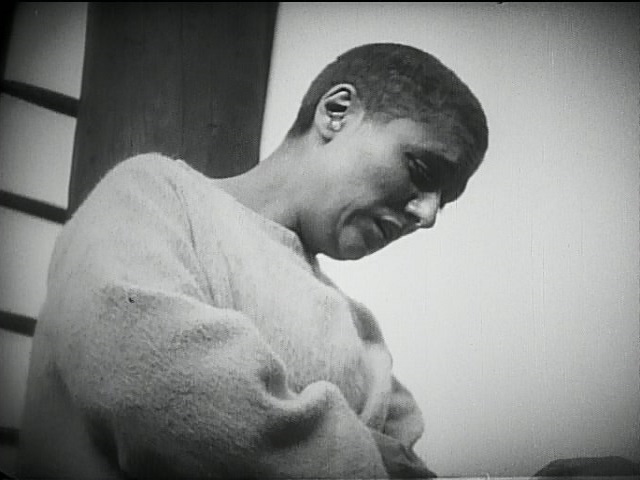
In Renée Falconetti's astounding performanceeasily one of the most famous in world filmJoan's silences
are even more captivating than her words. Falconetti never played another role onscreen, making this
performance singular both in matter of fact and in emotional power. The methods by which Dreyer elicited
this remarkable turn, reputed to include depriving Falconetti of sleep, food, and physical comfort, are
almost unjustifiable to some audiences, but together, actress and director create an aura of genuine
torment intertwined with a tangible will to endure, to testify to the Highest authority. Joan's acceptance
of martyrdom and her opposite commitment to staying alive are, miraculously enough, simultaneously on
display at almost every moment. Without the more overt and histrionic revisionism of a film like Scorsese's
The Last Temptation of Christ, Dreyer and Falconetti confer a fully modernist aspect of wrenching
ambivalence upon the character, but the sparseness and determined focus of the filmmaking keep the film from
seeming anachronistic or contrived.
I am not sure if Falconetti's utter inhabiting of the role was made easier or more difficult by Dreyer's
shooting style, which here comprises almost nothing but close-ups. This camera strategy is
another of his master-strokes in paring down the story to its essentials, austerely divesting the screen
of all content but the emotional registers of the actor's face. Most films use close-ups
only when a character exists in a moment of extreme feeling or when those feelings bear extraordinary
importance upon the way a scene plays out; as a result, these shots are often pure assignations of how the
audience is meant to feel, react to, or interpret the larger arc of the story and its ideas. The Passion
of Joan of Arc, however, by remaining so nearly
exclusively in close-up, demands that the entirety of Joan's trial be read as a sustained period of
heightened emotion and importand at the same time, each viewer must make individual choices about the central
turns of the story and the most germane aspects of Dreyer's treatment.
Encouraged as we are to evaluate Joan without any coaching or editorializing from the picture, Dreyer almost
puts us in a congruent position to those of the judges; we can only hope to respond to her testimony more bravely and discerningly.
Joan's emotions themselves are the things on trial, disturbing as they are to a scholarly
and élite group of men who believe themselves to be close to God but who have no context for the
urgent religious sensations of which this young, illiterate girl speaks. When they ask Joan why she
insists on wearing "man's dress," both in battle and in the courtroom, their phrasing, obviously intended
as an inquiry into her gender presentation, could just as well assume a universal understanding of "man":
what is this saint, this prophet, doing in the simple garb of a mortal being? If she is a saint,
how dare she challenge their narrow understandings by appearing in so subversive a guise? A blurred mix of
awe and rejection exists in most of the judges' questions and gazes. Their decision to burn Joan at the
stake assures the survival of her legend, whether intentionally or not, even as it silences her worldly
voice and subjects her body to the worst possible pain.
Despite some mawkish end titles describing Joan's spirit as "the white soul of France," The Passion of
Joan of Arc is not terribly interested in resolving the ambiguities of its heroine's spirituality,
her convictions, or her subversive personal politics. Rather, Dreyer commits himself to reproducing the
experience of the trial with the same mixture of broad strokes and intimate details that characterize the
Biblical stories on which he modeled his film. Photography, performance, and all the other components of
filmmaking synergize into a truly powerful experience.
In a largely hidden courtroom, before body-less judges, and out of almost any historical or momentary
context, Joan's trial can be likened to and understood in terms of the skeptical accusations that have
seemingly always been fired against history's most challenging figures. Even more shockingly, Dreyer and
Falconetti allow her story to resonate in its simplicity with the daily trials by which we all experience
our religious or irreligious sentiments, our gendered self-presentations, and our most privately cherished
convictions when they are placed uncomfortably under public scrutiny. By fostering this sense of Joan's
trial as a common human experience, The Passion of Joan of Arc ironically enough becomes an ode to
universality that, in its startling cinematic achievement, is virtually and transcendently peerless. Grade: A+