#91: Psycho (1998)
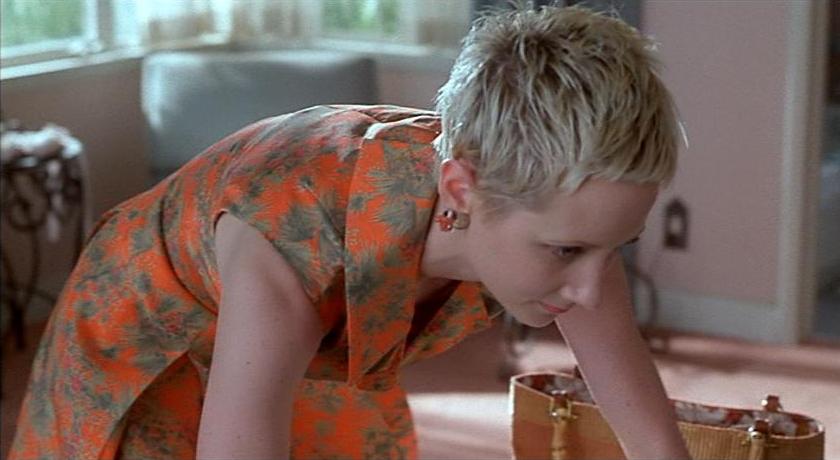 (USA, 1998; dir. Gus Van Sant; cin. Christopher Doyle)
IMDb // My Full Review
Seriously. That Psycho. I remind the reader that this list prioritizes pleasure and personal association over
"pure" aesthetic credentials, though even on that grounds, Gus Van Sant's floridly punctilious remake of Alfred Hitchcock's
most famous movie has nothing to be embarrassed about. The whole exercise, a quite brilliant gambit, speaks as no other
movie I can think of to the paradox of how exactitude and imitation invariably call attention to deviance and asymmetry.
That's a Hitchcockian idea in itself—a sort of formal apotheosis of what Jimmy Stewart's character learns in Vertigo—but
it also places the movie expertly into a landscape of queer camp and performativity that includes Andy Warhol's star portraits
and soup cans, Judith
Butler's queer explications of gender as ideological theater, the entire history of drag, and queer cinema's own abiding
interest in the citation and subversive reinhabiting of classic texts. The same questions that Velvet
Goldmine poses to Citizen Kane, that All About My Mother and another
upcoming Favorite pose to All About Eve, that Derek Jarman posed to Shakespeare and Marlowe, and that Van Sant's
My Own Private Idaho posed to the Henry plays are succinctly crystallized in this pop-art diorama of
Psycho's once revolutionary and now ubiquitous twists and turns.
With the possible exception of Last Days, this is also my favorite Van Sant movie,
capitalizing on his own frigid detachment and his hyperinvestment in self-conscious form. It's a fond time capsule of
American movies circa 1998, when Vince Vaughn, Julianne Moore, Anne Heche, William H. Macy, Viggo Mortensen, Robert
Forster, and Philip Baker Hall were either hot new names or recently, happily returned to our attentions. In Christopher
Doyle's fluorescent, go-for-broke lighting and Beatrix Aruña Pasztor's equally daring costume choices, it's one of the
best and least expected transplants of Hong Kong style into a credible American idiom. Heche, shopping for used cars in a
green/orange print dress, color-matched sunglasses, a tangerine parasol, and a punky platinum dye-job, is not far from,
say, Carina Lau's killer look in Days of Being Wild—and this is but one of the multiple,
unimprovable accents in and around her stunningly inspired riff on Marion Crane. With one of the hardest acting
tasks—Vaughn's adequate but thankless work is in its own league as far as that goes—Heche is best in show by a
highway mile, reminding us of how much she deserves to have a career like Cate Blanchett's got. Moore, oddly uncomfortable
in her shoes (is she having one of her "funny feet" problems?), is still a sharp and merciful switch-in for Vera Miles.
Mortensen, Heche, and Van Sant conspire to make the adulterous foundation of the story all the more tawdry and plausibly
scofflaw, and Danny Elfman has a superb time sharpening the blades on what might be the cinema's most durable, age-proof
score. Inserts of rolling clouds and lounging nudes are just stupid, frankly, but the real secret is that Van Sant's
Psycho is its own movie, through and through. Sure it lives inside a formidable shadow, but it casts one of its
own, too: eccentric, intellectual, invigorating.
#92: The English Patient
and The Talented Mr. Ripley
 Patient (USA/UK, 1996; dir. Anthony Minghella; cin. John Seale)
IMDb // My Page
Ripley (USA, 1999; dir. Anthony Minghella; cin. John Seale)
IMDb // My Page
Anthony Minghella's The English Patient is a waning moon of a movie, full of terrible torture and recurrent explosions,
but more powerful still in depicting the low sputtering of a candle, the dimming of a flashlight, the erosion of love, the
wearing away of borders. The film's fundamental attitude, notwithstanding its multiple cataclysms and its memorable howls of
bereavement, is of poignant, downcast serenity. Proceeding along a gossamer thread of slow fades and lingering
dissolves, The English Patient doesn't plumb the horrors of war—the deaths, the displacements—so much as it
radiates a pearly, sometimes choking sadness that is the plausible aftermath of war, but also of love, and even of life itself:
a mournful tranquility with which we, like the world, absorb our shocks and weather our storms. Experiences, the terrible as
well as the transcendent, disperse and ripple outward into the mundane and unknown. They melt each other's boundaries, even
when we're working hard to distinguish them. Beauty and memory and knowledge recede even as they are awakened or unearthed.
The morbid eventfulness of the opening scenes, full of rasping soldiers and felled planes and exploding landmines, sets up
only a few of the maze-like inroads into the movie's concatenated narrative; more importantly, these scenes rush to provide
a context for that mood of bruised, wistful grief that defines Michael Ondaatje's novel as well as Minghella's adaptation. The heart of the film, then,
lies not in major story points but in seemingly ornamental shots like that of Juliette Binoche trimming her hair in the window
of an abandoned monastery, or another in which she uses piles of books to fill the gaps in a decimated staircase. Later—though
actually much earlier,
in the film's serpentine temporal logic—when Ralph Fiennes' leonine Count Almásy and Kristin Scott Thomas'
patrician adventurer Katharine Clifton are stranded inside a jeep during a terrible sandstorm, the emotional core of the scene
is not the deep desperation of their circumstances, nor the lusty attraction blooming between them, nor even the inevitable
chaos that will afflict their cohort once their affair begins. What that scene is really about is stealing a moment of unclaimed
time, so that Almásy can tell this gilded beauty about the names of North African winds, and so she can hear him and be
moved by what moves him. It is a rare, fleeting moment away from warmaking and mapmaking, away from worldly consequence, and it is
precious for that very reason.
Granted, the film does not always benefit from Minghella's taste for romantic projections or his fervently literary emotionalism.
His best visual and tonal ideas arise in that
opalescent monastery where Binoche takes care of Fiennes, but not so his most rigorous concentration on plot or character; in fact, Minghella
quite defies the emphases in Ondaatje's novel and inflates the Almásy-Katharine liaison into an erotic reckoning so potent
it's almost embarrassing. Other problems emerge from the clash of impulses between
aestheticism and political anatomy, and from Minghella's vague, uneven management of key characters like Willem Dafoe's Caravaggio and
Naveen Andrews' Kip. But if all of this makes The English Patient a film of moments more than a sturdy whole, the
moments are often glorious, and even as I confess my awareness of the movie's limitations, I maintain that its blend of bathos, adventure, contemplation,
and cosmetic luster remains hard to beat. Kristin Scott Thomas fuses sexiness and intelligence in such layered, fascinating ways that
she almost single-handedly validates the film's entire project of eroticizing ideas (or is it of intellectualizing eros?).
Binoche finds an ideal film and character for her translucent
style of acting; her early reading of the line "I don't know anything" tells you all you need to know about the character.
The sound design is dense and often pristine, doing just as much as Stuart Craig's excellent production
design and Ann Roth's typically subtle costumes to mask the film's low budget and, better, to foster its ambitions.
 Three years later, Minghella returned with another prestige literary adaptation, and this time he had more money to throw
around. But beyond being even more plushly outfitted than its predecessor, The Talented Mr. Ripley is in nearly every
respect the more impressive, surprising film. Minghella tinkers with Highsmith even more than he did with Ondaatje, but
rather than bend the material in more conventional directions as he did in The English Patient, he warps and weaves
Ripley into an object of even more sidewinding, epicurean perversity than the novel is. Where The English Patient
is suffused with death and immersed in the impermanence of things, The Talented Mr. Ripley has the guts as well as the
chops to turn a story about killing into a parable of invention, of production, illuminating not just how Tom Ripley turns himself
into someone else, but how each new imposture and each new murder actually creates something new—a new sense of who and
what Tom is, of who and what he craves, of where he is going, of what he has been up to all along, of what the world must be,
at essence, if Tom and his story are possible. Even though we, unlike any of the characters, know what Tom is doing and how he's managing it (often barely),
we still end the film with an uncanny sense of several Toms existing, of not knowing where or how to fix him, of not quite believing
there is only one Tom. And unlike The English Patient, the film takes perfect measure of every character and performance.
Cate Blanchett's heartbreakingly gauche heiress and Jude Law's apollonian narcissist are the crowning glories, though
Gwyneth Paltrow's seething anger at being so constantly abandoned, underestimated, and ungratified is a more impressive acting
achievement than most reviewers admitted. I saw The English Patient four times in the theater, besotted by its conception
and by the pure beauty of how it looked and sounded; Ripley, though, is the film I now dip into more often, and the one from which
I learn more. Both films offer enticing signs that all is not lost in the territory of the upscale period drama, and that
even within our illiterate age, ardent booklovers can both make and enjoy spectacular films.
Three years later, Minghella returned with another prestige literary adaptation, and this time he had more money to throw
around. But beyond being even more plushly outfitted than its predecessor, The Talented Mr. Ripley is in nearly every
respect the more impressive, surprising film. Minghella tinkers with Highsmith even more than he did with Ondaatje, but
rather than bend the material in more conventional directions as he did in The English Patient, he warps and weaves
Ripley into an object of even more sidewinding, epicurean perversity than the novel is. Where The English Patient
is suffused with death and immersed in the impermanence of things, The Talented Mr. Ripley has the guts as well as the
chops to turn a story about killing into a parable of invention, of production, illuminating not just how Tom Ripley turns himself
into someone else, but how each new imposture and each new murder actually creates something new—a new sense of who and
what Tom is, of who and what he craves, of where he is going, of what he has been up to all along, of what the world must be,
at essence, if Tom and his story are possible. Even though we, unlike any of the characters, know what Tom is doing and how he's managing it (often barely),
we still end the film with an uncanny sense of several Toms existing, of not knowing where or how to fix him, of not quite believing
there is only one Tom. And unlike The English Patient, the film takes perfect measure of every character and performance.
Cate Blanchett's heartbreakingly gauche heiress and Jude Law's apollonian narcissist are the crowning glories, though
Gwyneth Paltrow's seething anger at being so constantly abandoned, underestimated, and ungratified is a more impressive acting
achievement than most reviewers admitted. I saw The English Patient four times in the theater, besotted by its conception
and by the pure beauty of how it looked and sounded; Ripley, though, is the film I now dip into more often, and the one from which
I learn more. Both films offer enticing signs that all is not lost in the territory of the upscale period drama, and that
even within our illiterate age, ardent booklovers can both make and enjoy spectacular films.
#93: Pennies from Heaven
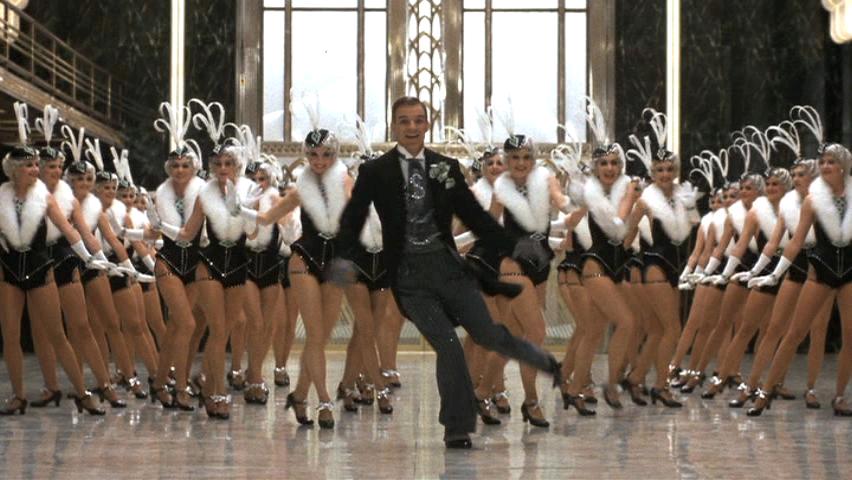 (USA, 1981; dir. Herbert Ross; cin. Gordon Willis)
IMDb
Musicals are even more of a rarity on this list than on my Top 100, not because I dislike the form
but because the ones that engage me tend to engage me at about the same level and in much the same way. Meanwhile, those
few that I truly love tend to involve an overt and self-reflexive consideration of the form, often at a significant ironic
distance—I'll take Singin' in the Rain, New York, New York, or Dancer in the Dark
any day over Swing Time, On the Town, or My Fair Lady. Same holds for theatrical musicals, where the
handful that truly excite me include Floyd Collins and Caroline, or Change. With the exception, then, of
Gene Kelly and Stanley Donen's masterpiece, one of the great consensus favorites of the American cinema, you can see how
my appetites often land me in square support of exactly those musicals that more fervent fans tend to dislike, and which
can even imply a certain rebuke to the genre's most famous pleasures, which I dare not call "simple."
Such is again the case with Herbert Ross' Pennies from Heaven, his opulent but abrasive adaptation of Dennis Potter's
BBC miniseries, which I have never seen. A major money loser for MGM, once so synonymous with tuneful crowd-pleasers, the
film possesses a royal flush of attributes almost certain to alienate popular audiences. Steve Martin cast as a basically
unsympathetic character. An entire cast that lip-synchs instead of singing, and to scratchy standards and thrift-store
arcana to boot. Trajectories into squalor and unhappiness instead of out of it. Fiddle-dee-dee! Little in the movie
even implies that it will formally stray from a miserabilist Depression-era drama with wry, almost mocking undertows until
Martin suddenly opens his mouth and moves his lips in semi-tandem with a 1930s radio hit that comes from nowhere. Not
long after, these incongruous moments of song flower into fully-blown, toe-tapping, Art Deco extravaganzas, like the
gleaming sequence where a colonnade of tuxedoed chaps rain money and romance on a debonair Martin and his floating,
platinum goddess—even as, in the forlornly designated "real world," he's being turned down for a bank loan. The pixie
dust keeps sifting and the songs keep coming as a sad schoolmistress (Bernadette Peters) is impregnated out of wedlock or
even lovelock, as the local pimp softshoes and splitses his way into coercive ownership of this broken dame, as our
dissatisfied and disloyal protagonist extends his record of abandonments and assaults, and as the whole glittering
kaboodle builds to a climactic execution.
The unexpected alignments of the movie's core elements and their dissonant cultural connotations were, I suppose, doomed
to win the film a reputation as an act of vandalism—either by undermining the nostalgic appeal of the music and the
choreography, all of which is utterly stellar, or by trivializing the incidents of the narrative, which speaks with real
earnestness to problems of restlessness, misogyny, and the plexiglas ceiling of social class. What interests me in the
movie is the idea that neither of its faces, the sweet or the sour, necessarily comes at the expense of the other. In
fact, at a level so far above Ross' other movies that you can't even see them from here, Pennies from Heaven
presents a dazzling and thought-provoking worldview where pop dreams and common predicaments are interfused every day,
often to deleterious effect, but would we have it any other way? Even in our starkest moments, do we ever wish to go
without our dreams or romantic fancies, any more than we would wish this film to go without its sleek art direction, its
marvelously controlled performances (especially from a remarkable Jessica Harper as Martin's wife), its exciting range of
dance styles and tones, its charming, attic-scented hopechest of songs, its breathtaking and allusive images shot by the
legendary D.P. of Manhattan and The Godfather? You often cannot know where Pennies from Heaven is
going, unless perhaps you've seen Dancer in the Dark and are starting to ask how Lars von Trier got away with quite
so much pilfering. Stretched between these two poles, a story of inexorable decline and a bouquet of formal surprises,
Pennies from Heaven is as taut and cutting as piano wire, but it's also a dream on a cloud. Who's to say these
things can't go together?
#94: I ♥ Huckabees
(USA, 2004; dir. David O. Russell; cin. Peter Deming)
IMDb // My Page

You got all that, right?
I know, I know, this movie came out, like, five minutes ago, but I ♥ Huckabees was the only movie of 2004 that
I paid to see three times in a theater, and every time, I laughed like I was screaming. Every time, the triple-threat of
Wahlberg, Hoffman, and Law proved that they deserved an Oscar category all their own for Flawless Comic Support Without
Scenery-Hogging. Every time, the movie's sharp harpoons into the absurd fractiousness of the American "liberal" left hit
all of their marks, even as the movie tipped all the sacred cows of big business, "Christian" hypocrisy, and star-studded
realpolitik with equal aplomb. The movie is crazily deep with subtle touches, golden scenes, and brilliant sidebar
performances. That dinner scene with Jean Smart and Richard Jenkins? The priceless walk-on from Talia Shire? Lily
Tomlin, her desk strewn with notebooks titled "Coincidences" and "Galaxies" and "Fathers," refocusing her eyes every few
seconds? Jon Brion's miraculous score, with the drunken calliope and the galloping rhythm? I ♥ed the whole thing,
and I'm not seeing the love dissipating any time soon.
#95: The Death of Mr. Lazarescu
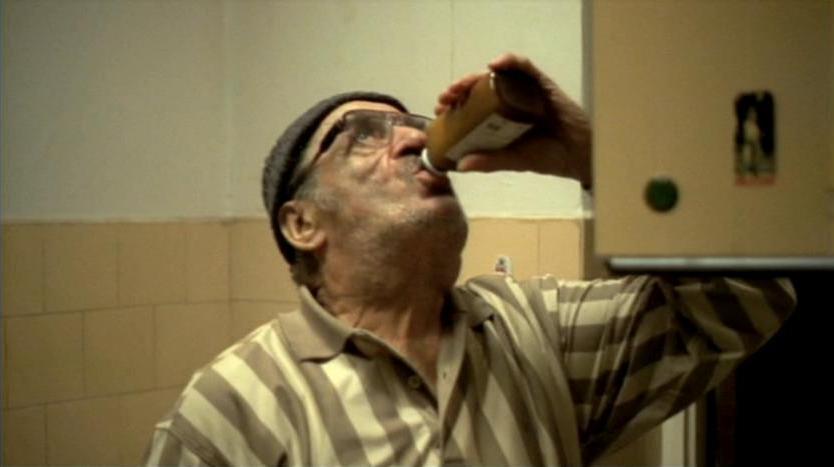 (Romania, 2005; dir. Cristi Puiu; cin. Oleg Mutu)
IMDb // My Page
What is that jaunty, synthesized pop song that plays over the opening credits of The Death of Mr. Lazarescu, a movie
that's about exactly what it says it's about? What do the lyrics mean? If you know, I wish you would tell me, because I love the
film, and I assume that it generates one of its infinite glints of mordant intelligence or humorous lament in relation to this
ditty: either the song isn't as sprightly as it sounds or the movie isn't as dour as it first appears... which is certainly true, but
how much more quickly does a Romanian-speaking audience understand this?
In the meantime, awaiting my full comprehension, I am assuaged by the fact of how brilliantly Lazarescu works as
a totally unique comedy, dingy and merry and terrible, about the brute incommunicability of almost everything: the sites of pain,
the proper prescriptions, the protocols of boarding an ambulance, how long it takes to send or receive a money order, the arrogant rituals of
expressing authority, the relative merits of cats and wives.
The beginning of the film is as self-evident as it gets, with old, sour-smelling, liquor-swilling Dante Remus Lazarescu slugging around
his untended apartment with its snot-covered lighting and dead-looking cats, ailing from some mystery condition that
causes him to expectorate bile or blood, plus whatever he just chugged from the bottle in his pantry. He spews this
all over his shirt. He responds, entranced with his own upchuck, with the desperately dignifying word, "Compote." With the absurd deliberateness of the myopically lost, he takes the shirt,
no doubt his favorite, into his jaundiced bathroom to try to clean off the gunk.
The film refuses to court our affections, though in its profound grasp and dense presentation of this milieu
and its rhythms, and the problems of its people, Lazarescu takes us fully into its confidence. Transparent visual style, long takes, an apartment that's the height of geriatric layabout realism:
Mr. Lazarescu seems to give itself over so purely, even though what it's giving isn't necessarily anything we want. But
nothing is really that simple, in Cristi Puiu's film, or anywhere—but perhaps nowhere are things as unsimple
as they are in a post-Communist bureaucracy when you're sick, and neither your testy neighbors nor
your offscreen relatives nor the Nine Circles of Health Care Administration have any clear idea
what to do with you. The movie will be full forever more of speculative diagnoses, neighborly spats
about Distonocalms and drill sets, difficulties about intake procedures and nurse's clipboards, lectures about
excess drinking, ambulance small-talk that very occasionally tilts into philosophical reverie,
debates about free beds and affordable procedures and quickest rouets from one clinic to the next.
Nothing is simple, although the astutely invisible camera-eye, the evocative but grossly quotidian lighting,
the indelibly careworn costumes, and the astonishing virtuosity of the ensemble cast (as fully immersed in this story
and in their characters as an Ingmar Bergman or a Mike Leigh repertory) keep the emotional and anthropological
experience of watching Mr. Lazarescu disarmingly simple. There's nothing "hard" about the movie, except the
rigidity of certain medics and the coldness of chauvinist husbands, and the possible tribulations of convincing a
friend to watch a 2½-hour document of one doddering alcoholic's final hours. Lazarescu is preoccupied
with arguments, impasses, and untranslatables, including the surreal hardships of translating life into death, but
it's as instantly and richly engaging as any novel you'd never have read if you knew what it was "about" (Great
Expectations? Madame Bovary? Invisible Man?) and it's as
convincing a testament as any I've seen to the universality of certain experiences—mortality and bureaucracy
principally among them.
The movie is a favorite, and not just an object of devout aesthetic admiration, almost exclusively because of the character
who appears 35 minutes in to limn the sallow, sometimes jocular, sometimes disputatious, implicitly dispiriting atmosphere
of Puiu's film with a warm beam of human industry, trained on behalf of a stranger in need. You don't immediately recognize Luminita
Gheorghiu's emergency medic Mioara as a moral center or a source of inspiration; with her terse manner, her blunt gaze, her
discordantly orange sleeveless jacket, her incongruous on-the-job smoking, and her burgundy-dyed hair, she looks more prepped
for the part of an unfeeling emissary of the medical institution than for the role of introspective, compassionate
audience surrogate that she eventually assumes, on her hunched and tired shoulders. Gheorghiu's Mioara is an even more
improbable heroine than Frances McDormand's Marge Gunderson, and she's an even fuller creation,
mapping an arc from stoicism to dogged but unflashy solicitude that mirrors Marge's different way of confronting the bottomless
surprises and deep sorrows of the world. Liking a character is a pretty jejune reason for liking a movie, especially a movie
with the formal fortitude and high-wire humor and the deceptively ragged, epic aspirations of this one.
But I like Mioara tremendously, and I think about her often, and I love Lazarescu for taking upon itself,
amid all of its other spectacularly fulfilled missions, the illumination of a new form of taciturn, street-level, wholly
believable kindness: professional but surely personal, created from scratch in every minute detail but endowed with
soul, with quiet desperation, with whatever in cinema has ever been or can ever be real.
#96: Possessed
 (USA, 1947; dir. Curtis Bernhardt; cin. Joseph Valentine)
IMDb
This slot could have gone to The Bad Seed, with its delectable camp excesses and deliciously
maladroit psychologizing, or to Mildred Pierce, which devotes considerable technical talent
and a terrific Crawford performance to an impressively absurd premise. But, in the interest of economy as well as honesty,
why not go with Possessed, the film that synthesized all of those films' bad-good qualities and added some more
of its own to boot? Crawford, a recent Oscar winner for Mildred, scored a second nomination here as Louise Graham,
who shuffles unsteadily into the early sequences, mumbling about someone called "David" on the sidewalks of LA before suddenly
collapsing into a coma. Worse, her scrubbed and denuded face looks like ten miles of hard road in Hell. It's kind of amazing
that Crawford of all people agreed to look this bad, though it's no less amazing that she agreed to say things like, "'I love
you' is such an inadequate way of saying 'I love you.' It doesn't quite describe how much it hurts sometimes. Sometimes I
get the sniffles and then my nose gets runny because I'm happy because I'm in love." Hard to explain, too, what Van Heflin
and Raymond Massey are doing lumbering around with their impossible characters, though Heflin at least has a good time
getting soused and shrinking uncomfortably from Crawford's fierce but addled affections—or is it from her fierce but
addled performance, which itself is some kind of apex in the eternal almanac of Bad-Good?
There is much that is fascinating about Possessed, including the way it refuses to be written off as a crappy movie,
even when the plot takes its serial nose-dives into purple implausibility, even when Franz Waxman indulges the most
apoplectic arpeggios and electric-organ decrescendoes in the certifiably insane score. However ancient its notions of
science—the title comes from Dr. Harvey Willard's expert opinion that Louise's schizoid persecution complex is one of
many mental-health states that amounts to being "possessed by devils"—there's a feral, almost involuntary conviction to
the film's interest in psychic unease that you don't really find in The Snake Pit or The Three
Faces of Eve or other, comparable voyages into the classical Hollywood booby-hatch. The form of the film convulses
amidst its own insensible agonies, alternating amongst elegant lakeside establishing shots, harshly expressionist chiaroscuro
effects, uneasy dissolves, and at least one handheld tracking shot from the point of view of a dead woman who may or may not
be haunting Louise (who, in turn, may or may not have killed this woman). It's easy to cackle and shrug at Warner Bros.
potboilers like this, and Possessed repeatedly earns the cackliest cackle you can manage: it's that crazy, and that
much fun. But it also feels symptomatic of...something, and harshly sincere: the sour force of spurned passion and the
suffocating pressure of obsessive lovers who won't go away have rarely been given such free rein. The violence they exact
on the movie's formal discipline is a major part of why you remember the picture.
Well, that and the ecstatic wrongness of Crawford's pleas that the alcoholic musician-engineer-mathematician played by
Heflin (!!) stop dodging her with his lovingly traced parabolas and his attempts to interest her in the complex calculus
of steel girders. "Why don't you love me like that?" she barks. "I'm much nicer than the girder, and a lot more
interesting." Joan, never a truer word was said.
#97: The Piano Teacher
 (France/Austria, 2001; dir. Michael Haneke; cin. Christian Berger)
IMDb // My Page
Nothing like The Piano Teacher to get this list off to a savage start, proving that just because I love a movie
enough to include it on a list of personal causes célèbres doesn't mean that it's easy to snuggle up to. I
am a sucker for razor-sharp formal control, and The Piano Teacher certainly has that, freezing the camera at
moments that are just as difficult and unexpected as the furious violence, emotional and otherwise, that often engulfs its
three major characters. I always go in for conceptual dramas, and the way Haneke wrests a bold meditation on music and a
cultural snapshot of Viennese schizophrenia out of this scalding character study is a subtle and breathtaking achievement.
I am a pushover, apparently, for movies about pianos. And, just as obviously, I relish nothing more than watching any
world-class actress tearing into a complicated part, and the ferocious precision of what Isabelle Huppert concocts
here—vengeful, expert, supercilious, tamped-down, lonely, and volcanically perverse—is something that no other
actress in years has equalled. (Most actresses could wrangle with this script for a decade and be too shallow or else too
shy to forge the Erika Kohut that Huppert uncovers.)
In combination, these separate marks of the film's distinction yield images and sequences so blunt and shattering in their
affective immediacy that the film is that rare thing—literally unforgettable. I do not have the greatest memory in the
world, but at the level of individual scenes, The Piano Teacher finds a needle-sharp line right into the mind's
cradle. Here is Erika, punishing a promising student with a grotesquely planted ambush of broken glass. Erika, abjecting
herself for sexual attention on tile floors, and abandoning herself to ecstatic violence in her own apartment. Erika, her
face tight and austere as a hangman's rope, withering in her estimation of her pupils' musical abilities. Erika, ducking
into a viewing stall for a quick, hot dosage of the kind of pornographic voyeurism that Haneke himself keeps threatening
but miraculously avoids. Penultimately, Erika, literalizing the wounds of her heart in one of the most shocking close-ups
I've ever witnessed, capturing Huppert in a look of raw agony that is utterly, irreproducibly her own. And lastly, the
music hall, the performance space, the indifferent scene of a death or a near-death, a massive edifice that Haneke has
taught us over two hours to read as both an emblem of trained sophistication and an altar to the obscene. The Piano
Teacher, so justifiably proud of its performances, is nonetheless bigger than all of them. It is a film of Artaudian
cruelty, and a boundary-breaker in the cinema's exploration of its own erotic and artisanal id.
#98: The Lion in Winter
 (UK/USA, 1968; dir. Anthony Harvey; cin. Douglas Slocombe)
IMDb
I am tempted to say that The Lion in Winter works better than it should. Its dual lineage in royal history and soap
operatics doesn't seem like the recipe for anything but a feathered fish, remote to popular audiences and unrecognizable to
more studious ones. The apoplectic performance style of Peter O'Toole whenever he's sprung from the Arabian desert seems
like an odd match with Katharine Hepburn's Connecticut vowels and her dry-gin flirts with the camera. For purposes of drama,
but also for those of Henry II and Eleanor of Aquitaine themsleves, there are too many sons running about. As in Zeffirelli's
Romeo and Juliet, released the same year, the sets and costumes are pretty but also too...clean. The palace is aspoil
with mongrels, hens, and fugitive vegetables, but not a thing has streaked Hepburn's ivory caftan or O'Toole's clabber-colored
face, still as white as empire beneath that well-tended beard. Past the edge of every frame, around every palatial corner,
you can sense the playhouse audience so clearly intended by these barbs and bon mots.
The Lion in Winter shouldn't work, but then, adding up all of its giddy affronts to seriousness and proper concert,
the movie shouldn't do anything but work, and that's exactly my experience of the movie: it works and keeps on
working, so succulent that it's no longer absurd, pumping so much pure voltage into its bickery version of history made at
night that there's no means of resisting, and no reason to. The Lion in Winter practically reels with its own sense
of fun, even as John Barry's timpani and trumpets keep fastening the movie to some form of gravitas, even as Douglas Slocombe's
photography, much more interesting than I remembered, casts a fine, sooty dust over these transparently modern personalities.
James Goldman's adaptation of his own play is a robust and roustabout chronicle, Holinshed in the age of Peyton Place.
Better, having devised this unique blend of annal and sitcom, dotted here and there with unsheathed daggers, he keeps it
going ingeniously. I've never been much sold on the work of his more famous brothers. Oldest brother Bo farmed thin
conceits in One Flew Over the Cuckoo's Nest and Melvin and Howard, winning Oscars for both that were more
rightly due the directors who placed so much trust in them. Superstar screenwriter and raconteur William, well-seasoned
with experience but annoyingly arch all the same, has even more overrated titles to his credit, like the thin wisp of
Butch Cassidy and the Sundance Kid and the preening whimsy of The Princess Bride. The Lion in Winter
has what none of these films have—though, giving credit where it's due, William's ace distillation of
All the President's Men has it, too: a braced and solid structure, a gallery of finely
etched characters, a huckster's gift for streamlining and popularizing the arcane, a beating heart of popcorn appeal that
still allows the film to go about its business, aggressively selling its strengths but never just shilling them.
Certainly I've never liked O'Toole nearly so much in his other films as I do here. His Henry is livelier as well as more
serious than his counterpart performance in Becket, though it helps that Anthony Harvey is a much better judge of
camera distance and emotional beats than Becket's Peter Glenville was. Katharine Hepburn bursts forth with by far
the best performance of her life after Spence. The standard meme in biographies, including her own, is that she tore into
the role with the admittedly displaced energy of massive grief, but it's worth noting that it's as sexy a turn as the one
in The Philadelphia Story. Hepburn writhes on her bed, tinders an incestuous spark in the eyes of all her boys,
contemplates her own image in a mirror shaped like a dragon's tear, and lures a leading man 25 years her junior into a
vivacious, erotic battle of wills that goes off like a charm. Maybe she was just turned on by all those great lines she
gets to recite and react to. "She smiled to excess but she chewed with real distinction," Eleanor offers in perfect
dismissal of a rival who, let's not forget, is already long dead.
"I marvel at you after all these years," mutters her nonplussed husband, "still like a democratic drawbridge going down for
everybody."
Shooting back at Henry's autumnal dreams of having more and different children, Eleanor asks, "What kind of spindly, rickety,
milky, wizened, dim-eyed, gammy-handed, limpy line of things will you beget? And when you die, which is regrettable but
necessary, what will happen to fair Alais and her pruny prince?" Give Katharine Hepburn that many consonants to bite down
on, sit back, and luxuriate. That Eleanor of Aquitaine can hardly be entertained to have said any such thing hardly
matters; that Pauline Kael spat vituperatively on the whole ship matters just as little. A slim skiff, maybe. Its last
act is utterly at sixes and sevens, and the actual finale slips right off the screen. But it's a proud pageant up to that
point, punchy and uproarious, a royal flag unfurled for the cause of popular delight.
#99: These Hands
 (Tanzania/Germany, 1992; dir. Flora M'mbugu-Schelling; cin. Suleiman Kissoky)
IMDb
Flora M'mbugu-Schelling's These Hands ranks easily among the most extraordinary documentaries I have ever seen. As I write this in the wake of the 2004
G8 Conference, Africa and its struggling economies have recently received an uncharacteristic boost in the attention of global media, but now that the
conference and the Live 8 festivities have come and gone, I can't help but wonder how long this well-intentioned media campaign will survive. If you're
trying to keep learning, keep considering, keep caring about African poverty, no document has ever made a more lasting impression on me than this one did.
Combining the class consciousness of Harlan County U.S.A. with the expressive minimalism of Night and Fog, These Hands is a 45-minute
movie that lacks any whiff of exposition for the first 35 of those minutes. All you are watching are huddles of women sitting or crouching in the open sun,
orbiting rubble-piles of fist-sized stones and using tiny hammers and chisels to break them down into smaller and smaller shards. This, ladies and gents,
is how construction-grade gravel is produced. M'mbugu-Schelling, the film's German-Tanzanian director, doesn't resort to any aestheticizing tricks, and she
doesn't observe any leering overseer or flagrant acts of worker abuse into the scene. She needn't: the pure fact of this hard form of labor speaks for
itself. These Hands is weirdly fascinating; the montage suggests, quite rightly, the tedium of the work, but it's smartly edited to prevent that
tedium from dulling our own sensitivity or our intellectual responses to what we are watching. But what are we watching? Again, the spectacle is so foreign
and opaque, despite its seeming self-evidence, that even as it compels our rapt attention, we can't help wondering about contexts and backgrounds.
With about 10 minutes to spare, These Hands drops a pretty big bomb, as one of the toiling women puts down her hammer and begins a remarkably
jubilant dance on top of the stone pile. Her fellow workers begin clapping hands and singing along with her gyrations, and this continues, uninterrupted,
for several beats. No one comes to bother the women; nothing further explains this sudden swerve in tone. Eventually, having gotten whatever it was out of
their system, the dancer and the singers resume their tasks. A quick worker's meal is had. The work continues, and the end of the day draws nearer.
Then, at the literal last minute, These Hands rolls its first expository captions. These women, it turns out, are self-employed; this is not a labor farm
or a rock plantation, per se. The quarrying they perform by hand pays roughly $6 per week, and this salary, like the autonomous working conditions, counts
as an enticing extravagance to workers, many of them refugees, who would be hard-pressed to find any better deal. In fact, the film implies, for Tanzanian
women and Mozambiquean expatriates, this deal is pretty good. Could there be a more heartbreaking truth, and could it be delivered with more rigor, less
sentiment, greater clarity than These Hands achieves? The chatter swirling around the G-8, as often self-congratulatory as not, suddenly gives way
to stark portraiture. Miraculously, an entire economic order virtually comes into focus—perhaps the hardest thing in the world to evoke within an
image, but Flora M'mbugu-Schelling does it, without any devices to goad or guilt-trip the viewer. Why bother? The film is suffused with a higher
consciousness about global working conditions and wealth distribution that cannot possibly go unheeded, even by the most hard-hearted capitalist or the most
obliviously coddled Westerner (and I am closer to the latter than I would like to admit).
If you're curious to see These Hands, and I hope you are, you'll definitely want to visit the absolutely priceless trove of African and African-American
film and video art available at California Newsreel. I've got a leg up because my university library
and the public library where I live both carry several Newsreel titles, but consider ordering some copies for yourself, your school, or your organization.
(On a much more chipper but still politically illuminating note, Djibril Diop Mambéty's The
Little Girl Who Sold the Sun is an absolute charmer, a near-contender in this Favorites list, and a sweet, important fable that anyone of any age
can enjoy and understand.) African movies, like African hunger, African poverty, African politics, African genocides, and African everything, get next to
no attention in this country; when they do, the continent's crises are rendered on such a vast, barely digestible scale that you wonder where to even start
making an emotional or intellectual inroad, much less a material contribution. These Hands offers a stunning place to start. Here,
here, and here are places to continue.
#100: Cemetery Man (Dellamorte Dellamore)
 (Italy, 1994; dir. Michele Soavi; cin. Mauro Marchetti)
IMDb // My Full Review
Talk about starting out ahead: tell me again why all movies don't begin with Rupert Everett, dripping wet with a towel around
his waist, shooting a zombie in the head at point-blank range? Cemetery Man, known to its hometown Italian fans as
Dellamorte Dellamore, thusly gets off on the right foot indeed, though it's a stop 'n' go affair ever after. Of all
the movies on this list, I think it's the hardest for me to get a bead on, and the one that I'm the most surprised to feel
such affection for. It also might be the hardest one to write about, as is further attested by my lame review,
written in the preemie infancy of this website.
Maybe I love Cemetery Man because it's one of the few cult films in existence whose cult I blithely stumbled into,
without even knowing it existed. Somehow, people everywhere seem to have seen this movie, which I caught on late-night
Cinemax, O whorish bride of cable TV, one time when I was house-sitting. Everything that happens early in Cemetery
Man happens again at least a dozen more times. Zombies, for the entertainment gods are good, can't stop rising out of
the ground, seven days after their initial burial. Rupert, for every other kind of god is good, can't stop taking showers.
That killer musical score, all sawing cellos and violins and deep-thrumming basses, never wears out its considerable welcome.
The indecently buxom Italian sexpot who turns Rupert's eye, played by an actress called Anna Falchi, keeps dying and
resurrecting herself, eventually returning in the guises of wholly different women, all with the same smutty expression.
The mayor's daughter gets her head lopped off in a road accident, but when it comes back to life on its own, Rupert's
porcine assistant has the politesse to perch it in the skeleton of a burned-out TV. Haven't you ever wanted to
look out from the boob-tube instead of in? And did I mention this is played for laughs?
Well, laughs of a sort. Cemetery Man is like Shaun of the Dead as rewritten by
Eugène Ionesco. Promiscuously genre-hopping among horror, comedy, Italian national satire, and highfalutin existentialism,
Cemetery Man has the surface qualities of a spoof—including its absurdly matter-of-fact nods to Citizen Kane,
Vertigo, and Psycho—but none of its comfy core. Its bones are not really funny bones. There's something
perversely poignant about its hero's unholy predicament: in trying to flee his thankless job as watchdog, caretaker, and
tireless re-exterminator at the local graveyard, he drives out of town until he almost tips over the literal edge of the
world... which means that all those zombies aren't a sign of The End at all, but are rather the tottering embodiments of a
bloodless status quo. You can laugh or weep, or, like Callum Keith Rennie in Last Night, you can just get horny.
Cemetery Man encourages all three, with a mad brio and a frank lack of interest in playing by any rules. I'm still
not certain that the picture really works. Recent re-viewings have been distressingly joyless, but isn't that very trajectory
from hilarity to nausea the plot and theme of this sucker to begin with? I think I'm gonna be sick, or maybe this is what
enlightenment feels like. Either way, I'm sure I'll watch it again. Like the most indefatigable zombie in the cool, cool
crust of the Earth, I just can't stop trying again.