#81: High Art
 (USA, 1998; dir. Lisa Cholodenko; cin. Tami Reiker)
IMDb // My Full Review
Lisa Cholodenko's High Art commences with a literal
meditation on how women look—a double-entendre that, like "high art" itself, is fully and richly intentional. During
the opening credits sequence, dotted with the names of female actors, editors, cinematographers, costume designers,
producers and executive producers, and writer-director Cholodenko, Radha Mithcell's Syd pores over a handful of photographic
slides at her light-table. The camera is entranced by her searching, intelligent eyes, starkly framed in thick black
glasses, rather than by her body or by the objects at which she gazes. Within the same sequence, though, this isolated
woman makes her way home through an empty office building and an uninhabited subway station, all shot from the kinds of
oblique angles and the dusky, doomy shadows that tend to signal female victimization in all ranges of popular cinema. The
movie prowls somewhere in the spectrum between Screen, the journal, and Scream, the girls-in-peril franchise,
and that's hardly the last spectrum whose measure High Art will take. Between still photos and the moving image,
between gay and straight, ambition and love, addiction and lucidity, there is sometimes a wide and nervy chasm in this
movie, and at other moments nothing more than a pause, a comma, a slide over to the next seat on the couch. As the plot
unfolds, High Art's debts to All About Eve become clearer, duplicating the essential scenarios of cunning,
camaraderie, idol-slaying, and creative power even as it lures into the light the earlier film's lesbian undertows.
Like All About Eve, if nowhere near its depth, the script of High Art is good enough that it would survive
even a mediocre cast, but thank God it hasn't got one. Ally Sheedy's watchful, forceful game of brinksmanship with her
own reckless tendencies never ceases to fascinate, while Patricia Clarkson turns all the burners on high with her soused,
semi-waking, gloriously catty, but intimidatingly naked portrait of Greta, an actress whose image is fading away on her.
There's a harsh scene, though not a cruel one, where Greta almost drowns in a bathtub, and the rhymes to both the ubiquitous
photos of Greta underwater and the elementary process of emulsifying a negative instantly capture how far past her
happiness—how overexposed—Greta has become.
High Art errs, more than once. The film makes feints toward two characters, Lucy's mother and Syd's boyfriend, that
barely even congeal, and the climax, for all that it captures an emotional inevitability, still feels wayward and abrupt.
These are the kinds of limitations you find in a movie that still exists halfway in the filmmaker's head; it hasn't yet
molted its basic layers of structure and concept, hasn't yet cooled and matured into full-fledged drama. But as opposed to
other good films with similar liabilities—Darren Aronofsky's Pi, Scott McGehee and David
Siegel's The Deep End, even to an extent Todd Haynes' Far from
Heaven—High Art keeps looping you back into its mysteries. The collective dissolution of the characters,
even the dourness of the film's trajectory don't deflate what is enigmatic and interesting about it. When women this
fascinating come this close to a camera, no matter what side of it they're standing on, it's always an event. Cholodenko's
follow-up, Laurel Canyon, works only sporadically; Cavedweller
barely works at all. What's best in those pictures are but paler reflections of the same issues that drive High Art—broadly,
what rebellious female artisanship looks like as its embers are dying down. But High Art doesn't snuff itself out.
You remember it.
#82: Walk on the Wild Side
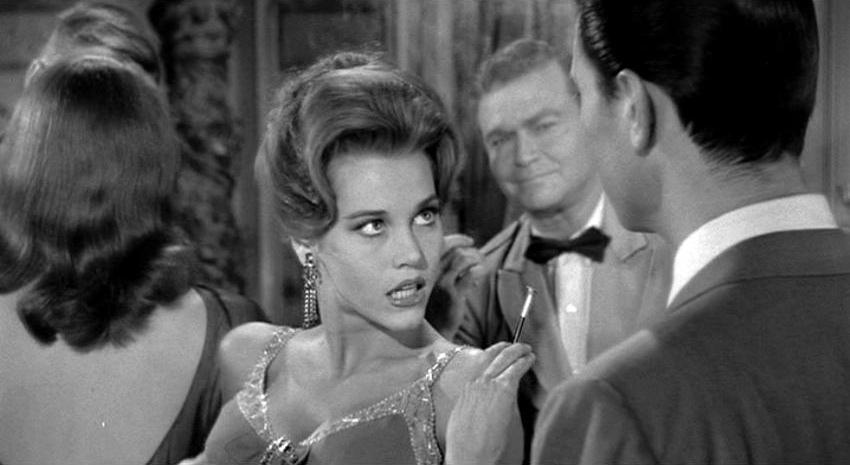 (USA, 1962; dir. Edward Dmytryk; cin. Joe MacDonald)
IMDb
Edward Dmytryk's Walk on the Wild Side is two of the best kinds of movie rolled into one, and the joy as well as the critical
trap of the movie is that you cannot fully tease apart its dual identities. On the one hand, this is grade-A, succulent, blood-leaking,
lip-licking trash, the kind of movie where flat, funnel-faced Laurence Harvey (of all people!) plays a prodigal
Southerner named Dove Linkhorn (of all things!) on a Sweet Bird of Youth errand to retrieve the dazzling
girlfriend who got away. In Sweet Bird, this character's name is Heavenly. Here it's Hallie, and she's
played by the single-named Capucine, taller, more knowing, and darker in every way than Shirley Knight. Hallie's
working under the thumb of New Orleans brothel madame Jo Courtney, who rules everything with an iron glove, a steel glare,
and the chic accessory of a legless henchman. The only thing she can't govern is her lesbian infatuation with Hallie, which often
leads her, even though she's played by Barbara Stanwyck in full-tilt mountain-lion mode, to drop her guard and question her own
instincts. In addition to Harvey's narcissistic and angular knight, Capucine's passive and willowy vixen, and Stanwyck's high-strung
yet coolly confident despot, we've also got Anne Baxter playing a Mexican with a roadside chili stand,
Imitation of Life's Juanita Moore tending kindly to the working girls in their open-air courtyard, and Jane Fonda setting off
small earthquakes of pure, insolent eroticism as Kitty Twist (!), the starving hitch-hiker whom Dove Linkhorn (DOVE! LINKHORN!) scrapes up
on his way to the Big Easy and then ditches once he's in town... only to see her end up... exactly where you're guessing.
You haven't guessed everything, though, not the slithery curves and potent confrontations in the narrative, and certainly not the pert, moody,
remarkably sincere emotionalism of all of the key performances—excepting, of course, Harvey's. Walk on the Wild Side was the movie
that yielded Jane Fonda's immortal quip, "Acting with Laurence Harvey is like acting with yourself, except worse," but when Harvey was cast to
take advantage of his hateful, plasticine indifference to others, the results could often be fine. Plus, without a male co-star to steal their
thunder or even distract their attention, Capucine, Stanwyck (gloriously), Fonda (pre-eminently), and even the bizarrely cast but affecting Baxter
are freed to relate in depth to their own characters and motivations—a luxury that few dramatic roles for women really afford. They also, when
the plot allows, relate in fascinating ways to each other, as in the tense and sizzling scenes between Capucine and Stanwyck, little operatic duos of
rivalry and tenderness and jagged recrimination between a velvety soprano and the mezzo who hates her and loves her and hates to love her. All of which
is to say nothing of the loping, febrile
Elmer Bernstein score, or the sets that strike the perfect balance between tawdry and elegant, or the sleek black-and-white photography by Joe
MacDonald, or the Tod Browning way in which whole groups of malefactors start pouring into the frame when it's time for some stark dramatic vengeance.
The brightest of the jewels that I can only hint at here is that opening Saul Bass credits sequence that gets more cinematic punch out of one black cat with a chip on its shoulder and an alleyway
nemesis than a lot of movies get out of their whole studio-issue parade of talent and money.
What I'm getting at is that Walk on the Wild Side does a stunning, sexy impression of a junk movie that's basically full of shit, and I'm sure
it can be ripely enjoyed on these saucy, skin-baring, disguisedly sentimental terms. Not every movie with dreams of drive-in necking sessions
or midnight-movie revival showings is able to hold itself together as tautly as this one does, nor with the same steady velocity of indecent
pleasures and nutty lines of dialogue and high-pitched arguments and blowzy, French-quarter existentialism. The critics in 1962 certainly didn't
care much for it, and fans of Nelson Algren's novel usually rush to disparage the adaptation. But if you ask me, Walk on the Wild Side is also
a sterling exemplar of the superficially "bad" movie that's actually, electrically
alive, and better for that reason than a lot of safe, classical, abashedly "good" movies. I almost never want to budge the camera or alter the
pace, I relish the sophisticated blend of autocratic rule and naughty, laissez-faire contentment that seem to waft around the brothel, and I would kill
for any number of higher-priced and haughtier movies to look or sound this terrific. The odor of wreckage and ruin only makes the film more interesting—Dmytryk's
career hobbled by the blacklist, Harvey who died so early, Capucine who died by her own hand, Stanwyck emitting a dialectic of sapphic desire and furious
rage that's hard not to take as deeply personal—but because the filmmaking is so strong, the extra-curricular echoes of decadence and dilapidation only
heighten the movie's interest, instead of eclipsing it or (worse) substituting for actual interest. Pleasure, excitement, inspiration, risk, absurdity, lust, and
scandal: they're all here, lurking inside and slinking around the actual text, not just its biographical history. They're ready to be tasted, ready to be
rolled around your tongue, ready to be taken for a quick, disreputable, deliriously satisfying roll in the proverbial hay.
#83: Orlando
 (UK, 1993; dir. Sally Potter; cin. Aleksei Rodionov)
IMDb
1993 marked the first year I penetrated the suburban county line with the explicit purpose of seeing an art movie. I was a
sophomore in high school, and with the intrepid Blosser sisters, Susan and Carol, I went to the Cineplex Odeon Shirlington
7 in Northern Virginia to see first Much Ado About Nothing and then Orlando. We all loved the first movie,
drunk as we were on Shakespeare and on our ripe imaginations of Ken and Em as companionate perfection. Remember those days?
I, though, was secretly much more taken with Orlando, a movie I had virtually made up my mind to love anyway.
Another anecdote: the first issue of Entertainment Weekly I ever bought and obsessed over was the Summer Movie Preview
in 1993, warmly remembered for the moment at which I finished reading about Cliffhanger and Jurassic Park and
Sleepless in Seattle and suddenly flipped to a picture of a red-headed androgyne and a withered old man cast as Queen
Elizabeth, both of them bedecked in the most outlandishly plush theatrical finery while escorting a pack of grey, almost
aqueline hunting dogs down the proverbial garden path. Aside from its sheer beauty, I couldn't believe that this picture
was afforded a full half-page, or that the plot explored a literal, magical switching of a person's gender, or that it was
written by this "Virginia Woolf" about whom I was just learning. (Albee's pun escaped me entirely; frankly, it kind of
still does.) It was hard for me to imagine that Orlando could possibly measure up to the promise of this photostill,
so imagine my awe when that shot came and went a mere 10 or 15 minutes into the film. Imagine my elation at actually loving
the film, rather than just posing as one who loved it. The minute I reached the end of The Vampire Lestat, which I
was then reading, I lept into Woolf's novel, was stunned by how different it was in tone as well as incident, but I loved
it just as much, and couldn't stop gazing at Tilda Swinton's arch but somehow sly, Holbein-type portrait on the cover of
the Harcourt Brace reprint. We could sum all of this up as a sort of Queen's Throat
moment in a wee, proto-queer cinephile's young life, and for all of these reasons, Orlando will always remain a
favorite.
There are other reasons, Swinton's gorgeous and utterly impossible face being one. Watching Young Adam last year
with a friend, I leaned into his ear and said, "Her face is like a brain." You can literally read her thoughts, in an
almost disconcertingly subtle and complete way, and the thoughts are always interesting—sometimes much more so than
the movies she's in, though that isn't the case with Orlando. Released as Derek Jarman lay dying, though of course
I had no sense of this at the time, Orlando confirmed that both Swinton and costume designer/archangel Sandy Powell
would have thriving careers even without their patron and discoverer. I like to think of the frankly wobbly coda of
Orlando, when Sally Potter uses rough, handheld Super 8 to render the modern Orlando's return to the field where we
first met him/her, as at least in part a gentle elegy for Jarman, who so brilliantly pioneered the interpolation of
celluloid and video as a uniquely expressive collage-form for the cinema. I like how many of Orlando's technical
ventures pay off, like David Motion's defiantly modern score, as brazenly instrumented as those of Jon Brion but with
techno undercurrents and, still yet, some classical melodic lines. I like the use of Russian and Uzbek locations to sub in
for, respectively, the dowager Elizabeth's icebound Winter Court and the blistering palace-resort of Lothaire Bluteau's
Turkish pasha, and I like wondering how they possibly made this movie for $5 million. I like that cinematographer Alexei
Rodionov's mannerist motif of panning back and forth between dialogue speakers, bending if not quite breaking ye olde
180° rule, somehow resonates as clever rather than just as a sterile conceit in this story all about cryptic
transitions and spaces between. The later epochs in the narrative get something of a bum's rush after all the visual,
musical, and narrative lavishments on the early passages, but Orlando is a hoot, a hit, and a surprisingly
boisterous comedy for most of its running time. You'd expect it to smell like scholarly folios, but it doesn't. It's as
warm as those morning rays of sun that discover before anyone else does, with no Crying Game anxieties whatsoever,
that he isn't a he anymore.
#84: I'm the One that I Want
 (USA, 2000; dir. Lionel Coleman; cin. Lionel Coleman)
IMDb // My Page
Her name is MARGARET, and she is here to WASH your vagina! Well, actually, she isn't; "Gwen" has got that covered. But
Margaret Cho is here to fire off completely unexpected lines like that, to bellow them out, to belly-laugh them, to
naughtily gift-wrap them, to reprise them in different voices, to make sure you never forget them. Same with, "I wasn't
like any Korean role-model that they"—read: anyone—"had ever seen. I mean, I didn't play violin. I didn't fuck
Woody Allen." Or, "Fag hags are the backbone of the gay community! We led you through the Underground Railroad! We went
to the prom with you!" Or her priceless answering-machine messages from her mother, or her in-store conversations with
same ("Oh, Mommy wasn't ready for that!!"). One of my absolute favorite bits is her gendered comparison between last-call
behavior at bars. I'm paraphrasing (why don't I own this movie??), but basically it goes, "When you go out with
your girlfriends, and one of them meets somebody, women are all, 'Oh my GOD, I feel so BAD, I can't leave with YOU, I'm
here with my FRIEND!' Gay men, however, will LEAVE YOU. They're like, 'You can take a bus! You can take a cab! You a big
girl, you go, girl! No, I said YOU. GO.' At last call, the only people in a gay bar are women."
Another of the funniest bits, though heartbreaking in context, is "I - was so - hungry! I was starving!!" Margaret
lets fly with that curveball at the point in her live, one-woman show when she has stopped (well, mostly stopped) explicitly
catering to her hometown and way-gay San Francisco audience and is chronicling her own short, unhappy life as a
corporate-fabricated Asian-American poster child in the mid-1990s. Cast in an "Asian family" sitcom whose cast of
characters were all, to anyone paying attention, of completely different Asian ethnicities. Coercively shadowed by an
"Asian advisor" who would dog her around the set and teach her to be "more" Asian. ("Here, use these chopsticks!" Cho
ventriloquizes in wicked but pained memory, "and then, you can put them in your hair!") All the while, Cho was fighting
dietary dictates from the network and the eating disorders they inevitably provoked, as well as various addictions, sexual
recklessness and eventual victimization, crushed expectations, vicious "fanmail," industry racism, and everything else
under the Angelino sun. As she tells the story, with no matter how much foul-mouthed and knee-slapping wit, you can see
that she's beating back every ghost in the book. Maybe this time, she'll win.
I'm the One That I Want, richer, more personal, and a good deal funnier than Cho's follow-up concert docs, is like
"Rose's Turn" sung out by Richard Pryor. Except, you know, "more Asian." The structural arrangement of her show,
testifying to her struggles against sexist and racist G-forces by playfully stoking her largely white male audience's
presumed familiarity with homophobia, comprises a thesis in itself about the dialogic possibilities between different
cadres of American outcasts. Cho raises all kinds of questions in her routine, and consciously or not, the routine raises
questions of its own. What is it, after all, about gay male fandom and train-wrecked female celebrities? What are the
stakes of such brazen self-stereotyping as Cho's personally patented pidgin-Korean? And what do you do with a comic who's
willing and able to say, "I went through this whole thing—am I gay? Am I straight? And then I realized—I'm just
slutty. Where's my parade??" My answer so far: you watch her movie. A lot. And you think a lot about what you're
watching, and why. And you laugh so much you almost vomit.
#85: A Streetcar Named Desire
 (USA, 1951; dir. Elia Kazan; cin. Harry Stradling Sr.)
IMDb
Is there a more poignant character arc in American drama, in American literature, than the disintegration of Blanche DuBois?
Throughout A Streetcar Named Desire, her wounds and anxieties, even her dreams, are those of Gothic fiction:
frittered estates, fabled suicides, eleventh-hour suitors, secret histories. Meanwhile, Stella and Stanley Kowalski, her
sister and brother-in-law, united by consonance, alliteration, and carnality, have more tangible concerns, like a pregnancy
Stella doesn't mention, a ritual poker night Stanley means to safeguard, and, bien sur, the Napoleonic Code.
Tennessee Williams' play, among its multiple and ingenious geometries, positions Blanche and Stanley as nearly parallel
vectors, moving nonetheless in opposite directions. It is somehow heroic that Blanche, with Williams' help, sustains her
romanticism, her "enchantment," as long as she does—even with a paramour as stolid as Karl Malden's Mitch, a walking
sack of flour. It is similarly heroic, for quite a long time, that Stanley manages to insist on the proud vulgarity of his
petty fiefdom, even as his cohorts offer to stand for the ladies and dance to their radio, as the sisters DuBois share a
laugh and later a derogatory confidence at his expense, as prospective parenthood dares to soften him into a stabler
companion-provider. Williams is brave to venture these two as complementary egos, each creating worlds within worlds, as
Blanche's steamy baths and Stanley's stinking shirt carve a two-room apartment into separate universes.
But A Streetcar Named Desire is not, finally, a relativist play. It stands fully behind Blanche when she names
deliberate cruelty as the one truly unforgivable thing, and as her inventions and self-insulations grow more threadbare—who
but a desperate woman could even imagine a figure like Shep Huntleigh?—her cold fate is sealed. Elia Kazan films her
lowest moment so that we hover over Blanche, her face and body upside down in the shot, rolling back her eyes in high-angle
so as to acquire some sense of whom she's talking to. Blanche, as she herself might put it, is utterly boulversée,
her blazing imagination finally bereft of all billows. With more severe lighting, it would be a Bergman shot, but it is
better for being a Harry Stradling shot: as in the rest of the movie, the low-contrast grayscale here is the color of
cobwebs while still assessing incredible visual detail in every frame.
Streetcar is to me what The Wizard of Oz or The Ten Commandments or It's a Wonderful Life or
Top Gun are to others: a movie and a story that have always been there, past which it's difficult to remember. I
read the play in 7th grade and simply never stopped, and Kazan's version has become such an iconic counterpart to the play
that it's hard to separate the two, despite their overt differences. In fact, these disparities are interesting: something
as simple as following Blanche immediately to the bowling alley to find Stella, instead of letting her nip her liquor and
calm her nerves alone for a few beats in the Kowalskis' tenement, changes the whole energy of the character. She doesn't
even have her little spat with the upstairs neighbor Eunice, which is especially surprising because Kazan is noticeably
preoccupied with Eunice and her husband Sam as an implied parallel narrative. We even cut upstairs to their apartment a
few times, once when Eunice is alone, and she is the last character we see in the movie. That I had forgotten these and
other variations entirely speaks, I'm sure, to the memory-filling power of the headline performances and the uncanny
perfection of the play. Vivien Leigh gives probably the best performance to ever win the Best Actress Oscar, somehow
making Blanche "work" even within Kazan's aggressively realist screen poetics. It doesn't hurt her work at all, and in
fact it probably helps, that we do have a sense of watching Leigh construct the performance as she goes—the odd accent,
the stiff turns of the neck, the ingenious acting she does with all of her outfits and props. Watching Blanche create
herself for such a long span is an ideal lead-in to watching Stanley, Mitch, New Orleans, modernity, the world take her
apart. Brando only improves as I get older, reacting no longer to the notoriety of the performance but to its exorbitantly
confident, lived-in quality, the hyperfamiliarity with the part that allows him to muffle key lines with no loss to Stanley
or to the piece. Hunter and Malden never entirely win me, but the production is so grounded in its superior qualities that
what's merely good in it becomes elevated by extension. There's nothing rattle-trap about this Streetcar.
#86: Where Is the Friend's Home?
 (Iran, 1987; dir. Abbas Kiarostami; cin. Farhad Saba)
IMDb
Ahmed Ahmadpoor, the eight-year-old protagonist of Abbas Kiarostami's Where Is the Friend's Home?, sits by sympathetically
but helplessly as the schoolboy who sits beside him, Mohamad Reza Nematzadeh, is harshly scolded by their teacher. Mohamad Reza
has failed, for a third time, to write out his homework in a notebook, as he has so often been reminded to do. The stakes
of his forgetfulness are that he will be expelled from school if he repeats the error a fourth time. So, wouldn't you know,
in the shuffling speed with which all students, including my own undergraduates, hasten out of class, and in the unbearable
unfairness of early childhood, Mohamad Reza's most well-meaning friend accidentally swipes his neighbor's notebook in place
of his own. Realizing his mistake only after returning home, Ahmed is heartbroken at the prospect of his friend's certain
punishment, and despite the ornery warnings of his parents and the biddings of his grandfather ("Fetch my cigarettes!") he
alights from his own village of Koker into the neighboring warren of Poshteh, looking for a friend whose whereabouts he can
only dimly guess.
The sweet-temperedness of Where Is the Friend's Home? is a main reason why the film appeals so profoundly, and why
it helped to jumpstart the international zeitgeist of enthusiasm for Iranian cinema. Especially by comparison to the rigid
conceptions of Kiarostami's recent work, the film is unabashedly rooted in human sympathy, an affecting but never cloying
scenario, and a neorealist filming style to make Bazin cheer from the grave. Kiarostami carefully but unobtrusively
manages the frame even while tracking young Ahmed through the sidewinding paths and chutes of Poshteh, so that our own
visual sense unites permanent dislocation with the constant unfolding of discovery. (10 is a
fine movie, but if you've seen Where Is the Friend's Home?, you'll wish that Kiarostami would unbolt the camera from
the dashboard already.) The repetition of key shots, paticularly that Zorro-swath of an unpaved incline that reaches to
the peak of a tree-topped hill, communicates a kind of hermetic life in and around Koker, even as Ahmed intrepidly tests
those boundaries, and even as the same gaggle of gossiping men you find in any decent-sized town the world over reminisce
about how much more disciplined they were in childhood, and debate the hot topic of how iron doors are fazing out the old
wooden ones. Meanwhile, Kiarostami's simple but supple screenplay weaves in threads of local humor and wisps of dramatic
irony—his mother, verging on disbelief of his story, thinks Ahmed simply wishes to avoid his own homework—that
only deepen the integrity of the young boy's conviction.
For some reason I always think of Abbas Kiarostami's Where Is the Friend's Home? as a sort of Iranian 400 Blows,
perhaps because both films pay such animated, concerted, and respectful attention to the quotidian but nonetheless deeply
felt quandaries of being a young boy. But it's a bad analogy. Ahmed Ahmadpoor evinces none of the incipient sass or
broodish alienation of Truffaut's Antoine Doinel, and certainly the aesthetics of the two films couldn't be more different.
If the Kiarostami film has any European counterpart, it's Bicycle Thieves, except this is a saga of trying to return
rather than recover something, and the malleable mind of the young boy in this story has direct access to his own vision of
the city, unfiltered by a father's shadow. Furthermore, the rural Iranian landscape is not, as in Bicycle Thieves,
riven with the signs of martial devastation. It's just, plainly, a tough place to get by, especially if you're small—one
of those lean but precious premises of which movies can always use more. Sparer, less pushy, and more resonant than later
Iranian exports like Children of Heaven, Where Is the Friend's Home is a perfect
tonic to your worst suspicions of kiddie-centered cinema.
#87: Hands on a Hardbody
 (USA, 1997; dir. S.R. Bindler; cin. S.R. Bindler, Michael A. Nickles, and Chapin Wilson)
IMDb // My Page
Longview, Texas, due north of Houston and due east of Dallas, is the home of the original "Hands on a Hardbody" contest, a
deceptively grueling annual rite where randomly selected entrants attempt to win a brand new Nissan Hardbody pickup by
outlasting all comers in the ability to stay awake with at least one hand on the truck at all times. No sleeping. No
breaks, except a group siesta for five minutes every hour and 15 minutes every six hours. No leaning on the truck to
support your weight. No squatting. For the final three contestants, a drug test. Benny Perkins, who won the contest in
1992 after palming the pickup for 87 hours, resented the way that the contest became a local tourist attraction, with
people forgetting that "we're suffering, we're hurting." The runner-up from the previous year describes the ordeal as
"the best experience of my life," to which the woman who beat him instantly echoes, "Oh, yeah!" A medical professional
whom this cheap, simple, do-it-yourself documentary bills only as "Dr. Jereb, Psychologist," describes the 3-4 day
Hardbody tournament as "A mystical experience...that transcends this truck that we're all holding onto, transcends our
lives." The visual impression of yellow-shirted buzzards caressing their blue metal carrion recedes beneath the
gobsmacking emotion that the men and women of the contest have already poured into and onto this apparently protean
vehicle.
Even more than the justly famous Spellbound, Hands on a Hardbody poses a ritual
competition as a ready-made cross section of American personae, ethics, and needs. Among the rivals in the 1994 contest,
which this film records, Greg has entered in a plaintive attempt to recapture the kind of discipline he feels he's lost
since his Marine Corps days; middle-aged Russell has put 250,000 miles on his old truck and can't easily afford to replace
it; Kelly, should she win, might parlay the truck's resale value into tuition money or orthodontia; Janis Curtis, who has
no front teeth whatsoever, thinks this trial will be a good way to prove to herself that she can finish anything she has
the will to begin; returning champ Benny, stunned by the serendipity of being chosen twice as a finalist, clearly relishes
the aura of the conquering hero; Norma Valverde, a dead ringer for Lupe Ontiveros, confides that "my husband and I have
been praying for a truck, and this is what I believe God wants us to do." The Valverdes sold their own truck the day they
learned of Norma's invitation to join the contest, and her congregation of 500 neighbors are conducting group prayers on
her behalf, with some smaller, singing circles on-site at the contest. Hovering over all of these pathos-laden backstories
is the fact that, unlike the spelling bee, the Hardbody contest doesn't become more or less winnable in any evident way as
a result of these personal histories. Almost embarrassingly intimate confessions run up against brute physical endurance.
A concentric ring of longtime contest-watchers espouse their guesses and critiques—Kelly is taking "smart breaks"
eating bananas and fish, while Russell, stupidly outfitted in heavy boots, "has got the attitude, but he's ill-advised."
Norma, listening to gospel hymns and recorded sermons on her Walkman, regularly bursts into wild, joyous peals of laughter,
which she credits to the Holy Ghost. Antagonisms form. Judges are called into question. In the 48th hour of the contest,
10 of the 23 aspirants are still standing there, bleary, their personalities gradually evacuated, still with their hands
slapped on the chassis. They still have a long way to go.
So, fearless renter, presuming you can find this elusive movie—the non-dubbed copies on eBay have run as much as
$85—what kind of experience would you like this film to be? Slice-of-life travelogue with sharp regional accents?
Genuinely surprising suspense thriller with truly unexpected developments—which, we realize in hindsight, have been
carefully insulated by the editing and the character introductions? Cooked-to-order parable of slavish capitalist
commodity-worship, tempered by compassionate appeals to each entrant's reason for perpetuating the system? Or how about a
rollicking human comedy, soundtracked by Norma's contagious laughter, or country-boy Ronald's improbable fear of thunder,
or the contest supervisor's Southern-fried defenses of an impugned judge: "These people are giving their time, and sure,
they didn't graduate from the Academy of Hardbody Hands of America, or what have you!" Watch Angie, Texan blossom,
carefully using one hand to apply the makeup products she has spread out across her Jackie Collins hardcover. Hear the
delirious tales of petting invisible dogs, obeying mysterious voices. Puzzle at why Matthew McConaughey and Benicio Del
Toro are both thanked in the credits. "You basically learn the values of humanity, because you see other people fighting,
struggling, who want the same thing you want," opines sage-philosopher Benny, who in a less grandiose moment contends,
"It's a human drama thing."
#88: Alice Adams
 (USA, 1935; dir. George Stevens; cin. Robert De Grasse)
IMDb
Among Katharine Hepburn's most famous and auspicious screen collaborators—including, in my own order of preference,
George Cukor, Cary Grant, and Spencer Tracy—director George Stevens is the least fêted member, but his achievements
with Hepburn should not be undervalued. Once an established star, she never looked more radiant than she did in 1942's
Woman of the Year, where Stevens' generous showcasing of her look and her performance beautifully counteracts the
script's rather mean imbalance against her. (Well, maybe until that cooking scene, anyway.) Earlier than that, Stevens
gamely ushered her through a spritely and underseen J.M. Barrie adaptation called Quality Street (1937), where
Hepburn's comic dual-performance paves the way as none of her previous roles had done for the screwball delights of Howard
Hawks' Bringing Up Baby (1938) and the aristocratic wit of Cukor's The Philadelphia Story (1940). But moving
back still earlier, it's not clear that any of Hepburn's once and future heights would have been reached without the
pretext of her first truly great performance in Alice Adams, which finds her amidst a glorious, once-in-a-lifetime
metamorphosis from the queer, coltish ingénue of 1933 (Little Women, Morning Glory, Christopher Strong)
into the rounded sophistication of her later work, somehow softer and more confident all at the same time. Alice Adams
is the moment where Hepburn becomes a star, and also the moment where she becomes truly lovable.
Adapted from a novel by Booth Tarkington—the writer, too, of The Magnificent Ambersons—Alice Adams tells
the story of a lower-middle-class girl, not far past her schooling years, who positively quivers with longing to join the
coterie of her more fashionable peers and to find the kind of domestic bliss that presumably once united her parents (the
excellent Fred Stone and Ann Shoemaker), whose tacit bond of affection is now sorely tested by illness, monetary need, and
other trials of late middle-age. Alice Adams is the kind of girl who would adore Pride and Prejudice, even though
in real life she might well have settled for Mr. Collins. One of the major ambitions of the screenplay and, I'm guessing,
the novel is to keep Alice so dotingly loyal to her family even as she dreams of something bigger or other than what they
have, which often compels a shame of her circumstances and a coy dishonesty about who she is and who they are. That the
emblematically patrician Hepburn is so convincing within both this cast and this caste is a complete revelation, even more
so in hindsight than it must have been in 1935, but her empathetic connection to this girl's gossamer aspirations couldn't
be clearer. Her body and voice are much more relaxed than we're used to seeing and hearing them, and even though she takes
center stage in a way she wouldn't truly do again until David Lean's Summertime in 1955, she holds the movie, as she
does the character, with graceful, unpugnacious care, as though cupping her hand around the spores of a dandelion, keeping
them from blowing away.
Stevens, so intuitive and judicious in realizing his best films, cuts to Hepburn at unexpected moments, lingering on her
face longer than other directors would—possibly because, as in Woman of the Year, he's found the right angles
and lighting concepts to make Hepburn's proudly intellectual face stay remarkably open and emotive. But more than that,
his gift falls in knowing when to cut to Alice, when to understand the debates and dramatic actions surrounding her as
essentially her story, rather than that of the bumptious family unit or the town at large. The two centerpiece
sequences of the movie, when the guileless and ill-dressed but optimistic Alice takes her Cagneyish brother Walter to a
local-society ball, and later when suitor Fred MacMurray arrives chez Adams for an uncomfortably hot and subtly humiliating
evening of dinner and conversation, rank among the greatest passages of narrative filmmaking in the American cinema of that
decade. The style is elegant and holistic, even as it magically embraces such different elements—MacMurray's somewhat
lumpen appeal, the adroit conveyance of stifling temperature, the wholly unexpected elegance of Walter's dancing, a tart
cameo from Hattie McDaniel, a romantic proclivity for fades and dissolves on Alice when her spirits flag, and the almost
neo-realist shot where she kicks her wilting, homemade bouquet of hand-picked violets under a chair. There is also, of
course, the justly famous and encapsulating shot of Hepburn weeping in her bedroom after the ball, filmed through the
rivulets of rain running down her window. Moment by moment by moment, Alice Adams reverberates with humble but
sure-handed technique and a credible reverence for modesty as a virtue. The last line of the movie is "Gee whiz!", and as
dramatically precipitous as it is—the one major miscalculation in the script, I think—the sentiment is fully shared
by the audience.
#89: Chronicle of the Smoldering Years
 (Algeria, 1975; dir. Mohammad Lakhdar-Hamina; cin. Marcello Gatti)
IMDb // My Page
As I write this capsule, so many of 2005's movies have attempted to delve into the ongoing crises and entrenched corruptions
of the developing world, with especially strong epicenters in the Middle East (Paradise Now,
Syriana) and central Africa (The Constant Gardener, Darwin's Nightmare). To recognize that Syriana was written and directed by an American,
Darwin's Nightmare by an Austrian, and The Constant Gardener by a Brazilian does not deprive their films of
any claim on authenticity, but it remains noticeably rare that the filmmakers of the so-called Third World acquire the
license and resources necessary to make films about their own national histories and struggles, and even rarer that these
films "play" on the world market. The three-hour Algerian epic Chronicle of the Smoldering Years, aka Chronicle
of the Years of Embers, was something of an exception, garnering the Cannes prize in 1975, but clearly its exceptional
status has only gotten so far. The film is all but impossible to see outside university archives and screenings. Even in
the hour of its victory, amid a field that included
Antonioni's The Passenger, Herzog's Mystery of Kasper Hauser, and Martin Scorsese's Alice Doesn't Live
Here Anymore, the film didn't make as much headway as you might hope among the Western critical mandarinate; in the
Film Comment writeup of that year's Cannes, the writer blithely confesses to having skipped "the three-hour Algerian
movie" to dally around the Croisette, and describes how many of her cohorts were stunned, but not quite shamed, when it
claimed the top prize.
Like Within Our Gates, Chronicle of the Smoldering Years is a film that I like
in no small part because I am rooting so hard for its point-of-view and its projects, including its own unlikely and
prodigious existence on film. But also like the Micheaux picture, the film commands awe and respect for what it shows and
does, not just for what it represents. Director Mohammad Lakhdar-Hamina works powerfully with extreme long shots of crowds;
he loosely strings his story around the tale of a serially displaced worker and sometime convict played by Yorgo Voyagis but
remains clearly more invested in the massive, tidal clashes among the Algerian people and between Algeria as a whole and its
imperial foes. The very first shots follow various rural Algerians already grown furious with the penury and difficulty of
their lives, barging off to the city and its mirage of promises. Even these brisk and muscular shots, however, focalize
the crowds of fellow citizens trying hard to keep their communities together at least as much as the outraged emigrés.
Quickly following is one of the movie's most impressive sequences, a fierce skirmish between two colossal clans over a
listless, shallow, and muddy river that lies in the desert like something half-dead and flung down. Then, mid-brawl, a
rain falls, and the fantasy of a truce with each other and with the world is temporarily realized. The stakes and sources
of these people's misery are not hard to discern, and Lakhdar-Hamina's filmmaking neither employs nor requires much
subtlety in revealing them, but his steady refusal to individualize his tale is fresh and revelatory to audiences
accustomed to tales of the noble outsider or isolated freedom-fighter. They also pose a challenge to the editing of the
film, since the standard grammar of alternating crowd shots with close-ups on heroes or favored personalities is so clearly
out the window much of the time. Beyond the Voyagis character, a couple of key relatives, and Lakhdar-Hamina's own
admittedly romantic role as a mad prophet of colonial-Marxist rebellion, precious few faces hold themselves aside in this
movie, but the progress of the movie never feels clunky or sluggish or ungrounded in human experience. You actually
experience history in a different way, watching it happen to groups of bodies rather than unique victors or sufferers, and
even more than the geography and perimeter of the film's concerns, hardly over-exploited in world film, the very approach
is illuminating.
At the end of Gillo Pontecorvo's infinitely more famous The Battle
of Algiers, the chorus of wailing women and rising armadas in the far-off hills of Algeria imply that while the
European colonials have won the most recent round of combat, Algeria's self-liberation is still imminent. Pontecorvo's
film has become such a cultural shorthand for the Algerian experience of their own struggle that the hinted-at but mostly
withheld tale of village-level agitation can lapse into abstraction or invisibility—unless, of course, we do something
truly revolutionary, like take our history from books and testimonies instead of just the movies. Don't worry, Kettles,
I'm the pot in this equation the vast majority of the time, but Chronicle of the Smoldering Years, in itself and in
its solidarity with the Third Cinema movement, helps to keep our eyes re-opened, our memories challenged, our vistas
expanded.
#90: Hyenas
 (Senegal, 1992; dir. Djibril Diop Mambéty; cin. Matthias Kälin)
IMDb
African cinema has always ranked down in the absolute dredges on the list of American appetites, somewhere in the vicinity
of Brussels sprouts, socialism, and the learning of foreign languages. Not that I imagine that these films are lighting
big fires on the European or Asian markets, either. Even last year's critical phenomenon Moolaadé, directed by
the renowned Senegalese master Ousmane Sembène and centered around the outrageous and topical problem of female
circumcision, couldn't penetrate the competition lineup at Cannes, which ceded valuable space to such cubic zirconia as
The Life and Death of Peter Sellers and the Coen Brothers' D.O.A. remake of The Ladykillers.
Almost 18 months later, its American DVD release is nowhere in sight. Maybe the issues so often addressed in African
cinema—economic plights, political breakdowns, male bragging rights, women's subjugation, paralysis in "tradition,"
perils of "progress"—are just too discomfiting to observe from the outside, perhaps because none of us can pretend
that we are truly outside the complex circuits of both complicity and victimhood. Maybe it's the tonal sophistication, so
easily dismissable as tonal simplicity, that disconcerts: from what I hear, and again, I'd like to find out for
myself, Moolaadé is, like so much politically charged cinema from West Africa, is really rather droll.
Still, what accounts for all the cool kids rushing to, say, the spare but so often precocious Iranian cinema of the late
'90s, when you still can't dragoon a halfway decent audience to an African anything? </Rant>
Djibril Diop Mambéty's funny, harrowing, colorful, and terrifically astute Hyenas is an emblematic case of a
masterpiece—and a good time at the movies, to boot—that these cultural trends wholly short-change. Heroically, it
did participate in the Cannes competition lineup in 1992 and in that year's New York Film Festival, it was micro-mini
released in commercial venues that fall, and it's available for rent on DVD or VHS. So, hop on it, and observe how
piquantly Mambéty adapts Friedrich Dürrenmatt's The Visit, one of the twentieth century's great plays, and
infuses the material with exciting, entertaining, and shrewd new meanings within the West African context. The plot
concerns how Linguère Ramatou, an acerbic, broken-bodied, and vengeful old woman, returns to her small-town hamlet
after decades of amassing a shadowy fortune. She now indulges the citizens with improbable luxuries and other, decadent
incentives so long as they agree to execute the town's most popular citizen—in this version, an avuncular barkeep and
shopowner named Draman Drameh, who long ago denied having fathered the illegitimate child that occasioned Linguère's
banishment in the first place. The bankrupt village, whose town hall is impounded in a very early sequence, has a peculiarly
African (but also not peculiarly African) susceptibility to superficial remedies and cults of personality, and they
are sure that the woman's promised fortune shall be their redemption, even as they profess outrage at the demand for Draman
Drameh's head... and even as Linguère and Draman volley back and forth between nostalgic recollections of their ancient
affair and bitter disputes over her grudge and its consequences.
So, yes, we have here another plotline that seems inhospitable to the kind of witty, almost tongue-in-cheek tone that
governs several scenes, even as the lurid heart of Linguère's scheme and the tragic cooptability of the town of
Colobane are never far from our minds. "These people have no ideals," Draman murmurs with contempt about his neighbors,
having been picked, of all people, to escort Linguère on her homecoming tour. "They will soon enough," she responds,
ominously but humorously foreshadowing the blackmail plot she's yet to reveal. The mayor of Colobane, his lectern
festooned with a French flag, regales his subjects with proud, ringing endorsements of both the town and its suddenly
favorite daughter; she icily thanks them all for their "unselfish joy" in so receiving her. Draman's wry and thoroughly
disillusioned wife hunkers behind the bar, uncertain of which side of this spat she properly belongs on. The theatrical
blocking of actors testifies to the stage roots of the material, even as the flat vocal affect applies an African trademark,
and the emotionally rich closeups, smart framings, and eye-flattering colors refit the story seamlessly as cinema. The
trickling build-up of imported and largely useless commodities is a good joke with a terrible and rather aggressively
flaunted secret; this is a universe, our universe, where the farming of brand-name clothes, the provision of Pepsi (where
once there was only Coke!), can we twisted both to sanction and disguise the deepest crimes. Hyenas, in a way, is
like a Gold Coast forebear to Dogville, a homology you
hear even in their titles, but where Von Trier's tract is bullyish with its theses and ostentatious in its formal conceits,
Hyenas crouches in laughter and quiet, marshaling its armies at every increment of the tonal spectrum before
suckering you, as real life often does, with the absurdity, the dailiness, the familiar face of tragedy.