#41: Irma Vep
 (France, 1996; dir. Olivier Assayas; cin. Eric Gautier; with Maggie Cheung, Jean-Pierre Léaud,
Nathalie Richard, Nathalie Boutefeu, Bulle Ogier, Lou Castel, Alex Descas)
(France, 1996; dir. Olivier Assayas; cin. Eric Gautier; with Maggie Cheung, Jean-Pierre Léaud,
Nathalie Richard, Nathalie Boutefeu, Bulle Ogier, Lou Castel, Alex Descas)
IMDb // My Page
Olivier Assayas' Irma Vep crouches and teases from a funny, sexy, slinky space halfway between the chapbook and the
manifesto. There is no doubt that Assayas, however offhanded his technique, means to shake up the French cinema. His characters can't stop bitching about
the safe and stolid pictures that keep plodding around on Gallic screens, even as they join together to make a film of their
own. Their shifty, shaky leader in this enterprise is René Vidal (Jean-Pierre Léaud), a once-fêted director about
whom everyone now seems especially dubious. René has somehow succeeded in wheedling Maggie Cheung into flying halfway
around the world to France in order to star in his remake of Les Vampires, Louis Feuillade's six-hour film serial of 1915-16.
Unfortunately, René flummoxes himself and everyone else each time he tries to articulate why he is making this movie and
what indeed he means for it to be. He
has fiercely specific ideas about individual shots and scenes, and he forces his cast and crew through an intensely mannered,
deliberately antiquarian project that none of them quite understands—and yet, when he watches the rushes at the end of a
full day's work,
he is apoplectic with disgust. More and more, Irma Vep insinuates that René isn't just a stern, eccentric taskmaster
but a genuinely ill person. He vanishes from the set in the middle of the shoot, the victim of a rumored breakdown, at which
point the studio recruits another director to steward the project.
That's about it for story in Irma Vep, but what bewitches about the movie are its crafty, on-the-fly methods of capturing
the stop-and-go rhythms of filmmaking, to such an extent that the nascent film-within-a-film is itself almost an afterthought,
albeit a beguilingly odd one. Reviews routinely called Irma Vep a satire, but it's never perfectly clear that René's
remake of Les Vampires is such a folly after all, and nor is it obvious that Assayas is exaggerating all that much the
swirling tumult in and around a set. Ironically, the more heatedly René disavows his labor, the more the cameraman,
costumer, and cast members devise their own excited inklings about the film's artistic potential. Then again,
most of these characters are so quicksanded in their own private neuroses that it's a minor miracle that any film is coming
together at all. Markus (Bernard Nissile), René's cinematographer of 15 years, is infuriated by the director's wordless
dismissals of each day's work. The producers seethe with bureaucratic stresses and with petty suspicions of their colleagues. Laure (Nathalie
Boutefeu), the second-billed actress, is diplomatically supportive of René's ambitions, at least until she learns that she'll
inherit the lead role if the new director, José Mirano (Lou Castel), succeeds in appropriating the film. Most memorably, Zoé
(Nathalie Richard), the perpetually frazzled and temperamental wardrobe supervisor, keeps trying to suture the flimsy latex of
Maggie Cheung's principal costume—a zippered catsuit modeled less on Feuillade's original character than on Michelle Pfeiffer's
Batman Returns get-up—while simultaneously nursing a potent but anxious crush on Maggie herself. While all
of these characters repeatedly explode at each other, Maggie Cheung is almost supernaturally gracious and flexible: a refreshing
detour from actress-as-diva clichés, not to mention an extremely able performance in the always difficult role of oneself. In a
sense, Irma Vep takes shape as a series of challenges to Maggie's equanimity, but she keeps her cool not just
around this retinue of barking headcases but in the face, too, of Eric Gautier's restive handheld camera. Then again,
Maggie may be harboring her own secrets: in the one sequence where she separates from the group, she appears to
sneak into a nearby hotel room and burgle an expensive necklace, while the naked owner gabs on her telephone mere steps away.
Given its uncertain placement within Irma Vep's montage, Maggie may simply be dreaming this trespass, but something
about the sheer, risky gratuitousness of her theft resonates with René's artistic vision and, indeed,
with Assayas' own: all three artists play elaborate, improvisatory games with exotic objects. For both René and Assayas,
Maggie herself is this object—and if anything, she understands
René better as his psyche further unravels and his fetishistic fascination with her becomes more overt. "That's desire," she
says, with kind, even-keeled understanding at the end of his confessional rant, "and I think it's okay, because that's what we make
movies with."
It's hard to write about Irma Vep and capture what is so special, playful, and exploratory about the movie. One major
reason is that Assayas operates from such a jazzy visual sensibility that words are poor communicants for his signature
fixations—for example, recurring shots of Maggie in her leather facemask, or the subtly sustained sequence shots in which Zoé's
unrequited crush graduates from a subplot to a major assertion of the film. There's also the fact that, shaved of its last
five minutes, Irma Vep would amount to a reasonably smart and enjoyably frisky sketch about art, recycling, and paranoia.
Instead, Irma Vep unleashes a whopper of an open-ended finale: proof positive that you don't need
a plot-twist, nor even much of a plot, to send your audience reeling out of the theater. As the crew of Les Vampires
2.0 gather to watch a rough assembly of footage by their hospitalized auteur, Assayas does more than call the bluff of
René's skeptics. What he has crafted is so fearlessly, unspeakably strange that this modest, desultory
movie suddenly quakes with the distilled force of aesthetic mystery. Forget Guy Maddin, or plastic bags blowing in the
wind, or those blinding cityscapes at the ends of Happy Together and Adaptation. Though Assayas would reach
further and score higher in demonlover (many of whose central motifs are already active here), Irma Vep bears
the signature of a filmmaker who can stand far enough outside himself and his medium to see what is truly remarkable and also
unsettling about both. He concocts, via a story about resurrecting old images, a tantalizing foretaste of the weird,
hypnotic, possible futures of movies.
#42: Kiss of the Spider Woman
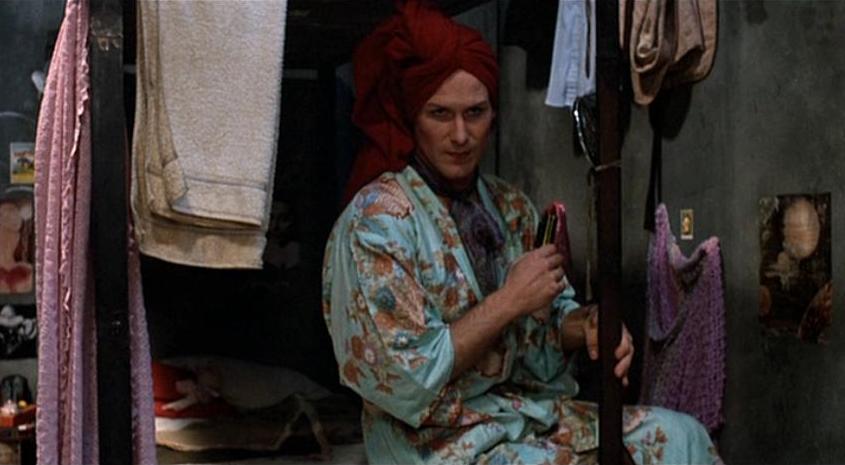 (Brazil/USA, 1985; dir. Hector Babenco; cin. Rodolfo Sanchez; with William Hurt, Raul Julia, Sonia Braga,
José Lewgoy, Milton Gonçalves, Nuno Leal Maia, Fernando Torres, Herson Capri, Denise Dummont)
(Brazil/USA, 1985; dir. Hector Babenco; cin. Rodolfo Sanchez; with William Hurt, Raul Julia, Sonia Braga,
José Lewgoy, Milton Gonçalves, Nuno Leal Maia, Fernando Torres, Herson Capri, Denise Dummont)
IMDb // My Full Review
Do titles get any better than Kiss of the Spider Woman? When I first heard about the movie, reading over the lists
of Oscar nominees in the local TV Guide—it was the last year before I actually watched the telecast—I couldn't imagine
why anyone wouldn't vote for it, or how a movie with that title could be anything but hypnotic, dangerous, creative. When
a poster appeared under a "Coming Soon" placard at the single-screen theater of the U.S. Marine Corps base in Quantico, Virginia,
I marveled at the exotic graphic design, the enticing indigoes and aquas of the central image, the diagonal affectations of the
fonts. When I learned at the beginning of high school, amid the faintest inner whispers about my sexual dispositions, that the
story concerned a gay man and a political radical sharing a prison cell in South America, and that the Spider Woman
was one of several fantastic movieland figures that the window-dresser described as vicarious pleasures for the Marxist, I knew I had to find the
movie. I didn't know what either a window-dresser or a political radical was. Even as I gobbled the movie three or four
times during my five-day rental allotment from Mr. Video in Hanau, Germany, I never quite absorbed Valentin's role or perspective.
Even as I read the superlative novel, and then performed Molina's opening monologue in theater classes and local drama competitions,
my hold on the story was only half-formed, tipped voluptuously in favor of one of its protagonists. Only in college, during
my almost annual returns to this story I thought I knew so well, did I start to comprehend not only that a whole second movie
awaited my discovery, rooted in forms of protest and discrimation that I had only begun to grasp, but that my
early adoration of the film, which hung (I thought) with such sophistication on the shoulders of a young teenager, floated
atop a complex network of projections, evasions, narcissisms, misreadings, and a rather blithe giving over of myself into
the most comfortable aspects of fantasy.
And so Kiss of the Spider Woman, a film in which I had recognized glimmers of myself with such early and total astonishment,
stunned me just as much by calling out my naïvetés and myopias—not from some new or rejected frontier of knowledge, where I was
used to being shocked or upbraided by life, but from an already treasured and intimate object. It's no mystery to me how
Babenco's film sets this sort of trap, at least for a certain kind of viewer. Where the early sequences are lusciously cinephiliac,
with their mocking but affectionate recreations of dubious melodramas, and their willowy transitions from that universe of
screen memory to the clammy, witty, and exciting reality of the jail cell, the later sequences assert their politics more
forthrightly, with the hard lighting, strained faces, and tightened editing of other Latin American political dramas, like
Luis Puenzo's The Official Story or Babenco's own magnificent Pixote. Fans who take Molina's epicurean escapism
at nearly face value, as I did, are likely to feel like the second hour sells them out. The seductions of John Neschling's music
or Patricio Bisso's versatile costuming don't evaporate as the film reaches its grave climax, but they shape-shift in a way
that requires a full immersion in every side of what Babenco, working from Puig's ingenious template, has constructed up to
that point. Almost by definition, the movie divides its sympathetic audience of marginalized liberals, forcing them to recombine
by movie's end in a richer, more expansive spirit of solidarity: quite literally, and purposefully, less fabulous than the
earlier chapters. It's a hugely ambitious journey that the movie takes, with impressive if erratic artistry. Nothing in the
movie, not the acting or the editing or the camerawork or the story structure, is immune to miscalculation here or there, but
Kiss also achieves substantial, flavorful successes in each of these areas. Best of all, because it is subtle and intelligent
in raising questions about storytelling, spectatorship, sympathy, borderzones, clichés, stereotypes, and sexual politics—terrains
where a great many movies start bonking you over the head, or else just flee in all the wrong directions—Kiss of the
Spider Woman consistently surpasses its own flaws, challenges your own sureties, turning them all into productive questions
rather than simple blemishes.
Kiss of the Spider Woman debuted the same year as The Purple Rose of Cairo, just a few rungs down on this list.
Both movies understand and reward the unique devotions and pleasures of the passionate moviegoer, even as they dissect such
devotion with an often uncomfortable accuracy. I learned even more from Kiss, and I feel even closer to it, because
its range of themes and arguments is a little broader, and it humbled me from ever assuming that I've got any movie fully
pinned down, no matter how much I love it or how many times I've seen it. Several of the film's pleasures are "simple": Sonia Braga
is exceptional, Hurt and Julia have terrific moments, the screenplay's twists are truly surprising, and the whole movie looks and sounds
great (especially for its low budget). It's a medicine wrapped in a morality lesson baked into a succulent dessert. When
the damned thing ever finally arrives on DVD, we'll all have cause to celebrate. (Ed., 2008: Eureka!)
#43: The Corporation
 (Canada, 2003; dirs. Mark Achbar and Jennifer Abbott; cin. Mark Achbar, et al.; interview subjects include Jane Akre, Ray Anderson,
Noam Chomsky, Milton Friedman, Sam Gibara, Lucy Hughes, Naomi Klein, Sir Mark Moody-Stewart, Michael Moore, Vandana Shiva, and Howard Zinn.)
(Canada, 2003; dirs. Mark Achbar and Jennifer Abbott; cin. Mark Achbar, et al.; interview subjects include Jane Akre, Ray Anderson,
Noam Chomsky, Milton Friedman, Sam Gibara, Lucy Hughes, Naomi Klein, Sir Mark Moody-Stewart, Michael Moore, Vandana Shiva, and Howard Zinn.)
IMDb // My Page
As delightful and hopeful as it has been to observe the popular renaissance of nonfiction
film within the mainstream market during these last five years, I've been worried by the trends of self-righteously simplified
rhetoric and of over-reliance on arbitrary stock footage (e.g., random bombs while we hear about the Cold War, random Arabs
while we hear about Bush family interests in Saudi Arabia). I keep my fingers crossed that more documentarians will show
the stamina to live alongside and observe their subjects in real time, as in the superb Love & Diane,
instead of building retroactive jigsaws from available archive materials; and that more filmmakers will trust that your subject
doesn't need to be explicitly political in order to yield major intimations about social structures and hierarchies, like
Spellbound did; or, best of all, that historically and
politically premised documentaries will harvest meaty, substantial connections between past and present circumstances, without
always prescribing the responses of their audience.
This kind of haughty, anti-intellectual approach is most thrillingly avoided in the tantalizing and fact-soaked film The Corporation, an emblem of leftist cinema at
its most honest and effective. Indeed, The Corporation
does a magisterial job of raising all sorts of urgent alarms about the traumatic effects of modern capitalism, without
privileging reductive cant over concise, illustrated argumentation, and without preaching only to the pre-converted. The
premise of the film's opening sequences is sublimely simple, but unexpectedly imposing: that is, to define what a corporation
is, exactly—one professor at the Harvard Business School abashedly realizes that nobody has ever quite put this query to
him before—and then to sketch the conceptual contours and legal entitlements that don't just allow but require
corporations to maximize profits without any ethical qualms or qualifications. From here, the movie hurtles into its second
conceit, aligning the hard-wired behaviors of corporations with the basic symptoms of diagnosed psychopaths, and then through
a roulette wheel of eloquent case histories. Many of these, like the extended pièce de résistance about how
FoxNews quashed their own story about America's contaminated milk supply, achieve the expected goal of arraigning white-collar
pirates and amoral dollar-chasers, but the detail and power in the arguments are more supple and lifelike than one usually finds
in films of this type. Plus, the pirates often furnish their own swords on which to fall. Wall Street trader Carlton Brown admits that
he and every other trader he knows spent September 11, 2001, gleefully selling gold to the highest bidders and relishing the
market's good fortune, quite literally. Lucy Hughes, a chirpy vice-president from Initiative Media, tips her hand about how
she abets toy manufacturers and other clients to brainwash children into demanding their products. "Is it ethical? I don't know,"
Lucy admits, but it's the job she has to do, and she does it well. Chris Komisarjevsky, a corporate spin doctor whom some
Orwellian neologist has rechristened a "perception manager," describes his job as though the corporations themselves—rather
than, say, impoverished laborers or lampooned environmentalists or snookered consumers or corraled protesters or, in one especially
vile anecdote, Bolivian citizens who were taxed by Bechtel for the privilege of drinking their own river and rain water—were
the victims of an enormously sentimentalized marginality. "I help corporations have a voice," Komisarjevsky
testifies, "and I help corporations share their point of view about how they feel about things." Though we almost never hear
the interviewers' prompts, it takes a seasoned and careful approach to draw out motivations and rationalizations from such a
broad spectrum of CEOs, activists, traders, historians, professors, consultants, and spies. Furthermore, these accounts always
refine our sense of how capitalism operates, from its skyscraper summits through its middle management to its immiserated
workers: the full canvas of the movie is richer and more important than the local shocks, cheers, or hisses occasioned by any
given detail.
Even more to the filmmakers' credit, they film all of their interview subjects before the same black background, in the same
light, so that we must actually listen and ruminate on our own behalves in order to assess the value of
each person's perspective. If we have trouble discerning whether Sir Mark Moody-Stuart, ex-CEO of Royal Dutch Shell, is an
unexpected voice of reason or a miscreant in heavy denial, or whether Roy Anderson, CEO of Interface Carpet, is an epiphanic convert to
geo-friendly policy or a canny soothsayer bending to the shape of a new market, the film offers no editorialized clues to
sway us one way or the other. Some of the factual assertions are sobering and intractable, and you walk away edified, as
from an especially potent lecture: who among us realized that, in practice, the 15th Amendment to the U.S. Constitution didn't
so much enfranchise former slaves, as per its stated intention, as it enfranchised corporations with newfound permission to
own property, engulf other businesses, perpetuate themselves indefinitely, and assert the same rights as living citizens? Other material in The Corporation
is energizing and practical, like the rising success rates of anti-corporate agricultural crusades in India, and the concatenation of websites
and NGO referrals that conclude the movie. The movie's moral barometer is sensitive, and its funny bone is lively. Sure, some
of the stock footage feels like empty accompaniment to voice-over accounts, but the film's overall graphic conception is
smart and elucidating: one particular motif, resembling a maze or spreadsheet of problematic corporate practices, is a terse,
purposefully overstuffed reminder of how effulgent and multifaceted the problems of corporate capitalism really are. The
Corporation knowingly bites off more than it can chew, but it still chews on more than most films even bite off, and it
is persuasively grounded in our world's complex reality, without drying up into a husk of scholastic finger-wagging. It's
the Lord of the Rings of modern documentaries: epic, vivid, wise, well-paced, expansive. It's the kind of movie that makes
you want to do more with your life.
#44: The Positively True Adventures of the Alleged Texas Cheerleader-Murdering Mom
 (USA, 1993; dir. Michael Ritchie; cin. Gerry Fisher; with Holly Hunter, Beau Bridges, Swoosie Kurtz, Elizabeth Ruscio,
Frankie Ingrassia, Gregg Henry, Eddie Jones, Matt Frewer, Megan Berwick, Andy Richter)
(USA, 1993; dir. Michael Ritchie; cin. Gerry Fisher; with Holly Hunter, Beau Bridges, Swoosie Kurtz, Elizabeth Ruscio,
Frankie Ingrassia, Gregg Henry, Eddie Jones, Matt Frewer, Megan Berwick, Andy Richter)
IMDb // My Full Review
"That's really the title?" someone chuckles underneath the HBO Films opening credit roll at the outset of The Positively True Adventures of the Alleged
Texas Cheerleader-Murdering Mom. Yes, it's really the title, with "Texas" and "Mom" exploded to screen-busting font; the title isn't just long, it's loud.
"That's really on this list?" someone titters at the outset of this entry, and yes, it's really on this list. Is it possible to love a movie as dearly as
I do this one and still always be tempted to switch it off around the halfway point? It's a bit exhausting, and its structual conceits entail a comedown in
tone and energy after its biting and gloriously disreputable first impressions. I do like the whole movie in the abstract, and back when I first saw it
in 1994, I loved the whole thing. I felt thoroughly grateful for the daring, playfulness, and tart intelligence of screenwriter Jane Anderson, who pushes
her script to lampoon the news media and the faux-sincerity of gotcha, Current Affair-type news just as much as it satirizes the tawdry, headscratching
tabloid saga of Wanda Holloway, the mother of two from Channelview, Texas, who commissioned a hit on the life of one of her daughter's rivals for the high-school
cheerleading squad. Or maybe the hit was on the rival's mother. Or maybe Wanda didn't actually commission the murder but bandied the possibility about so
enthusiastically with someone she identified as a trafficker in felonious circles that it sure seemed like she was ordering up a killing. But maybe
this man, who annually writes and annually breaks a new five-year plan to clean up his life and quell his addictions is too unreliable and hypertense a character
for us to accept as a serious witness-denouncer of Wanda, who also happens to be his slickster brother's spendthrifty ex-wife. I don't think anyone quite
had the details nailed down even in 1991 when the story broke, clawing its way toward the mastheads of national newspapers even as Saddam marched into Kuwait
and Bush the elder rallied the troops. Positively True Adventures peeps at a lot of these newspapers, ultimately indistinguishable as mock-ups or
ginuwine artifacts, and it's generally on surer ground with these kinds of nation-scaled jokes at the entire culture's expense than it is with the broader,
ruder, and frankly condescending way it keeps trying to nail its cartoon version of Texan provincialism to the wall. Not that I'm above a snicker at its
plaintive parodies of songs about dogs that get run over by cars, or its imputation that Wanda's choice in congregations is as garishly cynical as a tittering,
secular-liberal, cable-TV audience might have wanted to see it in 1993. (She's a Missionary Baptist, entailing absolute salvation and evacuating the need for
good deeds.) I like all this stuff. I've even got time, usually, for the purposely sludgy, airless fifteen minutes when the movie makes clear just how
inert and gratuitous a courtroom becomes when a case this tacky comes home to roost among witless defense teams, impervious jurors, and caustic court illustrators
who pencil-draw Wanda like she's Sycorax, or a rattlesnake.
Wanda is played by Holly Hunter, and her appointed nemesis, Verna Heath, is shrewdly played by Elizabeth Ruscio as Bála Károlyi in the gymnasium
and Bambi everywhere else. I like that director Michael Ritchie has found a related mix of parental advocacy, steely opportunism, and "who, me?" denials of complicity
in both women, even though Wanda's is in many obvious ways the crazier, more distorted version. Both women know what to do with the media's sudden if
short-lived solicitude: Wanda starts calling the shots around the set for her own interview ("What are those, like, jail bars or sump'm?") and hauling her
stultified daughter Shanna onto the Phil Donahue show; Verna gets a journalist to drive over to Taco Bell to pick up some chow for her whole peckish
brood, because it would just be so sweet if you could do that for us. If I cotton more to Wanda than to Verna, it's probably for the same
reason I had an unreasonable soft spot for the desperate, conscienceless, ring-grabbing vulgarity of Tonya Harding, as against the dainty princess act of
Nancy Kerrigan, who was as bland on the ice as Tonya was excitingly brutish, incongruous, and transfixing, getting her double-axel on to the themes from
Jurassic Park while everyone else went for Carmen or Saint-Saëns. Wanda also makes a better joke at her own expense, that the eventual
TV movie of her life will probably star "Barbara Eden or somebody like 'at," then Verna does when she proposes Susan Lucci for Wanda.
If you've seen the movie, you know that Verna suggests Lucci as a corrective measure to Jane Anderson, playing herself, confessing that she's writing the
film with Holly Hunter in mind. Verna's trailing-off "Nooo..." is a joke on one of our gamest actresses, but especially after seeing the movie, all anyone
can do is scream "YES!" with or without pompoms. I'm sure I didn't fool you when I buried the lead, but Hunter's performance, full of lowbrow gusto but handled
everywhere with Carnegie Mellon discipline and specificity, is an astonishing feat of caricature, not least because she pounces so enthusiastically on the
crudities of the character without ever stumbling into unsympathy, to say nothing of the surprising compassion, sunny and then tremulous, with which she
delivers her last two scenes. The actress and the crew clearly had fun with the cosmetic armature of the big-shouldered blouse, the "sophisticated" frosted
hairdo, the pancakey white makeup, and the thin, ferocious slash of lipstick; sometimes Wanda's mouth looks like a fresh, angry papercut. But Hunter finds
a real character here, no matter how slap-happy she lets herself get with Wanda's uproariously slurred consonants, her weaponlike Super Big Gulp, her hilariously
misplaced nods at what she perceives as decorum (studiously pushing in her dining-room chair before the police haul her off to jail), and the rapid-fire
enunciations of her anger ("Out! OUT! I don't wanna look atchoo right now" takes about one second to pronounce). Hunter's Wanda is plenty confrontational, to the audience
and to the other characters, even though she and Beau Bridges have clearly done careful, mutually generous work to show off her performance without short-shrifting
his. But even as she whips her head repeatedly in one of her signature 180° turns, even as she explains to her sweet but toadish husband that Shanna
"getting cheerleader" is a sure-shot preface to a comfy retirement for the two of them (does she actually think this?), she emits careful Morse-code signals
of Wanda's insecurities and resentments. And to the extent that it's far from a naturalized performance, she lets us see how scared she, Holly, is
of Wanda, but also what a saucy, dangerous, exuberant thrill ride it is to fill these shoes. My favorite moment in this outlandishly talky performance is
the long, glowering, gravestone silence that Wanda adopts when the offscreen interviewer implies some oblique censure of Wanda's upbringing; it's as withering
a glare as any in The Piano, and it's as necessary as it is inevitable to reiterate one's disbelief that Hunter assembled Ada McGrath and Wanda Holloway
within the same calendar year. I am trying not to let this countdown turn into the parade of actressy encomiums that regular readers have every reason to expect,
but when you're as pungent and funny and steely and still somehow as fair as Hunter is in this movie, and you're so eminently quotable besides ("I'll
put her on right now and you can tell her yourself how much you just don't care!"), my heart is already won. The rest of the movie has to work triple-time
just to compete with the delirious, crackling horror show of our first 45 minutes with Wanda, which are the scenes that keep me coming back again and again.
It's Holly's Madeline Kahn performance, cast in iron and fried in butter, with a cackle and a switchblade both within reach at all times. Whatever Clue
or Young Frankenstein or The Big Lebowski is to you, Positively True Adventures is to me.
#45: The Purple Rose of Cairo
 (USA, 1985; dir. Woody Allen; cin. Gordon Willis; with Mia Farrow, Jeff Daniels, Danny Aiello, Stephanie Farrow, Dianne Wiest,
Edward Herrmann, Karen Akers, Zoe Caldwell, Deborah Rush, John Wood, Annie Joe Edwards, Peter McRobbie, Glenne Headly)
(USA, 1985; dir. Woody Allen; cin. Gordon Willis; with Mia Farrow, Jeff Daniels, Danny Aiello, Stephanie Farrow, Dianne Wiest,
Edward Herrmann, Karen Akers, Zoe Caldwell, Deborah Rush, John Wood, Annie Joe Edwards, Peter McRobbie, Glenne Headly)
IMDb
"I've met a wonderful new man. He's fictional, but you can't have everything." So muses Mia Farrow's Cecilia in one of the
most perfect and most perfectly played lines of dialogue Woody Allen ever wrote, a line that is equal parts honey and rue,
just like the movie. Cecilia is a poor waitress, in at least three senses of the word: pitiable, without money, and wincingly
bad at her job, lost as she often is in two kinds of daydreams. Some are about the movies she has recently seen, others about
those soon to arrive in town. Even compared to the down-and-out customers and co-workers who surround her, even
in contrast to her thuggish husband Monk (Danny Aiello), Cecilia's plight is especially dolorous, her happiness particularly
moth-eaten. For some reason, this is how movies always portray inveterate filmgoers—who would haunt a moviehouse except
someone in dire need of consoling distraction?—but The Purple Rose of Cairo infuses real, enormous feeling
into its characterization of Cecilia. She is constantly inspired by the movies to leave her husband and her current life and to
imagine better versions of both. But then she is predictably rebuffed by how difficult it is to transform one's lot so utterly,
and so she comes back. Her world is one of continual cycles, and fairly early in The Purple Rose of Cairo, the misleading
allure of popular fantasy seems almost as cruelly sad as the threadbare upholstery and the dim, dusty-amber lighting in her apartment.
Did I mention, though, that The Purple Rose of Cairo is, at least in large part, a comedy? Alert as it is to the
insuperable remoteness of reel life, it also concocts a dazzling, warm, and utterly joyful emblem for the sheer pleasure of
movies, that inexplicable way in which their silvery flickers promise a space you could happily inhabit, and the
even more outrageous way in which cinephilia (which sounds a little like "Cecilia") starts to feel like a reciprocal adoration. If you love the movies enough, you start to sense or at least to dream that they love you right back. Hence, on her fourth or fifth
trip to a matinée of The Purple Rose of Cairo, cheekily rendered as some mad Hollywood combo of Egyptian adventure,
cabaret revue, and high-society romance, Cecilia is first noticed, then hailed, then magically wooed by the sweet-spirited
movie character Tom Baxter, who literally walks off the screen to join her. The plaintive mood of small-scale tragedy has
been so convincingly set by the preceding half-hour that the sudden jump into comic farce is as unexpected as it is
delightful. The rest of the movie, peppered with delicious dialogue and acted to perfection by the delicate Farrow and a
buoyant Jeff Daniels, follows Cecilia's rapid courtship with Tom, then her run-in with Gil Bellows, the flustered actor who
played Tom (and is also played by Jeff Daniels), and then her agitated decision about which of these figments, the
matinée idol or his lovestruck alter ego, shall usher her over the new horizons of her life. The high spirits of
the movie also encompass a zesty brothel interlude with Dianne Wiest and Glenne Headly; the Pirandellian fracas among the
other Purple Rose characters whom Tom has abandoned; and a climactic montage, diced with expert period details and
hammy innuendoes, in which Tom escorts Cecilia through the Hollywood dreamworld. All of these set-pieces
and plotlines enliven the movie and invigorate the audience, but even they cannot compare to a short scene in a pawnshop,
where Gil Bellows croons standards to Cecilia while she accompanies on ukulele, and the film leaps into the stratosphere
of movie bliss, while somehow maintaining its ambience of poignant modesty at the same time.
The Purple Rose of Cairo doesn't quite end how you expect, though it probably couldn't end any other way. Let's say that in wielding
the masks of comedy and tragedy so deftly within the same film, it obviates any need for future Allen endeavors like Melinda
and Melinda. Beyond the suppleness of the writing and the infectious, perfectly timed energies of the performers, The
Purple Rose of Cairo works because the actual filmmaking emanates nostalgia and exuberance in such equal, doting measure.
Cinematographer Gordon Willis, one of the truly indispensable figures in American movies, reanimates old-Hollywood idioms as
perfectly as he did in Allen's Zelig, but with a sense of fun and depth that the one-joke premise of that earlier film forestalled. For all of these reasons, Purple Rose situates you right in Cecilia's shoes: you recognize the limits
and the artifice of movies, and you hope there is something more in your life to go home to, but nor would you want your life, any life,
without the movies in it. The Purple Rose of Cairo was the first movie we saw in my high-school film studies course,
where it was paired with Hitchcock's Vertigo, an even starker myth about the appeals and the dangers of gorgeous surfaces and
emotional projections. In my mind, Purple Rose is also a natural companion to The Wizard of Oz, even though
a reverse journey from color into black and white marks the threshold of fulfillment in this case, and the adage that "There's no place like
home" echoes with even greater ambivalence. Beyond invoking connections to such undebated masterpieces, The
Purple Rose of Cairo, in its admittedly tinier way, reveals itself with every viewing to be a masterpiece of its own,
a witty and wise amalgam of innocence and experience.
#46: The Hours
 (USA/UK, 2002; dir. Stephen Daldry; cin. Seamus McGarvey; with Meryl Streep, Nicole Kidman, Julianne Moore, Ed Harris, Stephen Dillane,
Jack Rovello, Allison Janney, Jeff Daniels, Claire Danes, Eileen Atkins, Miranda Richardson, Linda Bassett, John C. Reilly, Toni Collette, Margo Martindale)
(USA/UK, 2002; dir. Stephen Daldry; cin. Seamus McGarvey; with Meryl Streep, Nicole Kidman, Julianne Moore, Ed Harris, Stephen Dillane,
Jack Rovello, Allison Janney, Jeff Daniels, Claire Danes, Eileen Atkins, Miranda Richardson, Linda Bassett, John C. Reilly, Toni Collette, Margo Martindale)
IMDb // My Page
The Hours, both Michael Cunningham's novel and Stephen Daldry's film, continue to frustrate and upset me, in ways that
are at this point indistinguishable from fascination. Sometimes that fascination is purer, more awed. At other times, both
the book and the movie emanate a powerful mediocrity, a distinct aroma of cliché, of unmet ambitions. I often furrow my
brow at the relentless lyricism of Cunningham's prose, which, in this book as in others, strives rather arduously for showy,
synesthetic images where more modest narration would happily suffice. He writes as though with each paragraph he hopes to
secure our vote, some badge of our readerly devotion, even though the heady conceptions of his books sometimes trip over all
the stylistic filigrees. And yet, Cunningham broaches subjects and themes that are difficult to articulate, or even to
acknowledge, and he is capable of real astuteness in how he treats them: the ways in which death can feel impolite, just as
caretaking can be officious and desperate; the worrying, thin line between liking someone enormously and loving them merely
adequately, and how a shift from one to the other can be more painful than any dislike or hatred; the ways in which people
look to art, especially books and music and movies, for telepathic prompts for their own life-choices.
The movie version of The Hours shares the arresting ambitions and the psychological acuity of the book, as well as
its prosaic and vaguely elitist excesses. To my mind, in recent popular cinema, American Beauty is the movie's closest
cousin, both of them built atop scripts that can seem courageously lucid and dismayingly glib within single scenes or
transitions, both directed in a glossy, theatrical, actor-friendly style that serves and also sabotages the material by
playing up the artifice. You can hold your ear up to American Beauty or The Hours and hear a worrying howl
from deep within the upper bourgeoisie, demanding and deserving to be taken seriously, but you can also somehow hear the
production teams slapping their own backs about the casts they've hooked, the certainty of prizes, the Big Issues they
broach. However, while the moods and structures of American Beauty, for all of its technical audacity, feel smaller
and more market-tested as the years go by, The Hours totally engrosses me. I keep sitting before it, open-minded,
sometimes open-mouthed. It becomes clearer, for one thing, that the movie has darkened the book considerably. Disapproval
of Richard Brown's esoteric, self-obsessed novel is more general. Vanessa Bell is more unhinged, almost repulsed, by the
ravenous loneliness of her sister Virginia Woolf. Laura Brown already intends suicide as she drops her son with an
indifferent neighbor. Clarissa Vaughan lets slip a major, unwitting insult to her daughter, and instead of nursing a fond,
fumbling reminiscence with Louis Waters on her comfy living room couch, she erupts and nearly dissolves in her cold kitchen,
where the light is the color of frost, the faucets detonate for no reason, and Louis looks on, agitated and annoyed, from
practically a mile away across the countertop. This last scene is my favorite in the movie: its scary unraveling of Meryl
Streep, usually so composed and sometimes to a fault, encapsulates the wholly credible and almost lymphatic unease beneath
the film's mannered language, the roiling score, the sometimes precious match-cuts.
I suppose it's no mystery that such a disciple of modern film actresses as myself would get swept up in this movie. I have
been known to listen to the Kidman-Moore-Streep commentary track on the DVD while I clean or cook. Still, The Hours
collects so many disparate, exciting actors into such a range of parts that it's almost hard to get a bead on the
performances: secondary players like Miranda Richardson and Eileen Atkins grow more interesting over time; my regard for
all three star turns cycles up and down; and character approaches that click well in one scene, or against one particular
co-star, feel subtly wrong in or against another. In some ways, the movie cuts more to the point of Cunningham's novel
than his own prose really can: the whole piece activates such complex, elliptical relationships among notions of acting,
essence, ritual, privilege, performance, gender, art, sex, and death that it somehow deepens the themes to see the bodies,
scrutinize the faces, smell the money, feel the flatness of the screen. A major concern of The Hours is the
ambivalence of love, the working out of conflicted emotions over time, even over generations. Fitting, then, that I keep
wrestling with this book and this movie, frowning at their shortcuts and platitudes, hooking onto their sublime moments,
assigning both texts in course after course, wondering where our attachments to art really come from, how fraught they can
be with disapproval as well as wonder.
#47: Erin Brockovich
 (USA, 2000; dir. Steven Soderbergh; cin. Ed Lachman; with Julia Roberts, Albert Finney, Aaron Eckhart, Peter Coyote,
Marg Helgenberger, Michael Harney, Cherry Jones, Conchata Ferrell, Adilah Barnes, Tracey Walter, Veanne Cox, Wade Williams, Cordelia Richards)
(USA, 2000; dir. Steven Soderbergh; cin. Ed Lachman; with Julia Roberts, Albert Finney, Aaron Eckhart, Peter Coyote,
Marg Helgenberger, Michael Harney, Cherry Jones, Conchata Ferrell, Adilah Barnes, Tracey Walter, Veanne Cox, Wade Williams, Cordelia Richards)
IMDb // My Full Review
In a stunning demonstration of the Newtonian physics of movie stardom, Julia Roberts both loses and acquires her
cool in Erin Brockovich, a movie that struts right past and, when necessary, stomps right over the hoariest clichés
of Liberal Crusader Cinema. Any paean to this film must pay obeisance to Roberts' presence and performance in the title role,
but what's most striking to me about her iconic turn is that "presence" and "performance" describe nearly opposite vectors
of her work. Much more typically, a showcase for a megastar like Roberts aligns who she is (or who we perceive her
to be) with what she does as a performer—and so, to take some easy examples, Garry Marshall practically keys the
lighting in Pretty Woman to her generous, toothy supersmile, and he interpolates that lusty, cackling, blooper take
of Richard Gere snapping the jewelry case on her fingers, such that her spontaneous whoop is indistinguishably Vivian's and
Julia's whoop. Sleeping with the Enemy and The Pelican Brief play up the fragile tremulousness of, respectively,
the newly anointed star who had best not put a foot wrong and the "comeback" queen trying hard to stay in the game while the
shadowy forces of Hollywood PR try to paint her as a waning commodity. Erin Brockovich, though, like My Best Friend's Wedding
and Notting Hill
except better, amplifies our loyalty to this star while palpably,
almost perversely calling attention to her most dubious and off-putting
qualities. After instantly winning us over in the first sequence,
pleading for a job that we're sure she won't get and probably doesn't
want, Julia allows her high-voltage charisma to take care of itself
ever afterward, choosing instead to emphasize how crabby and chirpily
ruthless Erin can be, how pinched she is by her borderline bankruptcy
and by snoopy co-workers. Her line readings are mercilessly good,
especially when she's flaring up with ire or its cousin, self-pity: "I
was Miss Wichita for God's sake... did I tell
you that?" Pacific Gas & Electric arrives into the movie as yet
another thing that annoys Erin, abrading her ever-abraded sense of
fairness—barely any different from the lawyer's office that doesn't
return her calls or the long-haired, engine-revving neighbor who has
the temerity to be attracted to her. Erin is a hero who is also a pill;
the script, limned with zingers and an unbeatably triumphalist
character arc, gets the vinegar treatment from a wonderfully emboldened
Roberts, who finally gets to use that haughty edge which marred some
other performances as a productive tool for tempering and complicating
this one. Steven Soderbergh, savvy to an extreme, captures Erin's
righteous pluck as well as her almost free-floatingly disdainful
attitude, and he captures these and other idiosyncrasies in shots that
remain character-driven and respectful of her roving intelligence, even
when the script starts to crank out the plot logic. Working both with
and against the screenplay, both with and against Roberts' lavishly
adored persona, Erin Brockovich activates an almost molecular field of humming electricity around this newly revealed
actress. When Walter Benjamin wrote about "aura," Julia Roberts as Erin Brockovich is what he had in mind.
And yet, it's as misleading as it is nearly unavoidable to consider Erin Brockovich a star vehicle, because Soderbergh's
eye and his guiding hand are just as attentive, as creative, and as revelatory with regard to everything and everyone else in
the film. Even the title is misleading: Erin Brockovich
sounds like the story of one imposing woman, who, incidentally, could
hardly have chosen a better name for herself: soothingly vowelly at the
outset, and then, without a moment's notice, armored and aggressive
with hard, intimidating consonants. But where, in that deceptively
monolithic title, could we possibly sense the perfection with which the
movie nails the entire Hinkly community, the weirdly telegraphed malice
of overstuffed manila files, the dead air of an office where co-workers
stolidly tolerate each other, and where new arrivals hang their dreams
of individuality on the prospect of choosing their own code for the
Xerox machine? How can we know that Albert Finney's Ed Masry will
emerge just as roundedly and memorably as Julia's Erin, or that just
when Erin is getting pretty easy to take at face value, Cherry Jones
will pop up to slam a door in her face with ample justification, or
Aaron Eckhart will withstand another caustic, patently defensive, and
narcissistic put-down from this ersatz champion of the little people?
"What about you, George?" Erin huffs, as though it simply hasn't occurred to her that other people need her, and that more than that, they need
the parts of themselves that she has colonized along her admittedly valiant warpath toward social justice. Erin Brockovich
isn't just about a woman who bucked the system but about the way that
even a fully warranted outrage, hers or ours, often spills over into
careless, omnivorous contempt. Like My Best Friend's Wedding, it doesn't quite end as you'd expect, but it's enormously
freeing to the actress, the film, and even the entire genre that new gradations of "resolution," new compromises in tone
and perspective, are finally permitted.
Like many critics, I trumpeted Traffic a little more loudly than I did Erin
Brockovich when they so famously debuted in 2000. It isn't so much that Traffic has aged poorly as that I haven't
had a single impulse to watch it again; my memory is of having a stout admiration for Soderbergh's ambitions, his seriousness,
and his organizing skills, but of trying to muscle that admiration into an actual enthusiasm, which deflated before I could
even write a proper review. (Truly, this was back when I really wrote reviews.) Erin Brockovich,
meanwhile, remains one of the decade's sturdiest and most perennially
rewarding entertainments: edited like a dream, paced like a racehorse
with nothing to prove, accented with smart shifts in makeup and costume
that far exceed the tarty first impressions, and lit with real acuity.
Those zingers still zing. In several scenes where Erin gets what she
wants with a flashy grin and a folksy demeanor—at the Water Board, in
the Jensens' home—the film delivers much funnier and richer riffs on
how Julia fabricates and manipulates her Julia-ness than Ocean's
Twelve ever quite manages. Erin Brockovich gets me cheering for Erin every time, but also empathizing with the
people wriggling under her stiletto pumps or cowering from her fury
behind their tackboard cubicles. It also gets me thinking about why I
am reacting this way, and about the value and the costs of Erin's
fierceness, and why we're all so pissed off these days (enough so for
Erin Brockovich to become a national folk hero), and about the good,
the bad, and the ugly sides of being so constantly pissed. The movie,
itself a little pissed, betrays its own lapses in tone and judgment,
but you forgive them because like everything else in the film, they are
interesting, entertaining, precautionary, and true.
#48: Husbands and Wives
and Another Woman
 H&W (USA, 1992; dir. Woody Allen; cin. Carlo Di Palma; with Mia Farrow, Woody Allen, Judy Davis, Sydney Pollack, Juliette Lewis,
Liam Neeson, Lysette Anthony, Ron Rifkin)
H&W (USA, 1992; dir. Woody Allen; cin. Carlo Di Palma; with Mia Farrow, Woody Allen, Judy Davis, Sydney Pollack, Juliette Lewis,
Liam Neeson, Lysette Anthony, Ron Rifkin)
IMDb
AW (USA, 1988; dir. Woody Allen; cin. Sven Nykvist; with Gena Rowlands, Mia Farrow, Ian Holm, Gene Hackman, Blythe Dannner,
Harris Yulin, Betty Buckley, Sandy Dennis, Martha Plimpton, Bruce Jay Friedman, Frances Conroy, David Ogden Stiers, John Houseman, Philip Bosco)
IMDb // My Full Review
I know that we are all totally over the idea that DVD jacket copy has anything to do with the film being presented, but still, some people just need to be
fired. "A directorial tour-de-force, Husbands and Wives is a comic valentine from an American master," the packaging proclaims, and all I can hope
is that no one ever sends me a valentine like this. The kind that emits a low ticking sound and turns your fingertips black when you touch it. I have
a friend whose first date with her now-husband was to see Husbands and Wives, which is a little bit like birthing your first child in the
middle of an orphanage. It's amazing what people survive. Amazing, too, what they don't, and how ruthless some of them are in dissecting the frayed
ends of ruined love, and how willing we are to experience an artwork as bitter as Husbands and Wives in order to admire its
toughness and absorb its lacerating perceptions.
One of the funniest and saddest fragments in Eula Biss' very funny and very sad experimental memoir The Balloonists
resonates powerfully with this film, and with other Woody Allen dramas, like the more quietly harrowing Another Woman. I'm thinking of the page
where the author remembers how she grew up thinking that everyone loved their work, which was why they chose it; that barbers must harbor a
passion for hair; that they've studied its physics and its biochemistry; that they have bonded so heartily with hair that they know just how it will fall,
how the shape of the head will change with each snip. And then she meets a barber who admits he stumbled quite by happenstance into this gig, and is
wondering laconically about turning the place into a burger joint. He's not even sure how he got into scissoring in the first place. The author senses a
rhyme with some of her recent broods about relationships: "It's possible, I suppose, that all those married couples are just people, not especially interested
in intimacy, who somehow ended up married." Surely that is what's happened to Judy Davis' Sally and Sydney Pollack's Jack, who make strained, falsely casual
theater of announcing their separation to their best friends, Mia Farrow's Judy and Woody Allen's Gabe. And surely that's what's happened to Judy and Gabe,
too, which is why she cannot even handle her own anger about her friends' disclosure, and why both of them seize on this dawning specter of illicit behavior
as a prompt to test the waters of their own non-wedlocked desires, and to needle each other into being the first to confess their ashy unhappiness—even if this means
being arsonists of their own relationship, so that their allegations of unhappiness will ring true. Farrow, looking drawn and under-proteined, like she's
been birthing Rosemary's babies for twenty years, soldiers around the movie in rectangular sweaters and rough, enormous hunting jackets, like she's literally
out for a kill, though she's also (and this is kind, to a point) the only one of the four protagonists who asks any real questions of anyone else.
Allen's Gabe is narcissistically interested in self-knowledge but in no other forms, and Sally and Jack sprint away from all forms of knowledge, leaving
Carlo Di Palma's jogging, winded camera to follow their neurotic, wobbly stomps across their lawns and their whips around corners and into waiting taxi-cabs
and their wrestling matches with idiot lovers whose reflex response to the withdrawal of love is to scream bloody murder in the middle of a driveway.
The movie isn't without humor, as when Sally can't help taking acrid exception to everything anyone says or does or likes: "I usually hate Mahler, but
that was good," she rasps unpersuasively, or "I'm only yawning because I'm hyper-oxygenating," or my personal favorite, when trying to elude an unwanted kiss,
"Metabolically, it's not my rhythm." Judy writes off a former husband succinctly as "the
kind of guy who gives you an appliance for your birthday," and Gabe coos about the brilliant short story that precocious, self-serious student Rain (Juliette
Lewis) has written for his creative writing class, entitled "Oral Sex in the Age of Deconstruction." But Husbands and Wives is a bloody affair. Everyone's
got little pieces of everyone else under their fingernails, and the feeding frenzy gets so intense that some of the actors go after their own characters with
the same pitiless, voracious zeal that these same characters bring to their howling spats with each other. Pollack is as unforgiving of his character's late-middle age
hedonism as Farrow is of Judy's passive-aggressive manipulations, and though everyone is constantly screaming "Bullshit!" at everyone else, I can't tell how
often the line is actually scripted. The film would be a deeply unpleasant affair, even minus the overbearing echoes of the Allen-Farrow nuclear winter that was playing
out just as the film was released, if the candor of the movie weren't so bracing with regard to the seldom-filmed realities of lover's quarrels. "We've
had this conversation before," Farrow says dismissively, and anyone who's ever been in a longterm relationship knows that this apparent forestalling of argument
is actually stage one in its scaly unfurling. The seething physicality of verbal spats, the intermissions for huge mugs of tea or nostalgic reminiscence, which never
actually mean that the storm has passed. The sharp annoynace of hearing your best friends celebrate their rescued relationship, when you've just finished turning
them into convenient alibis for torpedoing your own happiness. I haven't experienced all of this, and I hope vehemently not to, but Husbands and Wives is a credible,
compulsively rewatchable tale about love turned into warfare because it places its fingers so persuasively on the pulse of the grudges, flare-ups, and disavowals that are
ineradicable elements of intimacy, sometimes capable of eating the other elements alive.
 Another Woman is in some ways a dry-run for Husbands and Wives, with Mia Farrow's lachrymose cries of anguish and marital alienation, and the
reversal structure of one broken couple who reunite and one "happy" couple that falls apart. The mood of the movie isn't quite as ambitious, since it rarely
attempts anything on the order of a joke, much less the kind of fanged comedy of the later film. Another Woman self-consciously mimics the introspective
pall of a Bergman rather than the savage, neurotic vituperation that makes Husbands and Wives one of Woody's most boldly committed films; he's even
got Bergman's cinematographer Sven Nykvist filming totally incongruous shots of the protagonist's dead mother, as a gratuitous chance to crib the sun-dappled,
pastoral melancholy of the exterior shots in Cries and Whispers. Much more often, though, Another Woman stays indoors, among tight hallways
and cold, Chantal Akerman-ish symmetries, and the narrow color palette (browns, purplish browns, and salmon-shaded browns) mirrors the carefully regulated
emotional range of Gena Rowlands' psychologically besieged philosophy professor. I've written at length about my admiration for Another
Woman, in its attention to character and its consummate playing, but what impresses me anew about the movie is its tugging away at real/imaginary boundaries,
not just in the explicitly theatrical scenes, but in the patent dramatic devices of talk channeled through heating vents, muffled by pillows that conveniently
slip of their own accord, plus verbatim repetitions of dialogue, and the indivisible blending in the final sequence of literary fiction, private memory, and
redacted fantasy, scored to the dreamy abstractions of Satie's "Gymnopédie 3." Subtle, revealing slips abound: why, for example, does Rowlands' Marion insist she was never once alone with her best friend's lover, and
then offer the contradictory rationalization that she once told him that so long as he was dating the friend, a relationship was out of the question? If I knew
my Nordic dramatists better, I'd know if the atmosphere of Another Woman is as Strindbergian as I'm tempted to call it, but I at least feel confident
applauding Woody for making a subjectively delimited film about one woman's autumnal regrets and her restive mind that's as memorable and involving as his blistering,
seasick-bystander portrait of four or five collapsing, dead-ended, or shakily reconstructed relationships in Husbands and Wives. He doesn't think of
almost anything nice to say in either movie, but thank goodness (at least at that point in his career) that he didn't let that stop him from saying anything at all.
Another Woman is in some ways a dry-run for Husbands and Wives, with Mia Farrow's lachrymose cries of anguish and marital alienation, and the
reversal structure of one broken couple who reunite and one "happy" couple that falls apart. The mood of the movie isn't quite as ambitious, since it rarely
attempts anything on the order of a joke, much less the kind of fanged comedy of the later film. Another Woman self-consciously mimics the introspective
pall of a Bergman rather than the savage, neurotic vituperation that makes Husbands and Wives one of Woody's most boldly committed films; he's even
got Bergman's cinematographer Sven Nykvist filming totally incongruous shots of the protagonist's dead mother, as a gratuitous chance to crib the sun-dappled,
pastoral melancholy of the exterior shots in Cries and Whispers. Much more often, though, Another Woman stays indoors, among tight hallways
and cold, Chantal Akerman-ish symmetries, and the narrow color palette (browns, purplish browns, and salmon-shaded browns) mirrors the carefully regulated
emotional range of Gena Rowlands' psychologically besieged philosophy professor. I've written at length about my admiration for Another
Woman, in its attention to character and its consummate playing, but what impresses me anew about the movie is its tugging away at real/imaginary boundaries,
not just in the explicitly theatrical scenes, but in the patent dramatic devices of talk channeled through heating vents, muffled by pillows that conveniently
slip of their own accord, plus verbatim repetitions of dialogue, and the indivisible blending in the final sequence of literary fiction, private memory, and
redacted fantasy, scored to the dreamy abstractions of Satie's "Gymnopédie 3." Subtle, revealing slips abound: why, for example, does Rowlands' Marion insist she was never once alone with her best friend's lover, and
then offer the contradictory rationalization that she once told him that so long as he was dating the friend, a relationship was out of the question? If I knew
my Nordic dramatists better, I'd know if the atmosphere of Another Woman is as Strindbergian as I'm tempted to call it, but I at least feel confident
applauding Woody for making a subjectively delimited film about one woman's autumnal regrets and her restive mind that's as memorable and involving as his blistering,
seasick-bystander portrait of four or five collapsing, dead-ended, or shakily reconstructed relationships in Husbands and Wives. He doesn't think of
almost anything nice to say in either movie, but thank goodness (at least at that point in his career) that he didn't let that stop him from saying anything at all.
#49: The Cremaster Cycle
 (USA, 1995-2002; dir. Matthew Barney; cin. Peter Strietmann; with Matthew Barney, Marti Domination, Anne Bannert, Juliette Vassilkio,
Norman Mailer, Patty Griffin, Michael Thompson, Aimee Mullins, Richard Serra, Paul Brady, Sharon Marvel, Colette Guimond, Christa Bauch, Ursula Andress,
Joanne Rha, Susan Rha)
(USA, 1995-2002; dir. Matthew Barney; cin. Peter Strietmann; with Matthew Barney, Marti Domination, Anne Bannert, Juliette Vassilkio,
Norman Mailer, Patty Griffin, Michael Thompson, Aimee Mullins, Richard Serra, Paul Brady, Sharon Marvel, Colette Guimond, Christa Bauch, Ursula Andress,
Joanne Rha, Susan Rha)
IMDb for Cremaster 2, my favorite installment
Matthew Barney's five-part Cremaster Cycle
hurricaned its way into Ithaca, NY, in the spring of 2004, powered by a
tremendous reputation that was nonetheless, at least to my hinterland
ears, vague in its details. With apologies to all the visual artists
and museum devotees who probably roll their eyes at Cremaster fans like me—the same way I am nonplussed when, say, people
learn of Toni Morrison when she pops up on Oprah—I
had heard that the films were not made in the sequence implied by their
titles, that they were collectively named for the tiny muscle that
raises and lowers the testicles in moments of arousal, and that they
aggregated all manner of sculptural, digital, narrative, mythological,
and material experiments into a behemoth visual undertaking that anyone
curious about the future of movies should take some pains to see. And
so I saw. And as opposed to the letdowns I have experienced in the face
of other curator-approved, "post-cinema" movies (for example, Bill
Morrison's Decasia, a series of arresting ideas and images that persist at least three times too long), the Cremaster movies
were truly electrifying: baffling but terrifically engaging in their more arcane motifs, and persuasive as the kind of tout court
double-dare to filmmakers and audiences everywhere that avant-garde classics like Un chien andalou or Meshes of
the Afternoon or Dog Star Man or Empire must have been in their own days.
While an oft-promised DVD collection from Palm Pictures remains a dream perpetually deferred, I have only my two-year-old
recollections of Barney's formidable imagery and curiously interwoven "plots" to write from. Of course, the whole reason
why the Cremaster Cycle ranks so high on this list is that Barney's outlandish
mise-en-scène, forever emphasizing the organic, the amorphous, the
massive, the adhesive, and the fluorescent in quite literal ways, also
retains those very qualities in my memory. I saw the movies in
superficially "numeric" order (i.e., 1 and 2 on one night, 3 the next, and 4 and
5 after that), but even following that schema, you implicitly sense that 4 and 1,
the first films produced, supply the erstwhile Rosetta Stones to what
more fully follows. These, the shortest installments, condition the
viewer into the remarkable plasticity of Barney's visions, his outré
cosmetic mutations of his own body, his recurring propensity for
gonadal tropes and visual puns, and his fusion of mass-cultural
signifiers like zeppelins, stadiums, land-speed races, and flight
attendants with his carefully considered though highly subjective
apprehensions of specific occult histories: drawn from the Isle of Man
in Cremaster 4, but also from Hungary, Utah, and New York City in subsequent iterations. Both within each movie and across
the whole series, Barney expectorates a kind of gestalt system that no one can comfortably articulate—not even he, I suspect,
based on the "synopses" at the entrancing but opaque Cremaster website.
What is remarkable about the project, then, are its eerily
instantaneous claims on your sensory life and your sense-making
apparatus. Fashioning febrile touchstones out of the illusionist Harry
Houdini, the murderer Gary Gilmore, the architectural peculiarities of
the Chrysler Building and the Guggenheim Museum, the mating rituals of
bees, the salt flats of the Western U.S., the emerald archipelagos of
the Irish Sea, the Lánchíd Bridge of Budapest, and a full MGM cast of
satyrs, nereids, headbangers, and anthropomorphic hybrids, the Cremaster films summon a force of subconscious
recognition that is perversely hard to account for in anything we see
or hear. The linchpin materials—smelted Vaseline, Victorian couture,
body paints and plasters, shimmering silks and satins, rolling grapes,
twittering birds, Art Deco surfaces just waiting to be scuffed, a
lattice-work of seminal and fallopian passageways—all express the
pliability, viscosity, impermanence, and unresolved becoming of all
things. Thus, the potent emotional resonance of the Cremaster Cycle is due as much as anything to these media of
expression, their constant flights and drops, their splittings and
mergings, their plyings and smashings, and, perhaps most of all, to the
melancholy flattening of every gummy resin and lofty spire and shaggy
wig and crenulated frieze into remote, two-dimensional flickers.
Every Cremaster fan harbors a favorite installment, and mine is certainly the second. Even though I lack much of a compass
for navigating Houdiniana, Mormon lore, or the strange career of Gary Gilmore, Barney's figurations of Gilmore's murderous
loneliness—as a mucous membrane encasing his car at a gas station, as a penis shrunk to paper-clip size, as a plaintive
rodeo in desolate surroundings—evoke a blend of pathology and extraordinary pity on a par with Patty Jenkins' Monster,
despite how fully Barney challenges every extant recipe for
transmitting moral and psychological concepts on film. I also love the
sad, grand riffs on the generic staples of the Western, and as a
hard-and-fast Cronenberg disciple, I take a simpler, half-disgusted
interest in the colloidal jellies and creepy supernaturalism of the
opening "conception" scene. When I first composed this list, I meant
for Cremaster 2 to occupy its own spot, but then—partly by noticing that
I had misidentified a still from Cremaster 3 in the banner image for this feature—I realized how much my investments
in every Cremaster segment seep and pour into the others. Having therefore proven inept at compartmentalizing my memories
of these movies, I am now opting for the more cowardly but also more truthful position of commemorating them all in their
uncanny wholeness: a totality far greater than the sum of its prodigious, elliptical parts.
#50: Illusions
 (USA, 1982; dir. Julie Dash; cin. Ahmed El Maanouni; with Lonette McKee, Rosanne Katon, Ned Bellamy, Jack Radar, Rita Crafts,
Sandy Brooke, Lisa Phelps, Laddy Ashley)
(USA, 1982; dir. Julie Dash; cin. Ahmed El Maanouni; with Lonette McKee, Rosanne Katon, Ned Bellamy, Jack Radar, Rita Crafts,
Sandy Brooke, Lisa Phelps, Laddy Ashley)
IMDb
If Boyz N the Hood represents a high-water mark but also a truncated possibility within
the black commercial cinema, Julie Dash's Illusions survives as a gleaming nugget of invaluable, underexplored, unfairly marginalized
potential within the glorious black art cinema of this country. And of the feminist cinema, too, and the formalist cinema, and the cinema of
counter-history, and the American cinema writ large, and all of the other cinemas that Illusions embodies, upbraids, and smartly reconfigures. Dash
would eventually achieve greater notoriety as the director of Daughters of the Dust, a shimmering and polyvocal fable
about the non-asssimilated Geechee cultures off the Carolina coast, and a complex and idiosyncratic miracle of markedly
independent, culturally embedded filmmaking. A major foundation of Daughters' enduring mystique, not to mention a
doleful fact about American movie culture, is that no feature film directed by an African-American woman had ever circulated
in stateside commercial release until Daughters finally bowed in select American cities in 1992—a full year after
causing a stir and winning an award at the 1991 Sundance Film Festival. Even without its consequent status as a cultural
benchmark, the syncretic and oracular view of history in Daughters, simultaneously anthropological and mythological,
as well as the detailed mise-en-scène and the ravishing manipulations of light and montage are the cornerstones of the
film's success.
Illusions, though it lacks any trace of Daughters' dazzling visual palette, and though it concentrates on a
smaller cast of characters, clearly prefigures the pliable and critical perspectives on history that would characterize the director's
justly famous feature. Indeed, part of what makes Illusions so cogent and transfixing, despite an uneven sound mix and the
other technical vicissitudes of a film-school project, is that its deceptively straightforward scenario is so rife with contradictions
and diverse implications that, even as a half-hour film about a handful of people, it reverberates in so many directions and emits such
powerful, lingering questions. Illusions's central figure is Mignon Duprée (Lonette McKee), a mid-level producer and project
supervisor on a fictional Hollywood lot called National Studios in 1942. Few if any women of that time would have occupied
a position like Mignon's, but her intelligence, diplomacy, and stern persistence quickly impress, and the wartime context
furnishes its own alibi for Mignon's unlikely post. We see rows and rows of female telephone operators and office workers at National
Studios, many of them charmed by the military officers who are "advising" the studio's output, though not all of them are charmed.
Mignon certainly isn't. The present day's task requires her to oversee the re-looping of a musical whose soundtrack was poorly synchronized,
and whose female lead isn't much of
a singer anyway. Mignon, brusquely managing the technicians in the soundbooth, is calmed and then engrossed and ultimately a bit unnerved
by Ester Jeeter (Rosanne Katon), the young, gregarious, and unsophisticated session singer whom the studio has hired to salvage the number.
Ester sings beautifully, utterly unconcerned with the political frissons surrounding her recruitment as an invisible black
vocalist to redeem an all-white film. Meanwhile, Mignon's behavior grows erratic and her comportment unsettled in response
to Ester's singing, leading to the revelation that Mignon herself is passing as white in her professional life. Her
intuitive connection to Ester and their logical alliance as African-American women within the ideological hierarchies of America's dream factory are
nonetheless dangerous to Mignon's own security, not just in her job but in her very skin.
Illusions proceeds through some deft and subtle sleights of hand, building toward an emotional climax that may or
may not qualify as "empowering," and demonstrating considerable resolve in leaving so many of its key questions unanswered.
What is the nature or future of Mignon's acquaintance with Ester? How long has Mignon been working at National Studios,
and how long will she remain there? Has she actively dissembled about her racial identity or has she simply (if "simply"
is the right word) allowed her colleagues to naturalize or ignore the signs of her own otherness? These are all examples
of the narrative riddles that Illusions elects not to resolve, but even more fascinating to me is the complexity,
if not the inscrutability, of the film's politics. Is Mignon's labor, even her very presence in the flowchart of power at
National Studios, a progressive achievement in itself, or must she use her position on someone else's behalf—and how or
for whom is she to do this? What to make of the fact that the film's discourses on gender and race grow both richer and
narrower as it continues, and Mignon's personal traits and circumstances subsume our earlier perspectives on other women,
other races, other battlegrounds, literal and political? What to make of Dash's technical gamesmanship, using a vocal
track of Ella Fitzgerald to dub Rosanne Katon in the role of Ester, such that the "real" singer isn't "really" singing, and
thus refusing a clichéd linkage of blackness to authenticity? Illusions has been considered and critiqued from
a multitude of positions in the decades since Dash made it, but rarely among more than academic audiences, and seldom with
a full account of the movie's countless and enigmatic significations. Like Cheryl Dunye's The Watermelon Woman,
another monument within black women's moviemaking, Illusions powerfully resists the occlusion of black women within documented
history and within Hollywood scenography, not by excavating a true-life tale of improbable heroism but by fabulating a scenario
that never exactly happened, tugging at our gullibility while nonetheless stating a persuasive case for the necessity of invented
archives, new origin myths, nuanced politics, and historical revisionism. Illusions might speak most powerfully to
and from the standpoints of black women's experience, but in one way or another, as we make our way through this nifty hall
of mirrors, we're all liable to catch some wisp of our own reflections.