#31: Ghost Dog: The Way of the Samurai
 (USA, 1999; dir. and scr. Jim Jarmusch; cin. Robby Müller; with Forest Whitaker, John Tormey, Cliff Gorman, Tricia Vessey, Camille
Winbush, Isaach de Bankolé, Richard Portnow, Henry Silva, Gene Ruffini)
(USA, 1999; dir. and scr. Jim Jarmusch; cin. Robby Müller; with Forest Whitaker, John Tormey, Cliff Gorman, Tricia Vessey, Camille
Winbush, Isaach de Bankolé, Richard Portnow, Henry Silva, Gene Ruffini)
IMDb // My Full Review // Leave a Comment
What is the question to which Ghost Dog is the answer? What is the question even about? Urban eccentricity? Hip-hop syncretism? Existential isolation?
Samurai mythology? Traumatic compensation? Rationalized homicide? Mafia-genre absurdism? The ordeals of communication? Does the question arrive with a
cocked grin, or with the knotted brow of really wanting to know something? Is this joint for real?
Okay, that last one I can answer. Ghost Dog: The Way of the Samurai is definitely for real, gliding with the smoothness of real craft and coordination,
circling with the tranquility of an airborne dove around the mystery of its title character. Sure, the movie's tongue is planted in its cheek, but how far, and about what?
Writer-director Jim Jarmusch floats the joke of his main character's wild improbability alongside the parallel joke that Ghost Dog's acquaintances cannot quite
accept him as a premise, much less as a person. This refusal that speaks more to the buffoonish narrow-mindedness of several Ghost Dog characters. Meanwhile, the movie stokes but also calms our merry incredulity at the figure Jarmusch
has concocted and at his breezy, opaque plan for where he's taking this figment. The atmosphere isn't simply or straightforwardly comic, and in fact veers quite far from that territory, even if the whole project feels like it's build atop a cryptic joke. Jarmusch
limns all of this close-to-the-hoodie humor with Ghost Dog's nearly ecclesiastical sobriety, his whispery devotion to an idiosyncratic but gravely intoned creed.
Filtered through all of this irony and earnestness is a steady recurrence of close-range violence that makes you recoil from its candor and quickness,
even though the violence is virtually never bloody—all silencers and single-shot kills, with bullet holes that look more like punctuation marks than furious
flesh wounds. The violence is also quite funny much of the time, and it frequently justifies the overused adjective "balletic."
When you total all this up, Ghost Dog conjures at least thirteen
ways of looking at a black man. Although the movie doesn't engage race as a theme in any particularly overt way, its agile stylistics, polychromatic perspective, and strange, supple characterization are even more gratifying because American movies have failed so dismally to be imaginative or curious with regard to black characters.
We've met a lot of homeless African-Americans in movies, but rarely has a character's homelessness been packaged as a linchpin of mystical asceticism, volitional
to at least some degree, especially
given that Ghost Dog has frequent and ready access to top-drawer technology and to lucrative labor, however felonious. Black criminals have almost never been
sympathetic in American movies, nor have they been rendered as sensitive, meditative, sui generis, indebted at different moments to Mifune, De Niro,
and Belmondo.
One of the film's odd and lovely rapports arises between Ghost Dog and the young, precocious schoolgirl played by Camille Winbush, who reveals
that she's carrying around four books in her lunchbox: The Wind in the Willows, The Souls of Black Folk, Night Nurse (she likes the
cover), and Frankenstein. It's no stretch ascribing the same cheeky eclecticism to the film itself, manifested in the ways it reads, listens,
moves, and thinks. Certainly Forest Whitaker's performance is a quiet wonder of amalgamation, his physique top-heavy but astonishingly limber; his rooftop
practice-session with his saber is a thing of Astairean beauty. Whitaker's whole mien is contemplative to the point of total Zen serenity, yet Ghost Dog manages to leap when necessary right into a headspace of
spontaneous, murderous marksmanship. Without breaking a sweat or flinching at the outcome, he plots out the methodical steps of a particularly wicked hit involving a basement break-in and a
drainpipe. Still, he'd just as soon use his gun-sights to get a better, closer angle on the mad industry of a woodpecker in the wild. If Ghost Dog is at some literal level
a profoundly disturbed character, as is suggested by some sepia-toned flashbacks to his origin myth as a Mafia hitman, he is at the same time fascinated with
ethics, beholden to beauty, admired around the 'hood if only partially understood, and capable of reacting reflectively to surprises, whether or not he is
holding an automatic pistol at the time.
The film, with comparable stoicism and self-assurance, demonstrates how wide-ranging and flexible it is without blustering or back-patting about how many
formal languages it's able to speak. Few recent movies have worked so many wonders with the dissolve, whether to condense a clever bit of plot-business
about a license-plate switcheroo or to briefly resuscitate a dead character or to instill the percussive, majestic soul of hip-hop-jazz into the abstracted
flight of an urban pigeon. The superimpositions and cross-fades approach an enticing, Pillow Book-ish
aestheticism without violating the overall milieus of urban poetry and street-level conflict. A simple cut or fade can transport the
viewer from the jocular comedy of Ghost Dog and his French-speaking buddy watching a man build an ark on top of his apartment building to the mute, angry
despair of Ghost Dog returning to his pigeon hutch and finding his birds all destroyed. RZA's score, one of many musical watersheds that the
Academy passed over in Ghost Dog's eligibility year (see also Bamboozled and Dancer in the Dark), serves as the foundation for several new tracks in the low-key, groove-driven song score. Even so, the music is just
as beautiful and hypnotic without lyrical embellishment, and it engages in zesty counterpoint with the other interpolated tracks of hip-hop and Afro-Caribbean
pop. The camera assumes all sorts of surprising, gratifyingly weird angles, as when it peers through a six-inch strip of clear masking tape that Ghost Dog
affixes to a sliding-glass door, to keep it from shattering when he fires a bullet through it, or when it creeps toward his rooftop aviary-cum-temple-cum-haven
with a Steadicam mixture of curiosity and unease, evocative of David Lynch.
Beyond these flavorful moments and movements, the photography of Robby
Müller spins remarkable variations of beauty, menace, and comic-book exagerration out of its controlled palette of blacks, blues, and whites, with the
occasional smear of strawberry red or the odd swath of military green. The whole film is a master-class in nimble creativity both challenged and enlivened by
its enigmatic subject and by Jarmusch's commitment to presenting him in such a tricksterish panoply of tones. I recognize that The Godfather or
Goodfellas is most people's favorite mob-war movie. By a similar token, most people's favorite samurai movie hails from Japan, without a single crucial scene at an
ice-cream truck and without audio contributions from the Wu-Tang Clan or the Sunz of Man. With all due respect to those films, I do relish a curveball.
Ghost Dog is the sort of film most people wouldn't expect to work at all, but it's a marvel of grace and engineering, and however you want to cut it,
the thing's got soul.
#32: Birth
 (USA, 2004; dir. Jonathan Glazer; cin. Harris Savides; with
Nicole Kidman, Cameron Bright, Danny Huston, Anne Heche, Lauren Bacall, Peter Stormare,
Arliss Howard, Alison Elliot, Ted Levine, Cara Seymour)
(USA, 2004; dir. Jonathan Glazer; cin. Harris Savides; with
Nicole Kidman, Cameron Bright, Danny Huston, Anne Heche, Lauren Bacall, Peter Stormare,
Arliss Howard, Alison Elliot, Ted Levine, Cara Seymour)
IMDb // My Page // Leave a Comment
A breathless, typical, and totally verbatim excerpt of a recent conversation I had with Nathaniel
when he was my houseguest for a weekend: "Let's stay in, make some food, and watch movies where women lie to themselves!"
Were Blockbuster or Hollywood Video ever under our jurisdiction, to say nothing of Hollywood itself, this is the kind of
genre that would get major play. Maybe even the most play. Those under-employed actresses over 40 you keep hearing about?
No more worries. Safes and Vera Drakes and Under the Sands and Autumn Sonatas for everyone!
At the time of this writing, Nicole Kidman isn't even 40 yet but she has already offered a peculiarly fascinating entry in this delicious tradition.
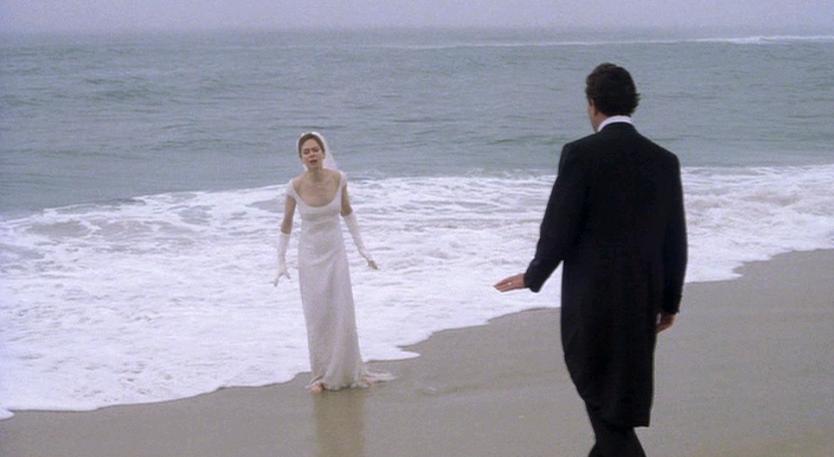
One of many astonishing passages in Birth, preceding a coda as fragile and clear as a bell jar, involves her pleading
monologue to a spurned lover, a thrumming fugue of stuttering self-delusion of a breed seldom heard since Safe's
Carol White soliloquized about diseases and reading labels and going into buildings. Still, Kidman's Anna Morgan is a mess
well before this. When we meet her, she is standing at the graveside of a husband already dead ten years, her breath
visible as she stands shivering in a minidress, winter coat, and heavy boots. With her short, Rosemary's Baby
haircut, Jonathan Glazer's procession of intimate close-ups, and Harris Savides' mother-of-pearl cinematography, there is no
visual or cosmetic barrier between us and Kidman's tremulousness. Where so many of the actress' recent roles have
disclosed her surprising steeliness—as Virginia Woolf, as Isabel Archer, as the mother in The Others and the
sometime martyr in Dogville—Birth draws near
to her cool lladro skin, her darting eyes, her trademark tic of blowing air through her nose in smiling agitation. Even as
Anna makes heavy choices and adopts iron stances, daring to believe that a spooky 10-year-old interloper is the
reincarnation of her immortal beloved, the probing camerawork won't corroborate her resolve. In an ice-cream parlor,
under a bridge in Central Park, amid the sickly lime of the living-room wallpaper, in that exquisite, tumultuous,
minute-long close-up at the Metropolitan Opera, we hover so close to Kidman that we're practically in her pores. From
this vantage, the movie reverberates with foreshocks of her heart's collapse.
So how does a movie like Birth still get made? The auteurist formal control of the movie, awash with directorial
signatures at every level and in every nook, feels anachronistic in itself, redolent of an emotional drift that hasn't
been felt much in American movies since Five Easy Pieces or The King of Marvin Gardens. The film's
absorption in Anna recalls Mabel Longhetti slipping under the influence, Evelyn Mulwray battening down the demons of
patriarchy, both of them listing away inside the diametrically different styles of their films. (In the Mood for Love
plumbs and lingers on Maggie Cheung in a very similar way, which goes far in explaining Kidman's recent, passionate
courtship of Wong Kar-wai.) Alexandre Desplat's roiling, sonorous score, the most beautiful thing heard in years of movies,
ebbs and rolls with a confidence to match its beauty, as if movies have been scored this way forever. Anne Heche, slicing
through the imposture and helplessness of the other characters, is as sharp and forceful as Kathleen Byron in Black
Narcissus. And the script, which came to such grief among so many critics, resembles nothing so much as those gorgeously
stuck, impacted stories of Henry James, like "The Beast in the Jungle" or "The Altar of the Dead." Does the film take itself
too seriously? Does it admit too little about too much? Maybe, but such bold and gorgeous reticence is a rare gift. Birth was the most recent
movie to rate on the first draft of this list, and after several rewatchings, it takes a giant step upward for this revised ranking, three years later.
The movie has already staked a fierce claim on my imagination, and I don't anticipate it letting go very easily.
#33: Dottie Gets Spanked
and Superstar: The Karen Carpenter Story
 Dottie (USA, 1993; dir. and scr. Todd Haynes; cin. Maryse Alberti; with J. Evan Bonifant, Barbara Garrick,
Julie Halston, Robert Pall, Adam Arkin, Harriet Sansom Harris)
Dottie (USA, 1993; dir. and scr. Todd Haynes; cin. Maryse Alberti; with J. Evan Bonifant, Barbara Garrick,
Julie Halston, Robert Pall, Adam Arkin, Harriet Sansom Harris)
IMDb // Leave a Comment
Superstar (USA, 1987; dir. Todd Haynes; scr. Todd Haynes and Cynthia Schneider; cin. Barry Ellsworth)
IMDb // Leave a Comment
Rebel cool: Superstar: The Karen Carpenter Story has been banned even more explicitly than The Baby of Mâcon
was from U.S. distribution or home-format circulation, so that every time I watch it, and even more so when I teach it, the movie transmits the thrill of
illegality. Just as cool, albeit less felonious: Dottie Gets Spanked was Superstar director Todd Haynes' response to a commission from PBS to
make a short film for their American Families showcase series. American Families, but without the slightest twinge of Hallmark Hall of Fame.
This not only demonstrates how much cooler public television is (or used to be) than people give it credit for but reminds us that, courtesy of artists like
Todd Haynes and Marlon Riggs, the New Queer Cinema movement of the early 1990s was not strictly
relegated to Sundance and Rotterdam and cosmopolitan arthouses, but was making enormous inroads into every American household with a cable TV connection or
a bunny-rabbit antenna. Still, despite the illicit pleasures and subversive energies of these two short films, Superstar and Dottie Gets Spanked have endeared themselves
to me because they have carried off an even nobler, richer sleight of hand. Within their extremely mannered, highly persuasive disguises as concept-heavy
thinkpieces, born unmistakably from an Ivy Leaguer's immersion in cultural semiotics and psychoanalytic theory, Superstar and Dottie smuggle
inordinate wallops of feeling, decimating the lines between heart and intellect, theory and memory. They endow the act of scholarly provocation with the
intimacy of a pillow-talk confession, the texture and tenderness of a velvet glove.
Which isn't to say that Superstar, in particular, ever relinquishes its biting, surgical edge. The conceit of reenacting the Passion of Karen Carpenter starring a repertory of plastic dolls makes for a hard, angular experience,
especially since Haynes and his cinematographer, fellow Brown-alum Barry Ellsworth, light and frame the dolls with an emphasis on their tough, rigid plasticity.
These aren't Mattel ads, with the backlight shimmering through Barbie's cornsilk blondness, and it's one reason that Superstar never once implies that
it has settled for an easy, one-dimensional jab at commodity fetishism or ideals of beauty or American empty-headedness. Equally clear, unless, apparently,
you're Richard Carpenter, is that the joke is never in any way on Karen. The fact that the dolls themselves are not a punchline is further illustrated by their own harrowing erosions; their faces are striated and their limbs diminished as the film continues,
with an effect verging on horror. As he would later do with the color palette and musical onslaughts of Sirkian melodrama, Haynes pulls out what is gentle,
what is suffused with emotional claims and starving for our affection within these unlikely objects, these swivel-headed, stiff-jointed figurines
with their ill-fitting sweaters and their pitifully imploring gazes. He plays our instincts to feel charmed by or protective of these figures against the
adult implications that they are the marionnettes of some unseen hand. Karen is being controlled, ruined, by something just as invisible but palpable as
whatever is ruining Carol White in Safe, and so is Karen's snappish brother and so are their uncomprehending parents. They're all in the grip of
something—Haynes is shrewd enough not to give it a name or a shape—but aspects of the Something are manifested in the combined impersonality and
doe-eyed vulnerability of the dolls, in the melancholia of the Carpenters' lyrics and melodies and of Karen's singing, in the heartsick post-adolescent's desire
to flee the parental thumb, in the temptations to funnel helpless concern into familial antagonism or to terrorize
your body in a plaintive bid for some quantum of control. There is considerable wit in the movie: Richard's ornery priggishness would be a hoot if we weren't
so worried about its toll on Karen; a hipster commentator on Karen's genius sounds indecipherably sincere and facetious as she praises the sophistication of
the singer's distinctive vocalisms; the mother betrays a sort of violent excitement in the kids' success that recalls Kim Stanley's zealous and short-sighted ecstasies in Frances.
There is plenty of edification, too, especially given that eating disorders weren't nearly as much of a media focus in 1987 as they are now, and there's
quite a bit of fright: from the eerie, midnight-movie shot of Karen's ragdoll legs as she lies collapsed on the floor of her closet, and from the debatably tasteful
incorporation of a shock-cut to Auschwitzian bodies being bulldozed into a dump. Unironic and utterly
tasteful is the genuine, yearning compassion the film shows toward Karen, as sufferer but also as artist. Her voice retains a timeless, bell-like durability that
the film all but denies itself; as Lucas Hilderbrand smartly argued,
the cumulative effect of so much video piracy, now that Superstar only exists in the form of illegal copies of copies of copies, is that the movie
itself suffers a version of Karen's anorexia, losing the battle of its own materiality in a way that only adds to the poignancy of Karen's plight.
 If my heart goes out to Karen in Superstar, it practically sprints toward Steven Gale, the tiny protagonist of Dottie Gets Spanked and the
poster-child of incipient actressexuality. Stevie loves Dottie Frank and Julie Andrews so much that he can't stop drawing them, and yet he absorbs so fully
the nimbus of disapproval spouting from his father and drifting through the household that he folds one final drawing up neatly
into halves, quarters, eighths, sixteenths, thirty-seconds, sixty-fourths, and then he balls it up in a fistful of tin foil, and then she takes it outside in the middle of the night and buries his drawing under
six inches of potting soil. I assume that it's impossible for any spectator to resist identifying with Stevie, blessed with the chance to meet his idol and then
semi-rebuffed amid the royal encounter, angelic and adorable in his red ear-muffs or his little-boy housecoat, his lips perpetually damp with what he's just
about to say (or deciding not to say). It's certainly impossible for me not to identify, given my own memories of writing pen-pal letters to Whitney Houston on my green
dinosaur stationery. Haynes shows extraordinary sensitivity here in crafting a tale about queer youth without ascribing anything as specific or potentially
anachronistic as a "sexuality" to his bashful young hero, who's still young enough for crayons and for recess on the playground, though he always sits it out
on the bench, watchful and listening.
If my heart goes out to Karen in Superstar, it practically sprints toward Steven Gale, the tiny protagonist of Dottie Gets Spanked and the
poster-child of incipient actressexuality. Stevie loves Dottie Frank and Julie Andrews so much that he can't stop drawing them, and yet he absorbs so fully
the nimbus of disapproval spouting from his father and drifting through the household that he folds one final drawing up neatly
into halves, quarters, eighths, sixteenths, thirty-seconds, sixty-fourths, and then he balls it up in a fistful of tin foil, and then she takes it outside in the middle of the night and buries his drawing under
six inches of potting soil. I assume that it's impossible for any spectator to resist identifying with Stevie, blessed with the chance to meet his idol and then
semi-rebuffed amid the royal encounter, angelic and adorable in his red ear-muffs or his little-boy housecoat, his lips perpetually damp with what he's just
about to say (or deciding not to say). It's certainly impossible for me not to identify, given my own memories of writing pen-pal letters to Whitney Houston on my green
dinosaur stationery. Haynes shows extraordinary sensitivity here in crafting a tale about queer youth without ascribing anything as specific or potentially
anachronistic as a "sexuality" to his bashful young hero, who's still young enough for crayons and for recess on the playground, though he always sits it out
on the bench, watchful and listening.
Without the kinds of direct, magnificent, obsessional templates that guided the look and feel of Far
from Heaven (a perfect yellow rose of a movie, and still, at that, my least beloved of Haynes' films), Dottie Gets Spanked constructs a comparable,
detailed, funny, sad, and specific diorama of the mid-century, middle-class lifeworld of upwardly mobile white folks. As iconic as Dottie is in decor,
in other design elements, in character archetypes, and in its riffs on Lucy and Sigmund Freud, it's also a weirdly personal vision, not least when
it incorporates an artifact as appealingly bizarre as that model molecule made of toothpicks and marshmallows that some poor schoolgirl is struggling to carry onto her
schoolbus. Haynes isn't hiding that his own movie is as bizarre and as painstaking as that model: he's working out his thoughts about psychoanalytic theory,
about the relations of gender to fandom, about a unique moment in U.S. popular culture, about the bonds between mothers and sons and female ideals, about what a
squealing, doll-like eight-year-old girl could possibly mean when she lobs the word "Feminino!" as a pink grenade, an epithet, a term of playground derision.
It's a heady, a potentially unwieldy stew of problems and talking-points. There are black-and-white fantasy scenes impossible to describe without making Dottie
sound unbearably arch, like something made strictly around (and for) a university seminar table. But it isn't; it's for everybody; it's elegant and warm. It
communicates by its own example that Steven can grow up safely, that there are others like him, and that they can be counted on to make art and to make room
for the next generation of Stevens.
#34: Eternal Sunshine of the Spotless Mind
 (USA, 2004; dir. Michel Gondry; cin. Ellen Kuras; with
Jim Carrey, Kate Winslet, Kirsten Dunst, Tom Wilkinson, Elijah Wood, Mark Ruffalo,
Jane Adams, David Cross, Deirde O'Connell)
(USA, 2004; dir. Michel Gondry; cin. Ellen Kuras; with
Jim Carrey, Kate Winslet, Kirsten Dunst, Tom Wilkinson, Elijah Wood, Mark Ruffalo,
Jane Adams, David Cross, Deirde O'Connell)
IMDb // My Full Review // Leave a Comment
What happens if I admit that I'm in danger of taking Eternal Sunshine of the Spotless Mind for granted? Not that I would ever volitionally erase any
part of it from my mind, but a kind of gentle fade has started to set in. When I'm thinking about the movie, though never when I'm actually watching it,
I'm less completely, polymorphously sensitive than I once was to its barely compromised brilliance and its godsent emotional earnestness, to every single innovative and
retro-tender thing in its structure, its techniques, and its images, to every round, exuberant, mournful, or minor note in its score and its performances.
Seeing Eternal Sunshine for the first time in a theater was one of my only adult experiences of knowing that I was watching a brand-new film that I would always consider
a masterwork, and probably everyone else would, too. I paired it with a Bergman movie in my original review and emphasized Charlie
Kaufman's unique take on contemporary capitalism because the movie did inspire those connections and reflections, but also because I immediately felt the need
to say something distinctive about a film I expected everyone to rave about in basically similar ways. The movie is barely five years old, but I've already spent those full five years thinking of it, talking
about it, and teaching it not just as a super movie but as an important work, and honestly, it's starting to dull my impulse to actually pop the thing in the
DVD player. Not because I'm averse to great works, but having absorbed them so voraciously when they arrive into your life, and having reached a point of
consensus with almost everyone you know that the artists, the culture, the world should feel proud of this object, you start to feel—don't
you?—like you've used the work up a little, or like it will be more exciting to sample something new, or to probe the crannies of some slightly less scrutinized
love-object, seeking to establish its genius, stamina, or adorability, rather than reconfirming the inherence of all those things in a movie like Eternal
Sunshine, which long ago passed every test. Plus, I haven't had to argue for it to anyone, maybe ever, and only once in at least three years have I spoken
to a friend who hadn't already seen it. Arguing or advertising on behalf of movies I cherish is often one of my surest methods for keeping its vitality fresh
in my own mind, but Eternal Sunshine already belongs to everyone—though I'm sure there must be people out there who don't favor it, just like I'm
sure the law of averages dictates that there must be people who dislike actual sunshine, or who don't think beagles are cute. I don't get too worked up
about Eternal Sunshine these days, much as I don't reach for Pride and Prejudice anymore when I want something to read. I can't separate
myself from it anymore; it long ago became a settled part of who I am; it doesn't need me the way I like to imagine that Birth
or Illusions or Home for the Holidays need
me and all their other fans out there proselytizing for them. Sunshine is safe. It's self-evidently spectacular.
So what works, what finally jolts me back into my earlier levels of fervor, is when I sift through the purported effluvia
that the movie had erased from its own life, its own memory bank, before it ever showed itself to us, and in my quick, reflexive horror, I can suddenly once
again conceive of Eternal Sunshine as a movie, not pure-born from the cortexes of effortless genius but made, rejiggered, contested by people who
didn't always know just what to do. Apparently, even Eternal Sunshine was and is as vulnerable to various pressures and blemishes as any other creative project. Is
film-love basically a close cousin of paternal protectiveness? Is that why I'm so quick to leap to Eternal Sunshine's defense, even against attacks
that were long ago foreclosed, and is that why advocacy feels so crucial to the experience of love? Whether or not any of that is true, when I read that
Nicolas Cage was once in line to play Joel (no matter how fabulous he was as the very different Kaufman alter egos in Adaptation),
or that Ellen Pompeo once headlined a subplot involving one of Joel's ex-girlfriends (why would I want to go deeper into his past, and why would I want to
find Meredith frigging Grey hiding in there?), I am reminded of just how exquisitely all of the Eternal Sunshine filmmakers have architected their movie around
the ambivalent whirligig of passionate friction between Joel and Clementine, without closing the movie off to its other characters or to a wider world. I
realize afresh how well the movie has calibrated its choice to delve deeply into the convoluted relations among this smallish ensemble, when just one more addition might suddenly
have entailed too much sprawl. Eternal Sunshine has exactly the right amount of rowdy libido, relayed through Joel's fixation on Clementine's body
and her flirty willingness to flash it at him, and through that pot-scented, undie-dancing gambol between Kirsten Dunst's Mary and Mark Ruffalo's Stan. The
Mary-Stan sex scene that apparently exists on the cutting floor is exactly where it belongs, with no disrespect whatever to Dunst or Ruffalo or sex.
With all the spry explosions of temporal and structural zigs, zags, and overlaps all over Eternal Sunshine, I'm stunned to discover that we were once
to be treated to some old-age makeup and some clearly telegraphed, beleaguered afterlife for Joel and Clementine, which wouldn't necessarily have been terrible, and given the
remarkable rightness of everything in Eternal Sunshine, I can only assume that everyone involved would have stayed on their toes. But for the same
reasons, I assume that Michel Gondry, Charlie Kaufman, Pierre Bismuth, Valdis Óskarsdóttir, and whoever else had say-so during post-production were
equally on their toes when they decided that the unresolved, funny, plangent, and breathy exchange of "Okay"s at the end of this movie could only be reduced
by any clearer vision of Joel and Clementine's future, any less of a wild, happy-sad leap off a cliff they've leapt off before, even as they know (or are
they just hoping?) that no two leaps are the same. Among all the redactions, I am most thrilled by the decision to slash some marginal gestures to the
darker reasons driving some other Lacuna
customers—rapes, abortions, battlefield traumas. I can only imagine that these would have served to placemark some kind of Seriousness amid all the
trapezing semi-frivolity of dinner-date squabbles and potato-heads and hair-colors and mad scrambles before the boss shows up. Or they would have just reminded
us of all the awful stuff in the world, as though we'd forgotten, and as though the pain of love isn't perfectly serious, and complexly serious, and
able to fuel its very own film-long conceit about optimisms and regrets, and all the gorgeous Saturn-rings of memory and association you sacrifice when you think you're
cauterizing a single wound from your mind or your heart.
Again, who am I? How can I assume that none of these excisions would have amplified the many thrills, provocations, and oases of gentleness in Eternal
Sunshine of the Spotless Mind? But even if there are movies I watch more often, with even more sense of a defiantly personal investment, I quickly
recover my quilty, expansive, and rich affection for Eternal Sunshine when I recognize how much it grew and molted during its artistic gestation,
and how much I wouldn't want a single thing about it to change. I still want to wrap myself up in it, precisely as it is.
Note: This film appears on the latest revision to my
all-time Best list, which means I will have to subtract it here—for reasons explained on the first
page of this Favorites feature. Vivat, vivat, Lacuna!
#35: Peel: An Exercise in Discipline
 (Australia, 1982; dir. Jane Campion; cin. Sally Bongers; with Tim Pye, Katie Pye, Ben Martin)
IMDb // Leave a Comment
For a moment there in the mid-1990s, before scads of critics decided she had unduly glaciated Henry James' Portrait of a Lady and
oversaturated it with her own "feminist" proclivities, and before Holy Smoke! and In the Cut showcased her entirely admirable impulse to build
compelling art out of gaudy-colored flapdoodle and barely credible genre exercises, Jane Campion was treated as a major world artist, enough so that a university
press could expect to recoup their costs on an entire anthology
of her press interviews up through Portrait. Whenever anyone ascends, however temporarily, to that plane of the celebrity genius, it's a kick to look
back at their earliest encounters with journalists, many of them second- and third-stringers whose senior colleagues are busy chasing last year's celebrity genius, and
most of them lacking any optimism or critical investment in the nascent sensation in front of them. What's the very first query, then, in
this chronologically organized compendium of reciprocally awkward press conferences? What did a cub reporter most want to know from this short-film Palme d'Or
winner, who would stand triumphant seven years later as the first (and still the only) woman to win the grander Palme d'Or for feature films? Wait for it.
Here you go: "What was it like to work with red-headed actors?"
The inarticulate genius of the question is that it's just the kind of thing that some bonkers character in a Campion movie would ask of a woman in her position.
Her portmanteau of films, disappointingly small more than a quarter-century after Peel, is a shrine to everything left-of-center, whether that sensibility
is being courted by a self-conscious maverick or whether, as a trenchantly satirizing angle of attack, it's applied to some stalwart who has no idea how outmoded
and absurd he is. Peel, most shinily accessible on the Criterion DVD of Campion's first full-length feature Sweetie, establishes just these
expectations for her future work, but like all the best short films, it's hugely undervalued if we only regard it as prefatory to the longer ones. As a prickly
anecdote about the combustible particle-field around every family, and about the bizarre poetry of the everyday (without pasteurizing that idea into bland
and creamy sentimentalizing), Peel feels utterly autonomous and perfectly judged. Three of those red-headed actors—and let me know if you've thought
of a single feasible way to answer that upstart's inquiry—star as a father/brother, an aunt/sister, and a son/nephew, as Campion explicitly bills
them in a static, triangulated flow chart at the start of the picture. This chart extends a quickly fulfilled promise of scrutinizing each of these people in relation
to both of the others, rather than indulging the usual habit of elevating adults above children or the other way around. Tim, the father/brother, is driving
back late from showing his sister Katie some property he's thinking about buying, and she's steaming in the back seat about the delay. Ben, who's probably six or
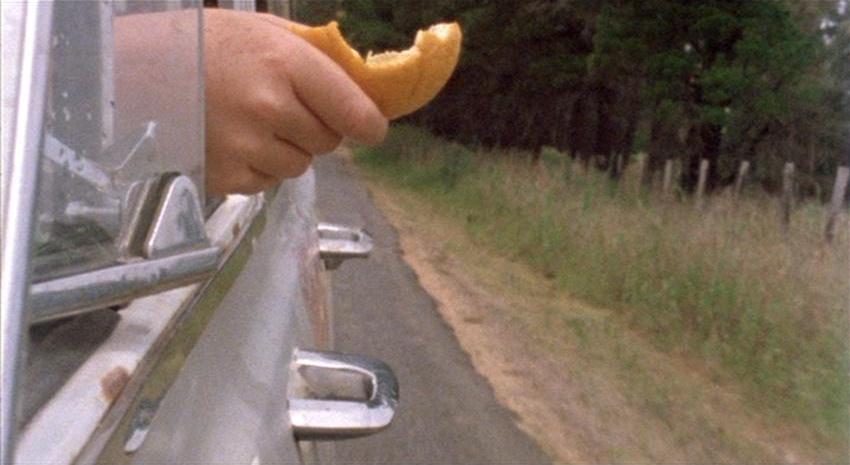
seven years old, is indistinguishably provoking or distracting himself from the charged mood of hostility in the car, by busily bouncing an orange against the
windshield and the dashboard, and dropping pieces of peel out of his window as he prepares to eat. Dad admonishes him to stop. Sis is too annoyed either
to care or to deal with the juvenile misdemeanors of her nephew. After one too many explicit infractions, Tim slams on the brakes and refuses to budge till
Ben retraces the last few kilometers and gathers up all those pieces of rind. While Ben is gone, and he's gone unnervingly long, the dynamic of livid
comedy between the two adults shifts from bad to better to worse, so that by the time Ben is finally hunted down and gathered back to the car, he
seems transfixed by a sense of transformation, maybe outright alienness, in his father and his aunt. He regards them, and they stare back at him (and at us),
with a combination of vacancy, wonder, and churlish impassivity. Tempers are simmering. Cars whiz past. Evening falls. No one's budging, except the
hyperactive kid jumping like popped corn on the roof of the sedan.
The overt "exercise in discipline" is the punitive errand of retrieving the peel, but Ben makes something unexpectedly poignant out of it: he attempts to
rebuild the orange out of what he's torn away from it, and his inchoate sense of the task's futility is as much a part of the closing tones as the obstreperous
clash of the putative grown-ups. Poignancy isn't quite what Campion's after here, but she mirrors Ben in swatting back at "discipline" (a mere eight minutes,
a mere three actors, a budget probably close to six or seven cents) by sizzling all the circuits of familial love and rivalry, and by flaunting all of her
knacks for piquantly estranging compositions, sounds, and color schemes. I don't think I'd ever really thought about color as its own expressive
device in any film before I saw Peel, give or take the neon slashes of the light-sabers in The Empire Strikes Back and the underscored
premiums on beauty and palette in costume dramas. Peel is as much about the color orange as it is about a fight about a fruit. It's also about
hiding behind your driving, whining about being late when probably nothing's waiting for you, and sticking your finger somewhere—inside an orange, or
inside a broiling argument, or somewhere even more abstract—just because you're wickedly curious to know what it will feel like. Any time you've got
eight minutes, you can take a look at Peel and see what Campion's brilliant if patchy career would subsequently feel like... but you can also reconnect
without an ounce of starchy academicism with the excitement of cinema, the insolence of color, the impossibility of car trips, the fashion fiascos of the
early 1980s, and the sure sense of encountering a young filmmaker who sees, hears, and feels in a genuinely new way.
#36: 3 Women
 (USA, 1977; dir. Robert Altman; cin. Chuck Rosher; with
Shelley Duvall, Sissy Spacek, Janice Rule, Robert Fortier, Sierra Pecheur,
Ruth Nelson, John Cromwell, Craig Richard Nelson)
(USA, 1977; dir. Robert Altman; cin. Chuck Rosher; with
Shelley Duvall, Sissy Spacek, Janice Rule, Robert Fortier, Sierra Pecheur,
Ruth Nelson, John Cromwell, Craig Richard Nelson)
IMDb // My Capsule Review // Leave a Comment
A story of someone else's remarkable generosity, or maybe just of me being massively spoiled: when I was an undergraduate and getting excited about the work
of Robert Altman, I voiced some regret to my wonderful, very bashful professor of film studies that I couldn't see 3 Women, which, in addition to bearing
the Altman imprimatur also sounded like some sort of Mojave Desert riff on Persona. Shivers! Regrettably, until the Criterion Collection debuted their typically
splendid DVD package of 3 Women in 2004, several years after I finished college, the movie did not exist on any home format unless you happened to
catch the occasional screening on one of the pay cable channels. Imagine my surprise when, the next week in class, my professor presented me with a copy
of 3 Women that he had made by running the film on 35mm in the campus cinema, videorecording the image, and then processing that recording onto a VHS
tape. Cine-altruism of the highest order. The only hitch was that his system for converting onto tape necessitated a 4:3 aspect ratio for the final
product, and 3 Women is a super-widescreen 2:35:1 movie. Thus, the whole image got squished into a virtual square, and both Sissy Spacek and (egads!)
Shelley Duvall were each rendered 175% taller and skinnier than these two walking willow-branches already are.
I first experienced 3 Women, then, as a sort of Djuna Barnes experimental drama where two barely personified vertical lines kept talking to each other
in tenderness and rebuke, although the temperaments of these lines transformed from the first half of the movie to the second, amid unsubtle Jungian dichotomies
of water and sand. What I perceive now as the uncanny and exaggerated horizontality of the scaly, scowling, and sharp-toothed archetypes in the third woman's
murals—dotingly rendered in the crater-pits of empty pools—looked at first like sinister icons of emaciation, a presumably reluctant mother
expressing her dark thoughts about malnutrition and rigidity and violence.
How apropos that 3 Women, of all movies, should prove so shape-shifty in my basic experience of what it is, how it looks, and what it shows, given
that the whole film is so obsessively preoccupied with unnerving mutabilities and porous boundaries, and given that my own feelings about 3 Women are
so susceptible to change. Less seduced now than I was at age 20 to the presumed homologies between womanhood and liquidity, silence and unknowability, pregnancy
and mysterious imminence, I am occasionally flabbergasted that this movie doesn't drive me straight up the wall. Maya Deren ventured into much of this terrain
more than thirty years earlier, and with a sharper, more dangerous edge to her fascinations. Rarely would you confuse 3 Women with any of the feminist
avant-garde filmmaking of its own era, by artists like Laura Mulvey and Yvonne Rainer, who pressed even harder against default formal vocabularies and against
the hieroglyphic figures of Woman that Altman privileges here: the frivolous ditherer, the stunted child, the glowering fertility goddess, the
detached mother, the harridan boss. And though Altman always traced the project's origins to his "own" dreams during a period when his wife was quite ill,
it's clear he's cribbing quite a bit from Persona without approximating any of Bergman's scariest and bravest material. Bibi Andersson getting the
whole theater bothered while recalling a long-ago orgy pretty much TKOs Shelley Duvall nattering on about microwavable hot dogs and suitors who don't exist.
But what 3 Women has going for it, well beyond its formative status in my proto-cinephilia, even past that aura of the unreachable object that never
fully dissipates even when you do reach the object, is that it frankly shouldn't exist. Nothing in the codes of Hollywood production or distribution
even in the 1970s, much less now, should account for what Robert Altman's scriptless, amorphous, very likely substance-assisted subconscious is doing up there
on the movie screen. Yet to watch 3 Women is to dunk yourself into the anti-narrative, fluid potentialities that exist just below the tidal surface
of so much American image-making. This isn't to say that Altman lets go of story, conflict, or characterization any more than he does his conservative,
focalizing premises about phallic aggression and amniotic infinitude. But as exciting as it is to see three female characters stand in such unresolved,
gradually emergent relations to each other—subjectively, psychologically, erotically, socially—it's at least as exciting to see human bodies and
their incongruous voices floated around on the screen like watercolor strokes, not tacked down into "characters" imprisoned by dramatic motivations or well-defined agendas. Duvall,
scripting a lot of her own stuff, is such a brilliant font of kitschy wisdom and soul-destroying household tips through the first hour ("You can start by
takin' some of that cheese spread and squirtin' it all in a circle on top of those sociables, and then put an olive on top of each one, k?") that I'm always
suckered by how fragile and haunted she becomes after the Spacek character's midfilm turnabout from childish acolyte to contemptuous, sex-savvy scold. Is
Millie Lamoreaux jealous or worried, or virginally curious, or protectively heartbroken, or just baffled or disbelieving as the resuscitated Pinkie offhandedly
wonders whether she was raped by a doctor while she lay comatose in the hospital? What inner resource would Millie possibly fall on to prompt her with an
appropriate emotional response, and what structures can possibly guide us, the viewers, in squaring these sinister imputations with the ghostly, aqueous farce
we've been noodling around with thus far? The fact that 3 Women specifically doesn't become as intense or as fully reworked in its second half as
Persona or Mulholland Drive do in their comparably remixed conclusions is not just proof of tentative artistry but a different, quieter way of
catching us by surprise. Millie's paralysis is nearly as serene, even in lighting, palette, and mise-en-scène, as her cheerful oblivion previously was. It's disarmingly easy to watch Spacek evolve from elfin waif
to the kind of hair-tossing California girl who would have made life miserable for Carrie White.
A funereal childbirth scene, marked by awful audio dispatches ("He's too big...") and the final recombination of personalities and logics cast a grim pall
on everything, but these compete for attention with Altman's characteristic jazz-notes and humorous asides, like how Shelley Duvall's skirts are perpetually caught in her car doors though she never once notices, and
how the nurses pout in the background of one dramatic scene about how the doctors are always stealing their pens. All kinds of stuff gets stolen in 3 Women,
and Altman himself does some of the stealing, but the film generates an atmosphere of menace and camp, of aridity and voluptuousness, that's impressively
its own. I might want to strangle that piccolo or stifle a zoom on occasion, and sometimes the movie seems best appreciated as an unwittingly cornucopial
offering to drag queens everywhere: "It's Penthouse Chicken night at the club, ladies, so bring your cans of tomato soup and your favorite yellow and purple
dress!" But as self-consciously "arty" as 3 Women often feels, I never doubt that it is art in some proud, irreducible way. As superior as I
let myself feel toward some of its choices, I always wind up humbled by its allegiance to obliquity, its desert tranquility laced with inner disquiet.
#37: Jackie Brown
 (USA, 1997; dir. Quentin Tarantino; cin. Guillermo Navarro; with
Pam Grier, Samuel L. Jackson, Robert Forster, Robert De Niro, Bridget Fonda,
Michael Keaton, Chris Tucker, Tiny Lister, Lisa Gay Hamilton)
(USA, 1997; dir. Quentin Tarantino; cin. Guillermo Navarro; with
Pam Grier, Samuel L. Jackson, Robert Forster, Robert De Niro, Bridget Fonda,
Michael Keaton, Chris Tucker, Tiny Lister, Lisa Gay Hamilton)
IMDb // My Page // Leave a Comment
Reservoir Dogs wasn't my cuppa, but I can see that it has its virtues. Pulp Fiction glistens and grooves, an
almost immaculate pop object, and yet I never seem to reach for it when I'm shuffling through my old favorites. The first
Kill Bill boasted a beguiling structure and some whizz-bang craftsmanship, especially in the action scenes, which
made it only more surprising and intriguing that Kill Bill, Vol. 2 slowed to such a relative crawl, plumbing for
feeling instead of laying on the pizzazz. These movies all hold together beautifully, and yet—when you absolutely, positively
got to thrill every motherfucker in the room, accept no substitutes. Jackie Brown is the AK-47 in Tarantino's
arsenal, which is all the more surprising because, on the surface, the director seems to have more on his mind than
blowing us away.
Jackie Brown starts hitting pitch-perfect notes in the opening credits, and it literally never stops. Pam Grier,
dolled up for her job as a stewardess for Cabo Air, glides into the right edge of the frame, while Bobby Womack's creamily
desperate anthem "Across 110th Street" sets a pristine, hummable stage for both the character and the movie. It's such a
simple gesture, capturing Jackie so quickly at her coolest, then gradually hastening her toward the airport gate as she
realizes she's running out of time. The whole movie will plot this same course, not just because Jackie stays all but invisible
for the next half-hour (and therefore has to hustle a little to reclaim her own film), but because Tarantino's
direction and his script are so exquisitely keyed in to Jackie's pragmatism and her panic: "I make about sixteen thousand,
with retirement benefits that ain't worth a damn... If I lose my job, I gotta start all over again, but I got nothing to start
over with." Jackie's basic, wholly adequate motivation for lawlessness is that from where she's standing, she can see the
dying of the light. When she drags herself out of jail, she worries about how bad she looks. When she sits down with her
obviously smitten bail bondsman, the first thing they discuss is how to quit smoking without gaining weight. Pam Grier is
so pert, charismatic, and funny in the role that there isn't anything cloying about Jackie's anxieties, just as there is nothing
overly precious about the film's presentation of them—even when Tarantino
lays down a vocal track of a much younger Grier singing "Long Time Woman" as a funky and succinct counterpoint to this older,
soberer, but still very funky version of herself. Perhaps the most remarkable thing about Jackie Brown is how unfoolish
and—a very un-Tarantino word—how wise this film looks and sounds while espousing a then-34-year-old, nonblack, male
filmmaker's vision of Jackie's predicament. Though the colors and songs are all Tarantino-brite, the framings are contemplative
and often very simple, even amidst key episodes in the criss-crossy plot; as the narrative accelerates and the vise of possible
failure closes around Jackie and her weathered but plucky accomplice Max Cherry (an invaluable Robert Forster), the film
never deviates from its carefully restrained pace and rhythms. Almost every sequence is designed such that seemingly simple
actions communicate several things at once: Jackie trying on a new suit, Bridget Fonda refusing to answer a phone,
Robert De Niro looking for his car in a parking lot, Lisa Gay Hamilton making nervous contact with Jackie in a food court.
Every one of them is crucial to Jackie Brown's plot, but they've all been filmed with the frisky, on-the-fly texture
of grace notes and improvs. The film has an exacting, exquisitely calibrated structure, loping forward and then
looping backward, but the steady hand and living, breathing humanity behind every moment lend Jackie Brown a warm,
plausible, and deeply enjoyable spontaneity.
Tarantino and Grier have "got" Jackie the way Mankiewicz and Bette Davis "got" Margo Channing, within a comparably ambitious
script and a similar marshaling of the actress' own backstory and persona into the service of the character. Too, if Jackie is
Margo, Samuel L. Jackson is the Addison DeWitt of ghetto crime. His charisma, irony, and verbal dexterity are such
that the audience instantly falls for him, but then our breath really catches as the actor and the film lay bare the discomfiting
essence of the character. Ordell Robbie is, obviously, an even tougher, more vicious piece of work than Addison, but he still
profits mightily from Tarantino's knack for spinning wily fun out of a fundamental, uncompromised melancholy—since Ordell,
no less than Jackie or Max, lives and acts from a critical juncture between his youth and his legacy. Almost any one-line
sample of Jackson's dialogue and delivery is a devilish, delicious, highly profane movie unto itself: "My ass might be dumb,
but I ain't no dumb ass" or "You think I'm gonna let a little cheese-eating nigga like this fuck that up?" or "Shit, Jackie,
you come in this place on a Saturday night, I bet you need nigga repellent to keep motherfuckers off your ass!" Jackie's
response to this last is a very modest "I do okay," but for Jackie, as for the film, that's a monumental understatement.
#38: Bram Stoker's Dracula
 (USA, 1992; dir. Francis Ford Coppola; cin. Michael Ballhaus; with
Gary Oldman, Winona Ryder, Anthony Hopkins, Keanu Reeves, Sadie Frost, Richard E. Grant,
Tom Waits, Cary Elwes, Bill Campbell, Monica Bellucci, Florina Kendrick, Michaela Berçu)
(USA, 1992; dir. Francis Ford Coppola; cin. Michael Ballhaus; with
Gary Oldman, Winona Ryder, Anthony Hopkins, Keanu Reeves, Sadie Frost, Richard E. Grant,
Tom Waits, Cary Elwes, Bill Campbell, Monica Bellucci, Florina Kendrick, Michaela Berçu)
IMDb // Leave a Comment
Bram Stoker's Dracula portrays two ardent, flamboyant, and perpetually haunted love affairs, one of which begins in
the 1400s and spans more than 500 years until the 1890s, the other of which begins in the 1890s and spans more than a century,
through 1992 when the film was released, and through 2006, and after. The first of these loves, exquisite but also inhuman
and adrift in its timelessness, is the erotic, spiritual, and finally organic bond between Count Vlad Dracula of Romania
(Gary Oldman) and his wife Elisabeta (Winona Ryder). Dracula fights with fervid conviction in a holy war in distant lands,
impaling his enemies in an intended tribute to his God and to his wife; already we may sense some confusion between the two,
a confusion which Francis Ford Coppola's absintheate mise-en-scène of lurid colors and superimpositions works hard to
amplify. Returning home to find Elisabeta tricked into despair and excommunicated as a suicide, Dracula perjures his soul
with such grandiloquent acts of blasphemy that he is doomed to live forever, no longer a man yet marooned among mortals,
alienated from his love but tortured by her reincarnations (which torture all the more because Ryder inhabits them with
such prissy and dumb discomfort). Meanwhile, as the shape-shifting Count chases Mina Harker, his wife's uncanny duplicate,
to her home in Victorian England, a new sideshow technology of shadows and silhouettes, of cranks and flickers and
distractions, has bemused the urban populace. Dracula's London is a London of kinetoscopes and zoetropes, and
Coppola is witty, risky, and besotted enough to saturate his movie with the ghosts of the cinema's own beginnings, to plumb
the antique past of the medium as an adventurous artery into a new and heady present.
The movie is proudly, almost over-emphatically vampiric, toying with its own shape, purloining liberally from all of the
arts, confusing its chronologies and sometimes confounding its own plot, reflective of and awestruck by the mercurial methods
of lead actor Gary Oldman, and almost cruelly willing to lay bare the limitations and vulnerabilities of an unlikely supporting
cast. Bram Stoker's Dracula is made of equal parts folly and terror; its very definition of love amounts to a fusion
of these two elements, each drinking liberally from the other, interfused so that we are less and less prepared to observe
any difference between the two. The film is both a strange and a logical one for Coppola to have made, merging the generational
torments of the Godfather series with the hallucinogenic anti-dramaturgy of Apocalypse Now and the curious,
occasionally abject self-ridicule of Peggy Sue Got Married. Bram Stoker's Dracula is a movie that slides
outlandishly between an extraordinary belief in itself, writ large as a belief in the cinema, and an equally extraordinary
drive to flout and undermine its own ambitions. How else to account for the scrupulous production design and exacting star
performance that we behold in Dracula's castle, while Keanu Reeves stumbles and falls, resolutely unsaved from himself,
through every moment of the very same scenes? How else to receive a movie that can locate and even sublimate a persuasive
romanticism within the guise of wild expressionism, culminating in scenes as beautiful as Mina's candlelit seduction by the
forlorn and raven-haired count, but also trash itself out with shock-cuts from a kitschy beheading to a bleeding, fatty
slab of English roast beef? When I first saw the movie, I marveled only at the beauty in Michael Ballhaus' cinematography,
so rich in its colors and proud in its artifice, but now I can detect something of Ballhaus' history with Fassbinder, the
way the images shuck us unpredictably between immersion and bafflement, sometimes flattering the actors and sometimes
catching them off-guard, ironizing their presence in the movie as well as our own.
For me, Bram Stoker's Dracula distills and sacralizes a form of aestheticized passion, the kind that insists on both
the virtuosity and the foolishness in artistic experiment and self-exhibition. The film finds its director living on the
outward edge of his mind's eye and inviting a plethora of fellow artists to join him there, all of them enraptured with the
arts that constitute the cinema if also a bit skeptical, maybe even a bit cynical, as regards the final product. This
peculiar, prevailing attitude both for and against art, both for and against camp, deliriously carnivalesque, is a mighty
challenging climate for a movie to grow up in, but then again, it fosters the kind of creative highs that a more serious
movie or, in some ways, a less serious movie would never be able to touch. I'm thinking here of Eiko Ishioka's costumes,
a nonpareil panoply of wacko but prepossessing conceits: an external armor of internal musculature, Victorian gowns in
saccharine shades of mint and pink, a funeral shroud topped with a reptilian headdress. I'm thinking, too, of Wojciech
Kilar's churning and thunderous score, which would be too overfull and insistent for almost any other movie but which sees
right into the brutish, beating heart of this one, running up and down the scale of ardor and violence. I'm thinking, too,
of the expansive and sometimes incongruous sound design, which gets away with inserting some whirring, chirping electronics
into a scene where Dracula's brides encroach upon Mina and Van Helsing inside a Wagnerian ring of fire; and of Greg Cannom
and Michèle Burke's hair and makeup designs, skewering Victorian masculinity, recycling but also satirizing stereotypes
of feminine delicacy and Slavic swarthiness, ushering Oldman's Dracula through not just an array of wild guises but entire
phyla of bestial existence. In many ways, Bram Stoker's Dracula is just too, too much, but its fusion of literary
and cultural archetypes with avant-garde novelties of vision and sound makes so many films look thin, frightened, and
underfelt. It's as though Coppola, his own career all but scuttled and his chosen medium increasingly eulogized, is
throwing every new and old inspiration he can find at the screen, and saying, baying, crying, laughing, joking, fuming,
declaiming, "Here, for better and for worse, is a movie that's alive."
#39: Boyz N the Hood
 (USA, 1991; dir. John Singleton; cin. Chuck Mills; with
Cuba Gooding Jr., Morris Chestnut, Laurence Fishburne, Ice Cube, Nia Long,
Tyra Ferrell, Angela Bassett, Regi Green, John Cothran)
(USA, 1991; dir. John Singleton; cin. Chuck Mills; with
Cuba Gooding Jr., Morris Chestnut, Laurence Fishburne, Ice Cube, Nia Long,
Tyra Ferrell, Angela Bassett, Regi Green, John Cothran)
IMDb // My Page // Leave a Comment
I remember like it was yesterday the televised moment when Kathleen Turner and Karl Malden strode onstage to announce the
1991 Oscar nominations, transcending the usual levels of obligatory hype by unveiling two Academy "firsts" that surged with
real excitement. And what different breakthroughs they were: Disney's tuneful and resplendent rendering of Beauty and
the Beast became the first animated film to earn a nomination as Best Picture, and in a double-barreled achievement,
24-year-old John Singleton became the first African-American and the youngest filmmaker to be nominated as Best Director,
for his severe and proudly didactic debut Boyz N the Hood. The times truly
seemed to be a-changin', even if Singleton's rallying cry, born equally of anger and despondency, was still jockeying for
space with the avatars of white middlebrow liberalism; in the category of Best Original Screenplay, Boyz stood
side-by-side with Lawrence Kasdan's Grand Canyon, another hit film about race relations in contemporary Los Angeles
that nonetheless appeared to spring from an entirely different cosmos. Bear in mind, too, that 1991 was also the year of
New Jack City and Jungle Fever, with Ernest Dickerson's Juice and Julie Dash's Daughters of the
Dust lurking just around the corner in January 1992. In the same twelve months that witnessed the public proclamation
and the first, pathbreaking successes of the "New Queer Cinema," a New Black Cinema seemed equally viable and just as
culturally urgent, furnishing common cause to established (mostly white) critics, urban (stereotypically black) audiences,
and a rising and complicated tide of suburban (white youth) enthusiasm. Boyz was, in every way, the biggest hit of
the bunch, and despite the grim despair that permeates its climactic cycle of violence, it augured most brightly for the
future.
Is it possible now to watch Boyz and feel no pangs about Singleton's subsequent trajectory? Despite their generic
diversity and ambitious premises, neither the distaff road-movie rumination Poetic Justice nor the inflammatory
campus drama Higher Learning nor the historical commemoration Rosewood nor the sexually cautious but
adventurously acted Shaft remake nor even Baby Boy, styled as a sort of post-date to the Oedipal tensions
and turbulent maturations in Boyz N the Hood, generated much heat. By the time of his relative commercial successes,
2 Fast 2 Furious and Four Brothers, Singleton seemed to have capitulated to strict studio mandates, starting
over at a lowly rung of an industry he was once so keen to crack open. Perhaps it is a convenient, retrospective fallacy
to see in Boyz an allegory for the cruelly limited ecosystem of black Hollywood, where even the brightest talents
have a hard time breaching the stern perimeters of ideology and corporate subservience. Or maybe Boyz—scripted,
shot, acted, and edited with a clenched and gathering force that excuses its occasional gracelessness—derives its very
potency from Singleton's first-timer energy, and the proper response is therefore not to mourn the disappointments that
followed but to preserve our marvel at the might and the moment that Boyz so definitively embodied. As obedient as
the film is to Hollywood grammar, conceived and rendered through utterly conventional and occasionally overstated techniques
(dramatic close-ups, portentous inserts, dated and trivializing music), it sits almost wholly at odds with mass-manufacturable
Hollywood sentiment. The passion behind the story, the hotheaded political outpourings, the relentless dichotomies of hope
and danger, lucidity and impulse that fuel the montage bespeak the kind of personal signature that no one much expects from
Hollywood movies anymore. Singleton strips his art of almost all ambiguity in the service of thematic and emotional and
political transparency. Whether he was or is capable of greater formal sophistication than this seems beside the point;
Boyz finds the boldness, the directness, the persuasive power in Hollywood style, rousing its audience toward
renewed belief not only in the script's Afrocentric memes of economic and educational self-determination but in the modes
of Hollywood storytelling, marshalling every beginner's trick in the book toward a tragic purgation of pity, anger, and
fear.
The annihilation of Ricky Baker, harrowingly realized as both a repulsive coincidence and a graven inevitability, remains
one of the most shocking and affecting deaths in modern movies. It occasions a test of virtually every character and relationship
in the movie—the patient pacifism of Tre Styles, the flinty and precautionary wisdom of his father Furious Styles, the
frightened but solicitous empathy of Tre's girlfriend Brandi, the unappealing but ferociously optimistic favoritism of Ricky's
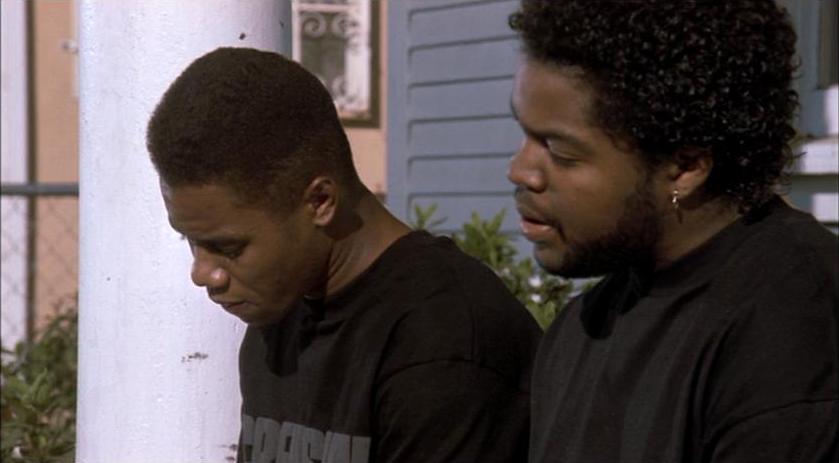
mother Brenda, and most of all, the loyalty and heavy-browed pessimism of Ricky's brother Doughboy, whose unexpected
inheritance of the movie's moral weight is one of Singleton's most audacious moves as both writer and director. Through
Doughboy, and through Ice Cube's superb inhabiting of the character, Boyz articulates the very logic and credence
behind retaliatory, intramural violence that so much of the movie—particularly Furious Styles' various sermons on
various local mounts—has worked hard to denounce. The impossibility of Tre's choice at the end of Boyz, whether
to help avenge his closest comrade or to honor his family and his own beckoning future by recusing himself, strikes equally
at our heads and our hearts, positing an ethical dilemma that is all the more gruesome for its very rootedness in everything
Boyz has recounted and reflected up to that point (as opposed to abstracting a moral paradox and erecting a thin,
beatific scaffolding of Movie around it, as in Sophie's Choice
or The Green Mile). However forthrightly the film implores
us to "Increase the Peace," Boyz conveys a rigorous sense of how difficult and self-alienating this seemingly faultless
imperative can be, and Ice Cube, without glamorizing or glorifying Doughboy in the slightest, invests the character with his
own critical, introspective grasp of this predicament. The choices these characters must make, so thickly in the midst of
their youth, their frustrations, and their desires, present a crucible that no one really escapes. Even when some closing
captions inform us that Tre and Brandi succeeded in their quest for an all-black college education, the film never actually
leaves their neighborhood. I suspect that Singleton believes that part of Tre and Brandi will always be stuck on these
small lots and gridded streets of South Central L.A. No one, Singleton included, makes it out of this film unscathed, but
instead of simply hectoring us with the hypothesis of cruel cultural determinism, Boyz enables us to feel this
tragedy. We grasp the paucity of choices that present themselves in a world like this (the racial ghetto, the working
class, the abandoned city) while the film nonetheless exhorts us, as well as its own characters, to choose—to change,
quite simply, the world.
#40: Home for the Holidays
 (USA, 1995; dir. Jodie Foster; scr. W.D. Richter; cin. Lajos Koltai; with Holly Hunter, Robert Downey, Jr.,
Anne Bancroft, Charles Durning, Cynthia Stevenson, Dylan McDermott, Steve Guttenberg, Geraldine Chaplin, Claire Danes)
(USA, 1995; dir. Jodie Foster; scr. W.D. Richter; cin. Lajos Koltai; with Holly Hunter, Robert Downey, Jr.,
Anne Bancroft, Charles Durning, Cynthia Stevenson, Dylan McDermott, Steve Guttenberg, Geraldine Chaplin, Claire Danes)
IMDb // Leave a Comment
One of my favorite costume-props in modern American movies, right up there with Margo Tenenbaum's Izod dresses, is Claudia
Larson's ribbed and massive magenta coat in Home for the Holidays. As Claudia (Holly Hunter) is quick to observe,
especially when cornered by an enminked high-school classmate from a lifetime ago, this isn't her enormous coat: "I,
of course, lost the stylish one that fits me in the airport." Upon arriving to her parents' crammed and gewgawed home for
an inevitably awkward Thanksgiving, Claudia is coerced into this mulberry nightmare by her huskily antic mother Adele (Anne
Bancroft), who foists it upon her before Claudia has even claimed her baggage. This means, yes, that Adele brought the coat
along before she could possibly know that her daughter needed one: an early sign that the impossible yet possible family in
Home for the Holidays is both perceptive and preposterous, knowingly and even uncannily predictive of each other's
needs and hurts even though they are unable to salve them, for themselves or for each other, which state of affairs the
film regards as merry, sad, and a little bit grotesque.
Home for the Holidays is a tottering but strangely durable object, just like the Larson family it chronicles. The
Time Out Film Guide dismisses Home as "a modest film (in every sense)," but I take exception on two grounds:
that the film's modesty is just as much a credit as a demerit, and that the structural detours, lopsided gags, and vastly
disparate tones in this film are often quite immodest. Nothing in the movie asks you not to notice these asymmetries, and
the resulting chaos of moods and performance styles illuminates something in the script, and in holiday rituals themselves,
and maybe even in middle-class American families, that a firmer directorial hand and a more balanced film would never be
able to access. So, skimming away the elements that plainly don't work—Steve Guttenberg, the farting grandmother
(Geraldine Chaplin being less to blame than her silly part), the deliberate spilling of a stuffed turkey carcass over the
head of a fuming sibling—a good deal of Home for the Holidays feels nervy, adventurous, and unapologetically
disillusioned.
The script, for one, is full of broken syntax, non sequiturs, lines that are interrupted or else just trail
off, and distended sentences that cry out for loopy, riffy enactment. Here is Bancroft's Adele admonishing her grown
daughter for abandoning her love of painting: "All I know is, whenever anybody comes in here, they make a beeline for your
brother Tommy's picture. 'Who did that?' they say. 'My oldest, my smartest daughter,' I answer, but she's busy squandering
her God-given talent filling in the holes in some dead people's pictures in Chicago, the Windy City." What makes the whole
line, the whole speech, is "the Windy City." Aside from the gratuitousness with which a mother reminds a daughter of her
own brother's name; from the rude way she actually reminds herself, mid-sentence, to name favorites among her brood;
from the implication throughout the movie that few (if any) outsiders ever do pass through this room; from the indictment
of the portrait itself, which bespeaks no talent whatever; from the bruising obliviousness with which Adele gets the nature
of Claudia's job totally wrong; there's the standing fact that Adele doesn't end her thought anywhere near where she began
it. In fact, she dead-ends herself in a little cul-de-sac of empty, accumulated knowledge.
The film teems with off-rhythms
like this: lighting and makeup are insistently unflattering, despite several scenes of dressing, bathing, and primping;
Claudia always loses the words of the songs she sings; the whole cast, stunningly well-matched for physical resemblance,
are vocally all over the place; speeches and toasts digress into outright opacity; everyone in the film drives poorly, and
too quickly. Like one of Adele's rattling speeches, the film doesn't end anywhere near where it began, charting an arc
from comically embittered candor to wild romantic mythmaking. But then, there are deep structural rhymes, too, as in the
twinned prologue and epilogue. At the outset, the hermetically closed serenity of a Renaissance painting that Claudia
restores in extreme close-up, breaking the whole of the artwork into isolated vignettes. At the end, more vignettes: a
montage of faux home-movies depicting islands of ecstatic happiness in the life of every character, though we have already
learned by now that the surrounding context for these moments is something less than happiness. Surely, we must apply
this pattern to the optimistic mirage of new love that almost concludes the movie. Of course, we hope we're wrong,
and I don't think the film faults us too heavily for hoping.
Home for the Holidays has a spirit and an ostensible shapelessness that are pure Cassavetes, enveloping a script that
only seems to reach for the precise calculations of 1930s screwball comedy. It's like a gene-splice of Cukor's Holiday
with Cassavetes' Love Streams, denying its own mise-en-scène either a veneer of reassuring beauty or the defensive affectation of obvious unbeauty.
Its director, notably, is one of our most controlled, businesslike, coolly mannered actresses, who had helmed only one movie
before this one and none since, but who is clearly jazzed by the vandalish act of producing an id-driven, deeply felt, but
sloppy-at-the-edges films; Home for the Holidays rewards all the impulses and admits all the angers that she tends to suppress as an actress,
despite her own frequent paeans to family devotions when speaking to the press. The whole film is an off-kilter prose poem of run-on sentences.
And sentence fragments. A raucous comedy tuned to the chords of middle-age, and thus closed off, almost by definition, to the typical (young, male) audience
for raucous comedy. A cast of top-flight actors, united only in having been so underutilized in bright but vaguely
disappointing careers, and pushed in this instance well away from their comfort zones. Note, though, that Foster's embrace
of cacophony at the level of acting, to include her heroic patience with Robert Downey Jr.'s exhilarating overplaying, has
been firmly prevented from afflicting either the soundtrack (prim, predictable, Polygram-stamped) or the stabilized color
palette (chestnut browns, burgundy, gold, black, and winter white, plus those offending yet scrupulously managed splashes
of hot pink). You can, if you want to, find some traces of Foster-ish control inside all the mayhem, which makes it both gratifying and deeply weird
when she lunges for stuffing-spilling sight-gags.
I know what you're thinking: much of the above reads like reasons to dislike the movie. My partner, aghast at this film's
inclusion on this list (and at such a high rung!) gently exhorted me to reiterate that this is a list of favorites, not a
list of "bests." Home for the Holidays is indeed a favorite, but also, for me, something of a best: a dramedy about
the funny-harsh messiness of families that truly doesn't blanch at being funny-harsh and messy. A middle-brow entertainment,
a holiday picture of all things, that preserves the spiky energies of a theatrical rehearsal, and one that radiates the dubious, even iconoclastic
instincts of a passive-aggressive analysand. And on the subject of cathartic honesty, this movie halts, three or four times, for moments of rare truth between
characters—the final antipathy between two sisters, the gorgeous love between a sister and a brother—that differ
entirely from almost anything the movies ever show us. As much as anything, these moments carry the rest of this shaggy-dog film to glory.