#24: Walking and Talking
 (USA, 1996; dir. and scr. Nicole Holofcener; cin. Michael Spiller; with
Catherine Keener, Anne Heche, Todd Field, Liev Schreiber, Kevin Corrigan, Vincent Pastore, Randall Batinkoff, Joseph Siravo, Lawrence Holofcener, Lynn Cohen,
Brenda Thomas Denmark, Allison Janney, Alice Drummond)
(USA, 1996; dir. and scr. Nicole Holofcener; cin. Michael Spiller; with
Catherine Keener, Anne Heche, Todd Field, Liev Schreiber, Kevin Corrigan, Vincent Pastore, Randall Batinkoff, Joseph Siravo, Lawrence Holofcener, Lynn Cohen,
Brenda Thomas Denmark, Allison Janney, Alice Drummond)
IMDb // My Page // Leave a Comment
#25: Georgia
 (USA, 1995; dir. Ulu Grosbard; scr. Barbara Turner; cin. Jan Kiesser; with
Jennifer Jason Leigh, Mare Winningham, Max Perlich, Ted Levine, John C. Reilly, John Doe, Jimmy Witherspoon)
(USA, 1995; dir. Ulu Grosbard; scr. Barbara Turner; cin. Jan Kiesser; with
Jennifer Jason Leigh, Mare Winningham, Max Perlich, Ted Levine, John C. Reilly, John Doe, Jimmy Witherspoon)
IMDb // My Page // Leave a Comment
You'll notice that the thumbnail photo for Georgia is almost a mirrored duplicate for the snapshot I've pulled for Without
You I'm Nothing, which itself would serve perfectly as a replacement title for Ulu Grosbard's 1995 drama about desperate, self-conscious, strung-out,
and hard-living Sadie Flood (Jennifer Jason Leigh), who has the wound and howl of a rock star but not the discipline or the consistency of talent. It's also about her
sister Georgia (Mare Winningham), sober in every way, who has endeared herself to the tranquil multitudes with her melodic, modulated, wisely delivered folk
music. In this context, "without you, I'm nothing" is a phrase that breaks both ways, and as with Bernhard, it connotes something other than a straightforward
endearment. Sadie pines for Georgia's self-assurance, her affection, and her musicianship, and she
ceaselessly puts herself in need of Georgia's caretaking and her terse but severe admonishments. That said, we cannot take for granted that Sadie yearns for Georgia's peculiar aloofness
or for her tranquil domesticity. The damp air of the Pacific Northwest hangs in Georgia's house like a stilled breeze lolling in the lavender, but Sadie wants
fire and charge, no matter what they do to her, or what they make her to do others (though she's never out to get anybody). One divines over time that Georgia
would be nothing without Sadie. True, her lifestyle feels inoculated against the wildness Sadie represents: substantial but finally soothing music, muted and sheltered children, scarves wrapped with reflexive self-protection around her
throat, vests and aprons and enormous glasses like pliable armor, a slightly downcast efficiency, and a helpless impulse toward judgment of her sister. It all feels like the kilned product of her own high-pressure determination neither to resemble nor to make herself responsible for the pleading bobcat who shares her blood. But of course desperate avoidance and self-differentiation do not exonerate Georgia from her bond with Sadie. If anything, they constitute one. At pinpoint moments in Mare Winningham's performance, flawless in its quiet self-encasement and its serenely contained prickliness, you catch her sad eyes gazing at Sadie, either curious about or terrified of whatever centrifugal element in her sister pulls her so cyclically into chaos. Perhaps Georgia wonders if she could possibly house a trace of this same gene, and maybe she craves just a taste of it. Just as likely, she is flummoxed at how ceaselessly Sadie emanates that ragged, lively, hungry spirit of hers, which Georgia's gliding harmonics, her maternalism, and her acoustic elegance will simply never assuage, even though they move Sadie tremendously.
Georgia might be my favorite example of a movie that compels you toward binaristic assumptions but keeps outwitting them, not through fussy sleights
of hand by the writer or the director, but by the entire film's thoughtful immersion in the palpable, sonic, psychological, atmospheric world that it inhabits
and constructs. Just because Georgia is talented doesn't quite mean that Sadie isn't, though she pushes so hard you suspect she'd grind like a boxcar
over her own gifts without even realizing it. Georgia debuted during the same holiday season as Sense and Sensibility, and as tempting as it
is to position Georgia as a thoughtful Elinor and Sadie as an exploded, heart-driven Marianne for the plaintive and strumming Seattle of the 1990s, you
can't fix them there. Georgia does have feelings, sometimes unbecoming ones, always complex ones; Sadie does think, just not necessarily about how to safeguard herself or her intimates, or about how to make judicious decisions. Georgia's marriage to Jake (another masterclass in understated acting, from The Silence of the Lambs's Ted Levine) is not a matrimonial ideal, but it still embodies something Sadie poignantly lacks, despite hooking as earnest and sympathetic a boyfriend as Axel (Max Perlich), whom Georgia nascently admires. She also sees what a fond, sympathetic, occasionally conspiratorial confidant Jake is for Sadie, a fact that engenders restless and unnameable emotion in Georgia, who doesn't relate to her husband the same way Sadie does, and seems to have no other friend who performs that role for her. In any event, if Georgia does have friendships, they must be obliterated from view whenever Sadie hops back on the scene, needing and needing and needing.
Georgia's key tool for dissecting and complicating the sisters and their relationships is its unerring gift for intensely focused realism,
a deep familiarity with character and environment that one rarely sees outside
of a Mike Leigh movie. Even at that, Grosbard's film exhibits a deeper, richer visual palette and a sophisticated approach to rhythm and concision that Leigh's films, for all their thespian virtuosity and rigorous scrutiny of behavior, took a while to achieve. Grosbard, a solid actor's director who hasn't made another movie to touch this one, shows pitch-perfect recognition of the kinds of wanderlusters, make-doers, drop-outs, long-distance runners, and swaggering, self-conscious "legends" who scratch out their livings or carve out their niche in the nomadic world of music. He also uses the film's songs ingeniously to carry the scenes and guide their textures. Without making a movie that makes an issue of shattering any conventions, Grosbard nonetheless plays as though there are no rules, dilating
the song performances for much longer than usual in a non-concert film, and often back-to-back, almost the way David Cronenberg used the sex scenes in Crash.
The most famous scene, a litmus test for the lovers and haters of Georgia, is Sadie's flailing, compelling, erratic, embarrassingly sincere, nine-minute
rendition of Van Morrison's "Take Me Back," in which context Georgia's turtle-dove harmonizing toward the end operates as an emergency intervention, a pinnacle
of on-stage spontaneity, a stabilizing hug, and a breathtaking act of stern, undermining aggression. I am enchanted with this scene, but no less so with the
jousting duel that happens between the sisters when Sadie performs a punked-out version of one of Georgia's songs at a low-lit club and invites her stupefied
but resourceful sister to join her on stage. My heart goes out equally to smaller, quieter scenes like the ghostly moment when Sadie drowses and fades into the wallpaper while covering Nico, or when she supplies an offhandedly uproarious series of caterwauls to "Yosel, Yosel" in a bill-paying gig at a bar mitzvah. (The humor of Georgia, like so much else about it, is hard to cite out of context, because it emerges so organically and in such an unforced way through circumstance and behavior.)
I simply cannot turn Georgia off any time I start it, and I thrill to the movie in every register. Given its incredible range of clipped
and extended scenes, of ferocious and restrained performance, of pearled and razor-edged music, of intimate hostilities and unexpected olive branches, I
think that's quite a feat. It's the movie that recent fans of Rachel Getting Married may not have heard of but should most
quickly take a chance on, though there are no marigold blooms or dazzling saris or funked-out, exuberant wedding parties to make Georgia any gentler
than it wants to be. Like Rachel, Georgia is a movie that was annoyingly ill-served by the Oscars, where only Mare Winningham was nominated,
and despite being the deserving winner among a notably strong field, she was treated in the press and on the telecast like one of those "invisible" contestants no one takes very seriously because she so obviously won't win. Ironically, though, when people ask why I stay loyal to the Oscars, Georgia often leaps to mind, because without that one nod, however divorced from the directing, writing, editing, and copious acting citations that should have accompanied it (including, of course, for the fearless Jennifer Jason Leigh), I doubt I would have bought a ticket to Georgia. I wonder if it ever would have gotten a DVD release or survived Miramax's carnivorous habitus of buying everything and then abandoning most of it in the purgatory of split-second, begrudging distribution. It's the kind of film that few people saw, many of whom found it itchy or unpleasant because it refuses to make
outward concessions to likability, or to tell a simplified story of amelioration or reconciliation. Georgia and Sadie do not, finally, secure their bond or break up with each other. Screenwriter Barbara Turner, who later worked comparable
wonders of characterization in Pollock, is Leigh's mother. Winningham, who performs her own songs and is a recording artist worth seeking out, is a longtime friend of both. Obviously, everyone who worked on this movie adored the project and trusted each other, but in a way that forced them to their own best, astringent, un-egotistical standards. They must have known it would only reach a self-selecting cadre of people but hoped that those proud, those few, would love it very much. Despite its being a movie that knows and exposes every single facet of the ambivalences of love (whether for others, for music, or for one's own life), my own adoration is total, and undiluted by the years.
#26: Without You I'm Nothing
 (USA, 1990; dir. John Boskovich; scr. Sandra Bernhard and John Boskovich; cin. Joseph Yacoe; with
Sandra Bernhard, Cynthia Bailey, Steve Antin, Lu Leonard, Ken Foree, John Doe, Djimon Hounsou)
(USA, 1990; dir. John Boskovich; scr. Sandra Bernhard and John Boskovich; cin. Joseph Yacoe; with
Sandra Bernhard, Cynthia Bailey, Steve Antin, Lu Leonard, Ken Foree, John Doe, Djimon Hounsou)
IMDb // Leave a Comment
"They call me... Peeeea-ches!" Sandra Bernhard sings, with shrill and seemingly misplaced pride, looking utterly ridiculous
in her calico West African robe and matching headwrap, and certainly no less ridiculous with her arms now raised
in triumph at the finish of this, her rendition of Nina Simone's terse and forlorn "Four Women." The spirited sincerity
of her performance is matched only by the stunning incongruity of both the performer and her approach. We could hardly have
imagined that Bernhard was headed here when, in a short prologue, she addressed us from her backstage makeup mirror,
trimming a few split-ends and testifying in the deadest possible pan, "I have one of those hard-to-believe faces: it's
sensual, it's sexual. Sometimes, it's just downright hard to believe." Even if you aren't an English professor, you want
to emend the redundancy. Or you may, like the sozzled, affronted, and undisguisedly bored patrons in Bernhard's audience,
want to make a shuffling break for the exits.
In short, ten minutes into Without You I'm Nothing, everything has already gone wrong—although every viewer will probably
cite a different epiphanic instant when the tawdry errancy of the film reveals its brilliant comic design, exposing that the uneasy laugh
you're having at Bernhard's expense is actually the laugh she's having on you, and on herself, and on almost everybody. Like Margaret Cho's
I'm the One That I Want further down on this list, Without You I'm Nothing is a
perfect screen transfer of what Bernhard frequently touts as a "smash-hit one-woman show." Bernhard, though, unquenched by her clever
conquest of the stage and her fearless lampooning of her own image, reimagines her material as a scabrous, slippery, and uproarious subversion of the stand-up
documentary. Which isn't to say that Without You I'm Nothing doesn't deliver, quite lavishly, as a purer and simpler form of comedy.
Bernhard, after a garish close-up of her ankles in wine-colored tights, themselves planted in chintzy gold high-heels: "When I was a little
girl, I used to come home for lunch every day, and I'd pretend that my mother was a waitress in a roadside café: 'I'll have a side-order,
ma'am!' A side-order consisted of a chunk of white-meat tuna, a dollop of mayonnaise, some carrot strips, and potato chips. And then I'd sit
at the counter, and ignore her." Later in the same monologue, now taking shape as Bernhard's envious ventriloquizing of her neighbors'
blissful Gentility: "I'd fantasize that I had an older brother named Chip, and a little sister named Sally, and my name would be either
Happy or Buffy or Babe, one of those big sexy blondes who plays a lot of volleyball... 'Oh, God, Chip, you are so cute! I wish you weren't my
brother so I could fuck you!'" In her next persona, as a blowzy chanteuse: "We've been all over the country, me and my Jewish
piano player... I would love to dedicate the show tonight to all of those who enjoy Remy Martin, because I love to sit around
my motel room after my show in my bra and panties and say to someone, 'Get me a Remy Martin with a water back, God damn it!'"
Maybe none of this is funny in transcription; in fact, if it reads as crashingly, irredeemably dull, this would suit Bernhard's comedy
perfectly. Only half the fun resides in Bernhard's priceless oscillations among a dozen diva archetypes—the disco nightmare, the
quivering addict, the crooner with the murderous melismas ("Me and Mrs. Jo-o-o-o-o-ones"), the soured Supreme, the shameless product endorser,
the fulsome patterer, the high-class auction fiend who thinks she's best friends with Andy, the gay icon in the age of genital panic ("I
would feel just a little bit better if you would apply some spermicidal jams and jellies to the area"). The other half springs from her almost
scary willingness to push every envelope of cliché, foolishness, coarseness, ethnic and subcultural appropriation. If ex-best-friend
Madonna, classically skewered here, is the undefeated champ of trendy pilfering, Bernhard is an unbeatable anatomist of the thieveries,
parodies, and pillories that are the spines and the mitochondria of pop entertainment. The bad jokes are made funny—hilarious—by the good ones.
The throwaway lines and gestures are as memorable as the big numbers. The critique of white celebrities' desperate courting of black approval
has got Bulworth beat by 20,000 leagues. The deployments of lighting, angle, and montage are as deft but also as silly as the spoken-word caricatures, and the
whole thing is weirdly, riotously exalting. And if that "Age of Aquarius" finale in The 40-Year-Old Virgin had you chuckling, just look
at what Bernhard does with, and to, "Little Red Corvette."
#27: Late Marriage
 (Israel, 2001; dir. and scr. Dover Kosashvili; cin. Dani Schneor; with
Lior Ashkenazi, Ronit Elkabetz, Moni Moshonov, Lili Kosashvili, Simon Chen, Lilia Chachmon Ayaliy, Eli Turi, Sapir Kugman, Aya Steinovits Laor)
(Israel, 2001; dir. and scr. Dover Kosashvili; cin. Dani Schneor; with
Lior Ashkenazi, Ronit Elkabetz, Moni Moshonov, Lili Kosashvili, Simon Chen, Lilia Chachmon Ayaliy, Eli Turi, Sapir Kugman, Aya Steinovits Laor)
IMDb // My Page // Leave a Comment
Viewers who avoid foreign-language films are almost always overestimating the "foreignness" of these movies. C'mon, people, live a little! Push that envelope!
But then again, a less widely acknowledged truth of film spectatorship is that viewers who consume a regular diet of foreign-language films, those of us who cannot possibly imagine why it's so
distracting to read subtitles, are often underestimating the foreignness of these movies. Occasionally something as bizarre as Tropical
Malady or Taxidermia, or a film from a culture as cinematically underrepresented as Afghanistan's or Mali's or the Inuits', emerges on the global
market to underscore how very different other aesthetics, other imaginations are from one's own. But often the specificity and unfamiliarity of a film is
subtler than this, and if the film is successfully radiating a sense of universality, its uniqueness and idiosyncrasy can go unnoticed. For example, the
second time I saw Late Marriage in the theater, I went with an Israeli friend who gave more complete translations of the dialogue than the subtitling
did, who handily clocked when the characters shifted between Hebrew and Georgian, and who invoked all sorts of cultural associations that shaped the way he watched
the movie—which played, for him, as much more of a comedy than it did for me. He clued me in that Moni Moshonov, so compelling here as Yasha, the
charming but exasperated father of a 31-year-old son who won't accept any of the marriages that his parents and their friends arrange for him, is known
primarily in Israel as a cut-up comic performer. While Ari admired Moshonov's dramatic change of pace, he also kept laughing at half of what Yasha said and
did, and reacting to inflections and rhythms in Moshonov's line readings that I obviously have no idea about. His sense, true or not, that Georgian immigrants
were often stereotyped in Israeli culture as the butt of ignorant jokes, the way "Pollacks" often were among the kids I grew up with (even though none of
us actually knew anyone from Poland), brought a dimension of ironized comedy to the Georgian characters' insistence that nobody else was good enough to marry
into their clan. He howled at the loutishness of the hirsute, cigarette-smoking troll whose wife is washing his hair for him at the beginning of the movie,
and at Lili's co-optation into her friend's superstitious advice about leaving a piece of her son's foreskin beneath the bed of a prospective wife, to ensure
the eventual match.
Even given its stripped-down style, the simply but sharply drawn characters, the bluntness of its sexual scenes and of its dramatic narrative turns, Late
Marriage is apparently much more than meets the eye, or the English-speaking ear. I love knowing that even a familiar object contains so many unaccessed
depths and complexities, but you have to hand it to writer-director Dover Kosashvili that his peculiar naturalism never pretends to be spelling out all of
the meanings in the story or the currents between the characters. The long dialogue scene between the unmarried son Zaza (Lior Ashkenazi) and Ilana (Aya
Steinovits Laor), the appreciably younger girl with whom he's been set up, is a taut, punchy dance between two obviously intelligent people, she a little
contemptuous of his fratboyish flippancy, he a little smug in cutting the figure of the book-smart, non-conformist free agent. Near the end of their scene,
Ilana pulls out her portfolio of design sketches, featuring several sleekly drawn women in states of modish dress and undress, and she and Zaza exchange
looks and pert, one- or two-word remarks. Late Marriage suggests here that Ilana might be a lesbian, and even less interested in this marriage than Zaza is;
or that her artistic talent and career ambitions make Zaza, still a student at age 31, too pathetic a figure for her to align herself with; or that she's expressing some mixture of
these messages that Zaza simply isn't getting, though he pretends to, or some unspoken alternative to all of these logics, which none of us are getting.
Nothing in the filmmaking or the performance styles flags the scene as determinedly ambiguous, but the writing, acting, and directing are so rich with
off-rhythms and implications, and the whole scenario mitigates so strongly against people's likelihood of fully speaking their minds, that Late Marriage
makes even this expository scene rife with suggestive power.
We never meet Ilana again, but the whole movie continues to operate consistently with this flavorful, funny, unsettling appetizer course. Scenes complicate
or transcend the boilerplate story beats they seem plotted to fulfill. Attraction and repulsion, as well as their sibling forces of affection and frustration,
overlap in myriad ways that make everyone's lives tougher, funnier, and more interesting. The mise-en-scène maintains a vivid attachment to sharp lines
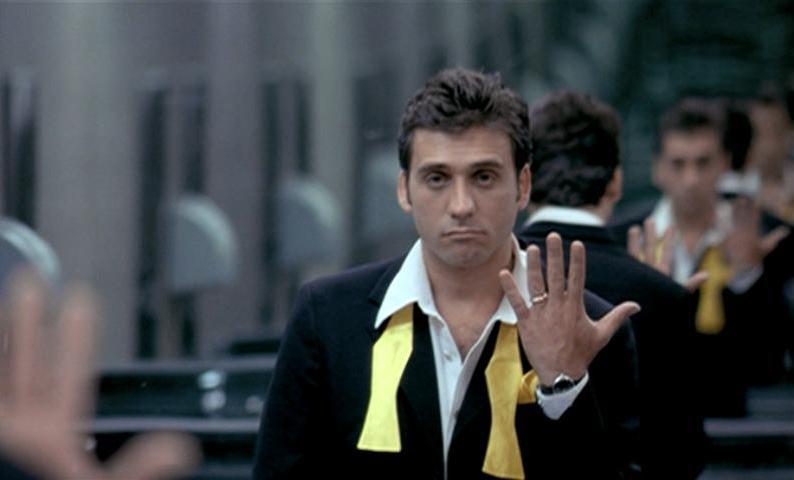
and bright colors—the yellow accents on Zaza's tuxedo, the white and red slip-dress Ilana wears to meet him, the parti-colored apartment where Zaza visits
his secret lover Judith (Ronit Elkabetz)—that contributes to the generally heightened reality of the piece while also making it sensually vivid in a way
the modest camera set-ups otherwise wouldn't. Dramaturgy alternates, sometimes on a dime, from the casual ease of Zaza's scenes with Judith and her daughter
to the sinister ritualism with which Zaza's extended family intrude into the apartment to the grippingly dilated reality of Zaza and Judith's love-making,
amidst which Judith reveals a secret that ironically invites comparison to the character who is her most formidable antagonist. That said, Late
Marriage evinces a gift for avoiding one-dimensional portraits of its characters' mentalities or their capacities for empathy, even as it pulls no punches
about the coercive, sometimes bitter power of tradition, family, and cultural allegiance. The final sequence, joining an outlandish encounter between father
and son in a bathroom and a nervous, painful, but outwardly boisterous public ceremony, is a marvel of a conclusion, crystallizing everything funny, everything
sad, everything skeptical, and everything wise about the film. Whether or not a non-Georgian or non-Hebrew-speaking viewer is catching every byte of communal
and ironic data, the humor, rue, and emotional arcs of Late Marriage have the lucidity and saber-edged power of a Flannery O'Connor or a Raymond Carver
story, give or take their own very particular regional and spiritual milieus. I can't think of anyone I know who wouldn't find themselves pulled into Late
Marriage. Meanwhile, Kosashvili, whose career stayed surprisingly mum after this attention-getting bow, finally has two
projects nearing completion, and after many, many trips through Late Marriage, I can't wait to get pulled into those.
#28: Howards End
 (UK, 1992; dir. James Ivory; scr. Ruth Prawer Jhabvala; cin. Tony Pierce-Roberts; with
Emma Thompson, Helena Bonham Carter, Anthony Hopkins, Samuel West, James Wilby, Vanessa Redgrave, Nicola Duffett, Jemma Redgrave, Prunella Scales)
(UK, 1992; dir. James Ivory; scr. Ruth Prawer Jhabvala; cin. Tony Pierce-Roberts; with
Emma Thompson, Helena Bonham Carter, Anthony Hopkins, Samuel West, James Wilby, Vanessa Redgrave, Nicola Duffett, Jemma Redgrave, Prunella Scales)
IMDb // My Full Review // Leave a Comment
Ruth Wilcox, embodied by Vanessa Redgrave with full-tilt mystique and ethereality, wanders in the gloaming around the grounds of Howards End, her beloved
country home. She looks as beautiful and as delicate as wisteria, the back of her dress dragging through the wet grass. The light and the texture of
the image are so beautifully calibrated that the screen is almost aromatic. She's just ambling, distractedly touching her shoulder and her necklace, with
a touch of uncertainty in the way she moves, and yet this is enough to constitute one of the quietest, most indelible opening sequences in the last two
decades of adult dramas on film. In one sense, it's also the last moment of total tranquility in this very plotty story, though the peculiar, cloudy frown
on Ruth's face is enough to signal that not everything is perfectly tranquil, not even here. The perfume of personal unease drifts underneath
the comic setpiece that follows—an engagement established and swiftly broken, an abrupt visit from an agitated relative, a confusion of brotherly identities. It lingers even around the toothy, gregarious ebullience of Emma Thompson's Margaret Schlegel, who arrives to suggest a gravitational center for the film,
although her sister Helen (played by Merchant-Ivory axiom Helena Bonham Carter) tugs the movie back toward herself whenever she appears, as does the dissipating
Ruth, as does the nervous clerk Leonard Bast (Samuel West), as does the ornery scion Charles Wilcox (James Wilby). The brooding, hypocritical paterfamilias
Henry Wilcox, rather sternly enunciated by Anthony Hopkins, makes a delayed impression and is too cold for the audience to sidle up to, but the film
summons even Henry as a complex character, not just an emblem of hardened class positions and dubious prejudices.
It's E.M. Forster's genius to establish a
story with so many characters serving as primary engines. But it's the genius of James Ivory's directing, Ruth Prawer Jhabvala's script, Tony Pierce-Roberts's lensing, and Richard Robbins's music (the least fêted but perhaps the most consistent element in the Merchant-Ivory arsenal) to enable each character's rounded, complicated claims on a viewing audience. Howards End is a lushly generous movie, even as it wends its way through a series of
decisions by its characters that the audience can't help but second-guess, building toward increasingly certain tragedy. Such generosity,
in tandem with the precise, focused screenplay and the steady momentum of the montage, conveys Forster's guiding conviction that the interrelationships
among all of these characters provide the emotional and intellectual core of the drama, rather than one lionized figure or one over-arching bit of dogma. No one character is the "heart" of Howards End, nor is anyone the hero. Sympathies and identifications shift and expand, and if the arrogant,
territorial Charles is plainly insupportable, the movie has the wisdom and the ability to make his limited, reactionary vision of England a seductive, even addictive fantasy in its own way. You see why Charles wants to live as he does, and why he doesn't perceive the huge tolls that other people pay to preserve and
consecrate his way of life. You can see how his imperial, finally bloodthirsty conservatism is not the same as his father's conservatism or his mother's,
and none of these conservatisms are equivalent.
Nor is Margaret Schlegel's emancipated liberalism entirely weaned of its taste for money, for masculine
authority, or for the accoutrements of the peerage. Leonard Bast is not an abused innocent, or at least he is not only this. Helen Schlegel is both righteous and self-righteous
as she bellows out the treacheries of the aristocrats. All of these characters have theatrical flair, and yet all of them are capable of charismatic stillness
and silence. The movie's crescendos and declines of action have an almost seasonal rhythm; unlike so many literary adaptations, you actually
have a sense of time passing in a worldly way. The text's assertions about social class are convincingly grounded in how the images look, in the outfitting and organization of spaces, in the way people talk and act and move. Howards End commits itself to characterization, not the posterboarding of political arguments, and yet political forces are palpable despite the rich sensitivity and the decorous sensibility of the filmmaking. Even when the
movie gets stuck with one of Forster's most literary conceits (the falling bookcase, the deathbed bequest), you believe in the reality of the moments. You also believe that these people's story truly reflects something larger and important about their era and their country.
Howards End is gorgeous, sophisticated, expertly wrought drama, and it's also a hell of a soap. The movie debuted at a time when "Merchant Ivory" felt synonymous with upscale bourgeois filmmaking, and it solidified a trend by which arthouses were as glutted with British heritage pictures
as they are today with badly-lit comedies of family dysfunction. Many journalists and spectators believed then or believe now that Merchant Ivory's movies
couldn't possibly resuscitate a world like Howards End's without the film somehow miring itself in an antiquated past, or that a movie with
such scrupulous costuming and set-dressing couldn't possibly have something to say about those cosmetics, something to offer serious cinephiles beyond
carefully aged lace and stiff upper lips. Not that Howards End wasn't a critical and a popular sensation; it opened on one screen in March 1992 and
stayed in theaters for almost 18 months afterward. If you want to talk about nostalgia, that's something that could obviously never happen today. But the movie implied its own backlash,
and after the following year's lustrous but somewhat mechanical Remains of the Day, you could hear how "Merchant Ivory" came to connote suspicion. The imprnt was a tag to overcome ("Film X is more than just one of those Merchant Ivory dramas...") rather than an imprimatur of quality and of worthy aspiration.
Maybe that's why I still love the movie so much, almost in the way that mothlike, subservient, unfathomable Ruth Wilcox loves her house. Some properties are worth
honoring, defending, and passing to people who will love and understand them. Superficial and soulless imitations need not besmirch the triumphs that inspire
them. There is sudsy pleasure to be found in Howards End—more, I'm sure, than many audiences who balk at this genre are liable to guess. Scandalous
pregnancies! Swords slicing the air! Emma Thompson finds the vitality in thoughtfulness and intellect, but she's also a plummy entertainer, unafraid to
poke fun at Margaret's impetuous glee at writing her own name on someone else's Christmas shopping list. The filmmakers offer more than burnished, elegant
maquettes of the past; they relish the pleasures of re-entering the past but are hardly blind to its ironies and perils. The movie swirls with first-person grace notes like
Leonard's dollying point-of-view shot as he strides all alone through a heathery field, more of a Wordsworth in his own mind than he is in anyone else's. Sometimes there's so much beauty in
the world, he feels like he can't take it. Sometimes there are so many ways to relish a movie—as literature, as portraiture, as concerto, as acting class,
as millinery, as essay, as museum piece, as Melrose Place—that I can't figure out why everyone doesn't cherish it.
#29: Solaris and Solaris
 1972 (USSR, 1972; dir. Andrei Tarkovsky; scr. Fridrikh Gorinshtein and Andrei Tarkovsky; cin. Vadim Yusov; with
Donatas Banionis, Natalya Bondarchuk, Anatoli Solonitsyn, Jüri Järvet)
1972 (USSR, 1972; dir. Andrei Tarkovsky; scr. Fridrikh Gorinshtein and Andrei Tarkovsky; cin. Vadim Yusov; with
Donatas Banionis, Natalya Bondarchuk, Anatoli Solonitsyn, Jüri Järvet)
IMDb // My Page // Leave a Comment
2002 (USA, 2002; dir. and scr. Steven Soderbergh; cin. "Peter Andrews"; with
George Clooney, Natascha McElhone, Jeremy Davies, Viola Davis)
IMDb // My Page // Leave a Comment
I think of the cinema less as an artform that "depicts" and more as an art that produces: images, meanings, concepts, resonances, desires. One
relishes moments when the movie screen acts as a mirror, especially if those moments are rare. If you belong to any group that is accustomed to very few or
very skewed portraits of itself in the culture, then the cinema's capacity to reflect your image back to you and to circulate that image to other
audiences (you really do exist!) is an exhilarating endowment of the art. The documentary facilities of the camera, the bulb, and
the microphone are of course magnificent, but even when the cinema is at its most explicitly "real," I am of the camp that insists on seeing a vision of life,
a situated perspective, an implicit and active poetry of the moment rather than a quadrangular frame thrown around a pre-existing picture. I'm no enemy of
realism; I know how much can be lost sometimes when we deny or abstract the reality of what we are seeing; but all other things being equal, my favorite and,
to me, the most exciting way to think about movies is through this generative model. The cinema is a factory of novelty and fantasy, even when its raw materials are
shards of the existing world. And that's why Solaris offers my favorite meta-reflection in movies of what the movies are: dream-planets, sentient
galaxies, impossibly faraway places that we only explore insofar as they are already exploring us, fiddling with our psyches, plucking the strings of our
feelings, hitting us where it hurts, stroking us with consummate tenderness, yielding up the impossible in the paradoxical form of the recognizable, the
remembered, the beloved.
Apologies if I'm getting ahead of myself. Solaris is the story of a psychologist in the future who is dispatched by earthly authorities to a space station
whose three-person crew has stopped communicating with homebase. When the envoy arrives, he finds that one of these officers has died. The two surviving
crew members are spooked and cryptic about recent events. Soon, the psychologist discovers his own wife on
board the ship, which is confounding because he cannot explain how she got there, and even more confounding because she's supposed to be dead. He responds
by obliterating her, at great pain to himself, because this woman can only be an impostor, a synthetic, and she surely has something to do with the space crew's
object of study, the strange planet Solaris, which evinces the traits not of geochemical matter but of a life-form. As the astonishing data from Solaris
persists, the avatars of the psychologist's late wife continue to appear, and his crewmates, subject to their own supernatural visitations,
must grapple with a plan of action. That's a lot of plot précis, but what excites me about the serial versions of Solaris—replicated
but nonidentical texts, like the undead lovers generated by Solaris—is that they confront this shared material with such excitingly disparate emphases.
Stanislaw Lem's brilliant, compressed novel is at its most gorgeous when describing the uncanny, colloidal surface of Solaris and the molten excrescences it
continually produces. These pillars and plumes are part of a continuum with the more richly elaborated, anthropomorphized creations that Solaris deposits so traumatically among the astronaut
crew and paragonal, too, of larger, troubled boundaries between subjects and objects, lives and things. Andrei Tarkovsky's film, made eleven years after Lem published
his book, underscores the philosophical and especially the theological implications of Lem's scenario; the scientists debate these sorts of ramifications,
amassing intellectual and spiritual unrest while the consecutive embodiments of Hari, the protagonist's wife, battle with rasher, more poignant forms of
self-conscious agony, culminating in her repeated suicides. The metaphysical arguments, as willfully slow as the lengthy shots and
the deliberative camera movements, always transfixed me in Tarkovsky's version; the implied dichotomy of men's mental anguish versus women's bodily suffering
rather less so, though Tarkovsky evinces deep sympathy all around. For me, though, the real calling cards of his movie are the haunting variegation of color
palettes and stylistic techniques, the solemn and majestic beauty of the widescreen images, and the penchant for filming Earth and the space station in
comparably alienated ways. He had me at the undulating, underwater fronds that Kris Kelvin, the scientist, is so morosely scrutinizing in the opening
sequence, though the disorienting edits obscure whether Kris really does see them or if the camera possesses its own, Solaricist consciousness. Solaris
was Tarkovsky's least favorite of his films, and superb as I believe it to be, I can see that he hasn't integrated the work as fully as he might have, and
that some of the longueurs don't feel as motivated as they could. Still, I like watching this master of imagery wrestle with the problems of creation and
perception (more accessibly than he does in Mirror), and I relish, perhaps perversely, the aroma of frustrated reaching that seeps out of the characters'
relations to their own experience, and occasionally out of Tarkovky's relation to Lem's heady material. One genius works to touch another, and the results
are mostly exquisite, but the restless, difficult space between them is almost as compelling.
 Steven Soderbergh's Solaris is a vexed project within his filmography, too, but not for the same reasons. Its box-office failure cast a quick chill on
the high-flying commercial career he had jump-started at the outset of the decade, and more problematically, it augured poorly for anyone else's hope of
using major studio money for such a brainy, oblique, meditative approach to the interstellar genre of popular cinema. As with the Tarkovsky, but again in
a different way, Soderbergh's movie falls short of providing total satisfaction. Natascha McElhone's Rheya bespeaks too many clichés of the unstable
Woman on the Verge, and though McElhone's essential aura of remoteness makes her a canny choice for the part, it doesn't always spark with George Clooney's Chris,
a character who has been interestingly shorn of the usual Clooney charm (but with it, more riskily, the baseline Clooney charisma). The concluding psychotrope
of images are a bit too besotted with its own non-linearity, and a submerged thematic about abortions and star-children dampens a film that otherwise demonstrates
such fastidious, high-wire discipline at shining warm, romantic light on philosophical horror and at filtering a lover's nostalgias and regrets through the
cold sieve of blue tints and sharp, rectilinear lines. As in the Tarkovsky, the alternations among color schemes—umber and gold, aqua and grey—follows
broad patterns that it sometimes disrupts; unlike the Tarkovsky, Soderbergh's version is freeze-dried into fewer than 100 minutes, more generous with affect,
and so sunken into Chris' psychology that his face is often the only object in perfect focus. That Soderbergh even attempts, much less achieves, such a dexterous
adventure in depth of field while serving as his own cameraman and adhering to a widescreen frame is even more thrilling to me than the fact that he attempts, much
less achieves, such a literally heady conception in the guise of a holiday-season sci-fi thriller, which audiences quickly divined that Solaris wasn't.
Less clear is whether audiences have learned that Solaris '02 has so much to offer—a lambent rather than a plastic or liquid planet, an insinuating Cliff Martinez
score, a fabulously succinct futuristic set design, a taut supporting turn by secret weapon Viola Davis. When I teach it, virtually none of my students has ever seen it, obedient as they have
been to poisonous word of mouth. No matter how many film-types cite Solaris as their favorite Soderbergh picture or as one American highlight of a very
good year in world cinema, it has a tough time earning its due. Solaris, like Solaris, is always re-producing, always sparking imaginations, and
always making someone deeply unhappy: the characters, the filmmakers, the audiences. This blend of the glorious, the self-defeating, and the ever-elusive
(will someone else attempt Solaris?) has no real peer that I can think of among other nested sets of novel, movie, and remake, and while I can't quite
go as far as Steven Dillon
does in positing Solaris as the key to all contemporary cinematic mythologies, I can fully appreciate his enthusiasm along with his eloquence. All
three texts, and the sum of them even more than the spectacular parts, make you want to think, feel, say, or essay something grand. You might fail; your
failures might come back, literally, to haunt you; but nowhere, not the home you left nor the imagined destination you never quite reached, ever looks the
same after you've tried.
Steven Soderbergh's Solaris is a vexed project within his filmography, too, but not for the same reasons. Its box-office failure cast a quick chill on
the high-flying commercial career he had jump-started at the outset of the decade, and more problematically, it augured poorly for anyone else's hope of
using major studio money for such a brainy, oblique, meditative approach to the interstellar genre of popular cinema. As with the Tarkovsky, but again in
a different way, Soderbergh's movie falls short of providing total satisfaction. Natascha McElhone's Rheya bespeaks too many clichés of the unstable
Woman on the Verge, and though McElhone's essential aura of remoteness makes her a canny choice for the part, it doesn't always spark with George Clooney's Chris,
a character who has been interestingly shorn of the usual Clooney charm (but with it, more riskily, the baseline Clooney charisma). The concluding psychotrope
of images are a bit too besotted with its own non-linearity, and a submerged thematic about abortions and star-children dampens a film that otherwise demonstrates
such fastidious, high-wire discipline at shining warm, romantic light on philosophical horror and at filtering a lover's nostalgias and regrets through the
cold sieve of blue tints and sharp, rectilinear lines. As in the Tarkovsky, the alternations among color schemes—umber and gold, aqua and grey—follows
broad patterns that it sometimes disrupts; unlike the Tarkovsky, Soderbergh's version is freeze-dried into fewer than 100 minutes, more generous with affect,
and so sunken into Chris' psychology that his face is often the only object in perfect focus. That Soderbergh even attempts, much less achieves, such a dexterous
adventure in depth of field while serving as his own cameraman and adhering to a widescreen frame is even more thrilling to me than the fact that he attempts, much
less achieves, such a literally heady conception in the guise of a holiday-season sci-fi thriller, which audiences quickly divined that Solaris wasn't.
Less clear is whether audiences have learned that Solaris '02 has so much to offer—a lambent rather than a plastic or liquid planet, an insinuating Cliff Martinez
score, a fabulously succinct futuristic set design, a taut supporting turn by secret weapon Viola Davis. When I teach it, virtually none of my students has ever seen it, obedient as they have
been to poisonous word of mouth. No matter how many film-types cite Solaris as their favorite Soderbergh picture or as one American highlight of a very
good year in world cinema, it has a tough time earning its due. Solaris, like Solaris, is always re-producing, always sparking imaginations, and
always making someone deeply unhappy: the characters, the filmmakers, the audiences. This blend of the glorious, the self-defeating, and the ever-elusive
(will someone else attempt Solaris?) has no real peer that I can think of among other nested sets of novel, movie, and remake, and while I can't quite
go as far as Steven Dillon
does in positing Solaris as the key to all contemporary cinematic mythologies, I can fully appreciate his enthusiasm along with his eloquence. All
three texts, and the sum of them even more than the spectacular parts, make you want to think, feel, say, or essay something grand. You might fail; your
failures might come back, literally, to haunt you; but nowhere, not the home you left nor the imagined destination you never quite reached, ever looks the
same after you've tried.
#30: Sherman's March
 (USA, 1986; dir., scr., and cin. Ross McElwee)
IMDb // Leave a Comment
Ross McElwee's Sherman's March may be the most convincingly lovelorn movie I have ever seen. When it was released on
American screens in 1986, half a decade after McElwee lensed all of the footage, the movie would have made a terrific double-feature with Eric
Rohmer's The Green Ray, a quiet, enormously compassionate, but wonderfully un-precious narrative about a lonely,
attractive, but moody French thirtysomething who can't find anyone to go on vacation with her, doesn't feel comfortable in any of the places
she goes, and very nearly resigns herself to a singleton's life. McElwee's memoir, filmed in the immediate aftermath of an unexpected
breakup with his New York City girlfriend, offers a more homespun, masculine variation on similar themes, though McElwee's problem is not
so much a dearth of companionship but a bewildering abundance of women who briefly "click" as lovers but who soon find reasons to part ways,
unless McElwee beats them to it. Sherman's March, then, records his humorously hangdog sojourn through the American
South: the director's home territory, densely populated with relatives, friends, and acquaintances who are trying to atomize his creeping
dejection and couple him off with one Dixieland bachelorette or another. One of the first, funniest, and most revealing cuts in the
movie carries us from McElwee's stark, empty loft apartment in Manhattan—a direct precursor of the one in When Harry Met Sally...
where Billy Crystal passes the hours by throwing playing cards into a bowl—to a stationary shot in the lushly verdant North Carolina woods,
where McElwee's extended family has convened an entire armada of eligible Southern magnolias, all under the flimsy pretext of a group
picnic. As the women pass single-file by McElwee's camera, the military undertone of the shot is not accidental, and in fact it resonates with
McElwee's other problem: when he was dumped, the nearly bankrupt filmmaker had just collected a grant to make a historical documentary
about General William Tecumseh Sherman's slash-and-burn cavalcade through the South during the American Civil War. McElwee is hugely,
genuinely intrigued by Sherman's story, but in the face of long-lost girlfriends who turn out to be recent divorcées, and
synchronized-swimming belles of Virginia, and guitar-playing sirens, and rockabilly blues women, and lavishly impatient matchmakers, who has
any headspace left for history? Sherman's March strives admirably—sometimes poignantly, often hilariously—to teach us some
things about the notorious Yankee marauder, but much to our slightly pitying delight, the gravitational pull of McElwee's
broken, optimistic heart is far and away the strongest influence on the film.
One reason why McElwee's film so bountifully transcends its limited and narcissistic premise, distinguishing itself from the mid-quality Woody
Allen movies to which many '80s critics compared it, is that the women for whom McElwee pines emerge as layered, credible, unexpected figures
in their own right—persuasive and interesting objects of love, rather than simple avatars of some generalized "womanhood" or empty mirrors in
which the filmmaker sees mostly himself. Quite to the contrary, McElwee continually detects interests, expertises, energies, and even manifest
foibles in these women that inspire him to be with them, and often to be like them. As much as his dashed hopes for romance provide the
film's driving conceit, it is palpable throughout that he is hugely, creatively, and indeed hormonally inspired by his encounters with Mary,
the middle-class fashion model for charity auctions; Pat, the deluded but indomitable aspiring starlet; Claudia, a kind and generous single
mother with wispy premonitions of the Second Coming; Winnie, a doctoral candidate in linguistics living a hermit's life on a coastal island;
Jackie, a onetime lover and now an anti-nuclear activist in South Carolina; Dedee, a singer and girl's-school teacher who gradually
reveals her ardent Mormonism; Joyce, an affable rock 'n' roll frontwoman and sometime lounge singer in red leather pants; and Karen,
an introspective lawyer who can't make up her mind about Ross or about her longtime on-again, off-again boyfriend Ken, who collects life-sized
statues of hippos and rhinoceri. If Sherman's March evokes Allen, albeit in an utterly different regional milieu, it conjures only the best: Annie Hall,
with a whole cornucopia of very different Annies. The same energizing, appealing radiance also emanates from women in the film who aren't
McElwee's inamorata, such as his sister Dedee, who confides conspiratorially about her recent eye-lift and "fanny-tuck" surgeries;
and the vulgar, protean, uproarious Charleen, a former teacher and mentor who threatens to castrate Ross if he doesn't put down his camera
when he's on dates, and who tries to school her errant pupil in the ardent vocabularies of love. Inside of eight minutes, she advises the
nebbishy Ross to intone to the ill-at-ease singing Mormon, "'You're the only woman I've ever seen, I would die for you, I live for you, I
breathe for you!' It doesn't matter that you don't know her! That's irrelevant!"
Charleen means what she says, just like she means it when she refers to the Civil War as "the late, great unpleasantness," and
just as everyone in this offhandedly riotous movie means every crazy, dreamy, downcast, eggheaded, space-cadet thing that they
say. Pat's spontaneous account of her ideal starring role is an early set-piece—it involves her curing cancer on a tropical
island with her Tarzan lover, before traveling to Venus over a score of Stevie Wonder songs, getting macheted at the neck by
her jealous paramour, and returning to Earth as a floating head-cum-prophet of love. The utterly credulous Claudia introduces
Ross to an amateur Civil War enthusiast who gripes that the Confederacy has gotten a terrible rap, and that its only mistake
was that "slavery should not be enforced, it should be a right—if you want to be a slave, be a slave; if you don't, fine."
By no means are the women only presented as figures of fun, in part because Ross is no more clued-in than they are about the
functioning world of grown-ups, in part because he is so sincerely and obviously attracted to them, and in part because a few
of them, Winnie and Karen in particular, offer such shrewd and impressive retorts about Ross' own shortcomings and deceptively
meek form of bullishness. Unlike a tedious exercise in detached, condescending picaresque like Jarmusch's Broken Flowers,
or even a comparatively wiser film like Payne's Sideways, Sherman's March is lovingly humane even when it mopes, pokes fun, or leaps to connect
the dots between bachelorhood, battlefield violence, and nuclear proliferation. On repeat viewings, the film's tone and perspective gets
more complex, while the jokes stay funny, and the technique evinces more craft beneath what looks like a resolutely on-the-fly chronicle.
The "characters," if we want to call them that, quickly doff their guises of stereotype and show us sparkling, surprisingly, sometimes
silly facets of humanity leading, for better or worse, with its needy, greedy, smiling heart.