The Fall of the House of Usher
First screened and reviewed in February 2003 / Most recently screened in January 2016
Director: James Sibley Watson and Melville Webber. Cast: Herbert Stern, Hildegarde Watson, Melville Webber. Screenplay: James
Sibley Watson and Melville Webber (based on the story by Edgar Allan Poe).
This silent, early American adaptation of Edgar Allan Poe's infamous short story was created, to its great advantage, before
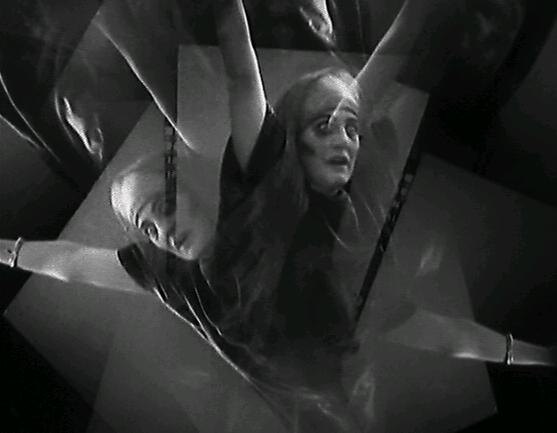
straightforward narrative acquired its dominant hold over how filmmakers conceived of and manipulated their medium. As a result, Watson and Webber's Fall of the House of Usher—not to be confused with Jean Epstein and Luis Buñuel's version, also filmed as a silent in 1928—spends its 13 minutes creating a powerful, frightening, and thrillingly imaginative evocation of Poe's famously perverse tale. Fitting with the story's themes, this Usher flouts almost every possible repressive taboo that was already organizing Hollywood films, for better or worse, into a predictable set of formal codes. Not only does The Fall of the House of Usher feature only three characters, you'll miss one of those three (the narrating traveler) if you so much as blink. Because the film forsakes intertitles, the scripted stage directions or dialogue that usually punctuated silent cinema narratives, even the basic points of Poe's plot are abstracted and encrypted within the movie's spookily sensory aesthetic.
To be sure, the doublings of character, mirror-tricks, enigmatic montage, and Expressionistic sets were imported from the
German cinema of the preceding decade, and modern fans of films like Wiene's The Cabinet of Dr. Caligari or Murnau's
Nosferatu will recognize immediately the influence of those films on Watson and Webber's stylistic practice.
Nonetheless, Usher eschews the temptation toward narrative even more than those films—Caligari, after all,
doesn't quit until most of the strange impressions of the mise-en-scène have received a narrative explanation, however
bizarre. Usher, by contrast, revels in our macabre agitation in the face of its unsettling visions: a frame filled
with kaleidoscopic images of Madeline's undead face, a top-hat that entirely stands in for the character who ostensibly
wears it, and best of all, a superimposition of two shots of the stame staircase, separated from any larger architectural
context, and overlaid so as to resemble some tortured cord of rope or deviated spinal column.
Different viewers, obviously, will bring different associations to these shots. I grew mesmerized by the way in which the film rejects a "story" account of an isolated couple's spiritual and very likely sexual corruption. Melville and Webber are deliberate in letting the house tell its own story, as opposed to Poe, who filtered the tale through the perplexed vantage of the narrating traveler. I'm not suggesting this is a categorical improvement, but the structural rearrangement gives Watson and Webber's version its own distinctive logic, erupting from within the core of the house like an unconscious fantasy or a buried secret. The house itself operates as a kind of group unconscious for Roderick and Madeline. It has almost no architectural identity outside of their various states of catatonia, dementia, and terror, so that even the shots of walls, stairs, and corridors, twisted and crumbled as often as not, resonate with the characters' sins. These images collect until the film's quietly sinister end, which, like the rest of the movie, is barely less insinuating for all its borrowing from earlier directors.
The Fall of the House of Usher was added in 2000 to the National Film Registry maintained by the Library of Congress
to preserve America's most treasured works of cinema. Like many of the films in that registry, this little-exhibited picture may well be unfamiliar to contemporary audiences, and so the thrill of discovering it—of exhuming an artwork that only seemed to have vanished—is all the richer. The best way to see the film is to hunt down a copy of the 4-DVD set called Treasures of American Movie Archives that was released through the auspices of the AFI a few years ago. There's all kinds of great, rare material on those discs: fragments from the first decade of cinema, newsreels and political ads from the first third of the twentieth century, obscure documentaires, archive footage of famous historical moments (like that of Marian Anderson singing on the front steps of the Library of Congress), experimental work by less-heralded members of the American avant-garde. All of it is fascinating, but even in such privileged, eye-opening company, The Fall of the House of Usher stands tall. Grade:A