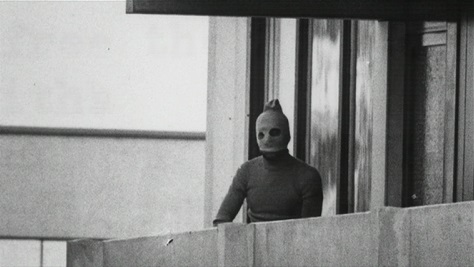
One Day in September
Director: Kevin Macdonald. Documentary. Profile of the terrorist hijacking of the 1972 Munich Olympic Games, including the
capture and murder of 11 Israeli athletes and coaches. Narrated by Michael Douglas.
Based on his two most celebrated efforts, I must admit that Kevin Macdonald's relation to documentary form, and his particular
trust and grasp of the subjects of his films, continues to elude me. Like his subsequent Touching
the Void, which trumps up and finally muddies a surefire narrative with odd interview choices, imprecise editing, and
gratuitous visual embellishments, his Oscar-winning One Day in September feels split in its allegiances, further and
further testing the viewer's confidence until the film almost collapses at the end. The nature, footage, and pause-giving
aftershocks of Macdonald's chosen subjectthe hijacked 1972 Olympic Games in Munich, Germany,
ending in the violent deaths of 11 Israeli athletes and coachesmake their own implicit and
potent case for the movie's value, and it's true that Macdonald has excavated some crucial and fascinating information,
including an extended interview with one of the terrorists. But as though unaware of the informative, sobering, and righteously
outraged movie that his right hand is busily assembling, his left (all apologies to lefties) keeps laying down cheap music tracks, molding
a global crisis into a real-time thriller, and rather stupidly if not suspiciously abandoning all of the inroads that lead to the heart of the matter. I wonder
if it's possible or even wise to reject One Day in September outright, but my admiration for it and my appreciation for having watched
it are enormously tempered by a rising swell of disdain for the director, who must be quite a silver-tongue to collect this rich and
diverse gallery of commentators but who fails to find the moment to drop the rhetoric and really wrestle with the stakes of
what he's dropped himself into.
However unexpected she may be as a place to start the film, it is illuminating and right that Ankie Spitzer, a widow of one of the murdered athletes, is one of Macdonald's interview
subjects, her recollections bringing a specific countenance to the expected face of loss. Married to Spitzer for just over
a year, she speaks with a distinctive combination of lucidity and sorrow, and though only three other relations of the hostages
appear in the moviethe wife of a slain wrestler, in archive footage, and the daughters of this man and of Spitzer, in
the present dayAnkie's memory and perspective are sounded with the clarity of a bell, illuminating how the grief
of the helpless, onlooking loved one is both heartbroken and practical, as she remembers the series of phone calls she both
made and received through the long day of September 5, 1972, and as she evokes in such telling, personal detail how inscrutable
the day's events were to anyone who wasn't there.
The real heft of the picture, though, lies in uncovering how equally inscrutable were both the crisis and its response,
even to the ground crews, police officers, negotiators, and other figures who were so blindly and quickly implicated in
the event as it unfolded. Even Jamal Al Gashey, the Black September operative who recalls his participation in low light and
under heavy, disguising layers of clothing, describes how hectic the day felt even from inside the athletes' complex. Given
no orders to kill, he says, his Black September comrades were assigned to hold and, if necessary, deport their hostages long enough to
extract a 200-member list of Palestinian activists from their prison cells. Thus, as Jamal describes the early, unplanned
shooting of the wrestling coach who tried to overpower the eight-man hit squad, the whole terrible incident emerges as one
that had already spun out of control before the world, even the immediate community, knew it was happening.
Unfortunately, Macdonald isn't the kind of interviewer who gets nearly close enough to Jamal's story to press him on the point
of whether the brutal violence was really so circumstantial, much less on the finer points of Black September's backup plan
if their terms weren't met, much less on how long the terror cell had planned this event. To keep in mind fair
concessions to the film, the entire context of Palestinian action, stretching from Black September's deplorable
extremism to the political history motivating their plot, ranks nowhere on the film's agenda, and Jamal's own discourse, as
truncated and partial as it is destined to be, is hardly where the film can be asked to press its case with the full energy
we might desire. One Day in September, as early as its title, is clear in stipulating that its aims have little to
do with the wider framework of Israeli-Palestinian strife, and nothing to do with complicating the dramatic canvas from the
sheer, revolting victimhood of the Israelis and the merciless aggression of their captors. This strikes me as eminently
reasonable, regardless of how frustrating and limiting it is to alight on any node of history without a full grasp of
where, historically speaking, the episode came from, what it reflected, where it led. Indeed, the Brazilian Bus 174,
a strong and much more recent film about another hostage crisis, nonetheless showed that padding a film with dollops of
generalized context can hamper the exploration of an incident as much as they help to reveal it. Memory and understanding
have to start somewhere, and besides, is there really any doubting that, on that one day in September, Israelis suffered as
Palestianians attacked?
Macdonald does interpolate some late footage where Jamal Al Gashey admits to his continued pride in his complicity, since the
event called unprecedented and, in his view, tide-turning attention to the crisis of his nationless state. To even hear this
contrarian view expressed, much less from the mouth of a perpetrator, in fact makes the film more subtly bold in characterizing
Arab/Israeli antagonism than it is in delving into the more immediate issues of how
the crisis was made possible, how the Germans conducted and in many ways bungled their rescue efforts, and what
kinds of direct questions, not about the Middle East but about terrorism and its circulatory system, the whole event injected
into world consciousness. Here, the film falls down repeatedly. Twice, the name "East Germany" emerges in stomach-turning
contexts, first when soothing, antiseptic narrator Michael Douglas tells us that East Germans familiar with the Olympic village
had helped the terrorists plot their approach to the Israeli apartments, and second when an already shaky-looking mission to
penetrate the complex and seize the hostages by firepower and force is thwarted by East German camera crews, who film these
preparations, air them live, andunwittingly or not, the film is tremulously unclearalert the Black September squad
to every single move as it's made.
Macdonald, in this odd pattern of bashfulness on hugely germane matters, appears to trade on "East Germany," an outmoded and safely vilifiable name, to stand in for a
depth and breadth of collusion that the film refuses adequately to research or explore. No promontory, no clarity of vision
is permitted beyond that opaque, sour-tasting stopgap of "East Germany," even though the facts of the case as we can best
divine them get much more upsetting from there. On the West German side of the equation, we learn that the country's
desperate hope to portray itself through the Games as demilitarized, unautocratic, giving and deserving of trust, and purged
of fascist will had led the government to slash ground security and safety provisions. We also hear several raconteurs, in
addition to Douglas, marveling at how a state so notorious for coordinated might and clockwork systems could be so untrained,
so under-resourced, and so frankly haphazard not just in anti-terror equipments but in basic police procedures, like honing
a sniper squad, allowing remote communications between deputies, even just staying the hell out of sight from the culprits
when it most matters to do so. German repulsions of outside aid, including a proposal from the sadly experienced Israelis
themselves, are hastily and almost laughingly glossed over. The non-involvement of the German military is just as summarily
and dismissed in Douglas' narration, an effect, he tells us, of "complicated border laws." The fatally delayed deployment of
armored cars as the day's events lead to their bloody and public climax are written off as something the German feds and police
simply forgot to do.
By the time we learn in a quick, rather rushed epilogue that the three agents of Black September who survived the spree of
gunfire were not only rescinded into Arab protection by Willy Brandt's government but done so under a cheesecloth disguise of
a faked airline abduction, the film's murmurs of a deeper, more telling, and even more rotten tale have risen to the
volume of a scream. But Macdonald, apparently, can witness and listen to loopholes and demurrals like thisseduced, perhaps,
by his laudable but wholly inadequate success in getting some sparsely identified Germans in suits to confess, or mostly confess,
the worst allegationsand simply let the film keep spooling away. Several voices in the film justifiably complain about
how the Games kept marching on, well into the day of September 5, and almost instantly after the memorial service for the fallen
Israelis. The fact, however, that Macdonald virtually mirrors this dubious allegiance to sportsmanship with his music-cued
and distracting midfilm montages of athletic prowess, seems not to have occurred to anyone. Likewise, an Israeli woman ventriloquizes
the viewer's disgust at the gathering, police-inhibiting swarms of onlookers who surround first the Olympic barracks and later
the airfield where the gun battle takes place. "Two men were already dead, and these are my people we're talking about!" the
woman inveighs, angry but hardly hysterical, "and they were turning it into a show!" Surely Macdonald hears her. He even
finds a newsman willing to confess the guilty consciences of himself and other reporters who realized what high ratings they
were suddenly in for. But what to make, then, of the way that One Day in September
adheres with such passion to its suspense-thriller templates, up to and including the intertitles of red digital time-signatures
that look swiped from any bomb in any Bruckheimer production, or the nearly salacious way the film keeps editing its footage
to conjurehowever powerfullythe cyclonic dread of the day, as though the film has any debt to entertainment, or as
if the cresting emotions of the moment supersede the documentarian's task of dissecting past the surface? Stephen
Hunter of The Washington Post, in a revealingly symptomatic review, sidles up to the throbbing, angry question of the
film's serial admissions of German incompetence, if "incompetence" truly reflects the real issue, but his
write-up finally abandons its own implications, fully in synch with how the film does the same, and makes a final,
connective leap from calling the film "fast-paced" to "utterly absorbing." Amy Taubin at least paused in the Village Voice long enough
to admit that the film "could be described as the most gripping political thriller to hit the big screen in many years... [although]
the words 'gripping' and 'thriller' have inappropriately frivolous and commercial associations."
These are hardly the only places where One Day in September's effectiveness and momentum as a thriller formed a basis
for high praise, but surely these are deficient and arbitrary critical categories at best, and inhumane ones at worst, by
which to assess a documentary on this topic? And just as surely, it is Macdonald's own promising but finally craven and
quietistic proclivities, amplifying suspense at the high cost of moral sense, that allows, even encourages such
reviews? The film's priorities tumble and list more outrageously as it goes on. Upon learning that German policemen
dressed as a flight crew on the decoy getaway plane actually left their stations mere seconds before the terrorists' arrival
with hostages in tow, the film lingers on a computer graphic of tiny green humanoids dispersing from the outlined craft, but
contents itself with one quick statement by one of those officers, who describes the unanimous feeling that their placing amounted
to a suicide mission. The intricate balances of common sense, professional abstention, moral frailty, strategic vagaries,
and possible hindsight reassessment disappear right into the cracks of the film, sacrificed to the self-evidence of graphic illustration.
Macdonald finds his nadir in a long photographic montage of the hostages' charred and gun-mauled bodies, scored to the same
rock-music idiom of Deep Purple and Led Zeppelin that is so incongruous throughout, but never as grotesquely as here. Empty as information, indelible
but redundant and exploitative as historical testimony, but occasioned more than anything by the editing's incorrigible build-up
toward ecstatic, thriller-like releaseabetted here, too, by a further, nonsensical montage of fragments from the film's own
tapestryOne Day in September hammers down the gavel in the case of its own perceptual ineptitude.
There is
too much essential material in the movie for it to be swallowed by this black hole of gross sensationalism. Even when
the film lacks the guts or the intelligence to do what Claude Lanzmann would do and probe the secret history of German errors
and possible assists, the fact that One Day in September at least suggests these avenues for closer scrutiny raises
the bar on its own value. But the film's imagination, its conception of what to do with its material, of what
its most urgent material even is, is distressingly unreliable. In starting when the most apparent terrorists
start and ending when their own involvement ends, in evoking sidebars and premises that are swiftly shunted back into darkness,
in making the film more saleably coordinated to how the day was experienced than to how or why it came to pass, Macdonald seems to
continue the pattern of hiding the soil and fertilizing process of political crime beneath the more obvious sights and symptoms of
that crime's most putrid expressions, and for that, his film, an important one to see, is an important one to condemn.
As filmmaking: B; As history: D; Grade: C
- Academy Award Nominations and *Winners:
- *Best Documentary Feature
- Other Awards:
- British Independent Film AwardsDouglas Hickox Award: Kevin Macdonald; Best Offscreen Newcomer: Justine Wright